
Bettors: Only Trust AI Sports Betting if Models Clear a 1.05 EV
AI can find real edges in sports betting, but only when the model outputs calibrated probabilities, not just confident predictions, and you pair them with disciplined staking and honest execution costs. In efficient markets like the NFL point spread, exploitable gaps are rare and close fast. In thinner markets, like second-tier soccer leagues or player props, calibrated models have shown real value in simulation studies. Start small, demand a public backtest, and never bet on a model that won’t show its calibration numbers.
TL;DR:
- Calibrated probability models outperform confident but uncalibrated predictions, especially in thinner markets like soccer leagues or player props.
- Regularly verify model calibration with metrics like Brier scores and ensure results are out-of-sample and chronologically tested.
- Use platform features that provide real-time odds comparison, transparent reasoning, and a public track record before trusting any AI-driven recommendations.
- Apply fractional Kelly staking, set EV thresholds, and log every bet to prevent emotional decisions and bankroll leaks.
- Expect future improvements including widespread uncertainty-aware architectures, increased transparency, and market-independent probability forecasts.
Table of Contents
- What Is AI Sports Betting, and How Does the Prediction Engine Actually Work?
- What Features Should You Look for in an AI Betting Platform?
- How Do You Tell a Credible AI Model From Marketing Hype?
- How Should Bettors or Providers Validate an AI Model Before Trusting It?
- How Do You Turn Model Output Into an Actual Bet?
- Where Does AI Betting Run Into Legal and Ethical Limits?
- How ParlayGeeks Maps to the AI Betting Checklist
- What Should You Actually Do This Month?
- Where Is AI Sports Betting Headed Next?
- The Gap Between AI Hype and What Actually Works
- Try AI-Backed Betting Without Betting Blind
- Sources
What Is AI Sports Betting, and How Does the Prediction Engine Actually Work?
AI sports betting means using machine learning models, not gut instinct or static power ratings, to generate win probabilities and point projections that get compared against sportsbook lines. The gap between a model’s probability and the implied probability in the odds is where value bets come from.
Different model families handle this differently. Ensemble methods like XGBoost chew through structured data (team stats, rest days, home/away splits) and remain the workhorse for most predictive analytics sports projects because they’re fast and interpretable. Recurrent networks (RNN/GRU architectures) pick up sequential patterns, like a team’s momentum over a five-game stretch. Convolutional networks trained on shot-chart embeddings, spatial data mapping where shots happen on a court, add a layer that raw box scores miss entirely.
None of that matters if the model is well-calibrated and confused with being accurate. A model can correctly pick more winners than losers and still be a terrible betting tool if it says “70% chance” on games that actually hit 55% of the time.

Statistic Callout: In NBA experiments comparing model selection methods, choosing models based on calibration instead of raw accuracy improved average ROI from roughly negative 35% to positive 34.7%. Same predictions, different selection criteria, opposite financial outcome.
That’s why uncertainty-aware methods matter. Techniques like Monte Carlo dropout and deep ensembles don’t just spit out a single probability. They generate a distribution, telling you how confident the model actually is.
- Well-calibrated model: predicted 60% probability outcomes happen close to 60% of the time across a large sample
- Overconfident model: predicted 60% probability outcomes happen only 45% of the time, a classic accuracy trap
- Uncertainty-aware output: flags low-confidence predictions so you skip marginal bets instead of forcing action
An uncertainty-aware NBA forecasting pipeline using shot-chart embeddings and dropout methods found its economic value concentrated in less-efficient market segments, not the heavily bet main lines.
What Features Should You Look for in an AI Betting Platform?
Not every tool marketed as “AI-powered” deserves your bankroll. Here’s the checklist worth applying before you trust a platform’s picks.
- Refresh cadence: live, short-horizon predictions that update as lineups, weather, and injury news change, not a projection frozen at 9 a.m.
- Cross-bookmaker scanning: the platform should compare lines across multiple sportsbooks and flag the best available price, since a half-point of line value compounds over a season
- Public track record: an accessible history of past picks with results, not cherry-picked highlights
- Exportable BetSlips: the ability to log, share, or export your bets for tracking and later review
- Explainability: some indication of why a pick was made (key stat, injury factor, matchup edge), not just a number and a “trust us”
Prop markets and match markets demand different things from a platform. A player-prop model needs granular per-possession or per-play data and reacts fast to injury news. A match-winner model leans more on team-level trends and rest patterns. If you bet both, check whether the platform’s data refresh rate matches the market you’re actually playing.
Pro Tip: Before you unlock any premium pick, check whether the provider publishes even basic calibration data. If a platform can’t tell you how often its “high confidence” picks actually hit, treat the pick as a guess with better marketing.
How Do You Tell a Credible AI Model From Marketing Hype?
Calibration metrics matter more than win percentage, and here’s the checklist to demand from any AI betting model before trusting it with real money.
- Ask for the Brier score or a reliability diagram. These measure how well predicted probabilities match real-world outcomes, which matters more for your expected value than raw hit rate.
- Confirm chronological partitioning. Models tested on data scrambled out of time order can accidentally “see the future” through leaked features, a problem researchers call circularity. A legitimate backtest trains only on data available before the prediction date.
- Look for out-of-sample results, not in-sample fit. A model that performs well on data it never trained on is the only meaningful test.
- Check for a long-run equity curve, not a hot streak. Three winning weeks proves nothing. A multi-season sample with drawdowns shown honestly proves more.
- Ask how uncertainty is reported. Sensitivity analysis, confidence intervals, or dropout-based variance estimates all signal a team that understands its own model’s limits.
Statistic Callout: Calibration-focused model selection tied to a fractional-Kelly decision layer with EV filtering produced better economic outcomes in simulation than models chosen purely for predictive accuracy, mainly because calibration errors compound directly into betting losses while accuracy errors sometimes cancel out.
If a provider won’t answer questions 1 through 4, that’s your answer about whether to pay for their picks.
How Should Bettors or Providers Validate an AI Model Before Trusting It?
Building a credible model, or vetting someone else’s, comes down to a few non-negotiable steps that separate a serious tool from a curve-fit that will collapse the moment real money is on the line.
- Split data chronologically. Train on last season, test on this one, never the reverse.
- Check for leakage. Any feature that wouldn’t have been known at prediction time (final box score stats used to predict the game they came from) invalidates the test.
- Simulate real friction. Add odds movement, partial fills, and per-bookmaker stake caps to backtests so the equity curve reflects what actually happens when you try to bet a five-figure edge into a market that limits winners fast.
- Run portability tests. A model trained on NBA data should get evaluated against other leagues, like Serie A or the Premier League, to see whether the signal generalizes or was just noise that fit one dataset.
Open-source tooling exists for bettors who want to build their own modest pipeline. The sports-betting Python package offers dataloaders and backtesting utilities specifically built for value-bet identification, which is a reasonable starting point before trusting any commercial black box.
Pro Tip: Run a hyperparameter sensitivity test before you trust any model’s staking recommendations. If small tweaks to the model’s settings swing its picks wildly, the model is overfit, and no amount of backtesting will save it in live markets.

An equity curve with a few realistic drawdowns is more trustworthy than a smooth line climbing straight up. Real betting results are lumpy.
How Do You Turn Model Output Into an Actual Bet?
Converting a probability into a wager is where most bettors, even smart ones, sabotage their own edge. The process should be mechanical, not emotional.
- Set an EV threshold. Only bet when the model’s implied edge clears a minimum bar, commonly EV of 1.05 to 1.10, meaning the bet needs at least a 5 to 10% theoretical advantage before it’s worth the variance.
- Size with fractional Kelly. Full Kelly staking is too aggressive for real-world model uncertainty. Betting a quarter or half of the Kelly-recommended stake smooths out the inevitable drawdowns from a model that’s right on average but wrong plenty of individual times.
- Cap stakes per bookmaker. Spreading action across multiple sportsbook accounts protects you from a single book limiting your action after a few wins, a common outcome for sharp bettors.
- Log every bet. Timestamp the odds you actually took, not the odds you saw an hour earlier, since line movement between decision and placement eats into real returns even when the model was right.
- Re-evaluate monthly. Compare predicted probabilities against actual outcomes on a rolling basis. If calibration drifts, the model needs retraining before you scale stakes back up.
Skipping any one of these steps turns a mathematically sound model into a bankroll leak.
Where Does AI Betting Run Into Legal and Ethical Limits?
AI is not a guaranteed win button. Betting markets react to smart money fast, and any edge a model finds tends to shrink as bookmakers adjust lines in response to sharp action. Regulatory rules for sports betting vary significantly by state and jurisdiction, so check your local laws and each platform’s terms before depositing funds.
- Never bet blindly on a “black box” pick with no visible reasoning behind it, since opaque AI outputs undermine trust and make it impossible to catch a broken model before it costs you money.
- Favor platforms that publish an audit trail of past picks rather than asking you to take results on faith.
- Treat betting as entertainment with a mathematical edge, not income, and use resources like BeGambleAware if betting starts affecting other parts of life.
How ParlayGeeks Maps to the AI Betting Checklist
The workflow above only works if the tools support it. A credible AI betting platform should provide real-time odds comparison across sportsbooks to help you catch the best line before it moves, offer expert picks with analysis to show reasoning behind selections, and include live injury updates that feed into situational factors a serious model needs.
A typical session looks like this: spot an AI-flagged value opportunity, check ParlayGeeks’ odds comparison to confirm you’re getting the best price across books, apply your own EV and staking rules, then log the bet in a shareable BetSlip for later review. Educational resources covering bankroll management fundamentals support bettors who are still building that discipline.
[Author credentials and case study placeholders to be inserted here.]
What Should You Actually Do This Month?
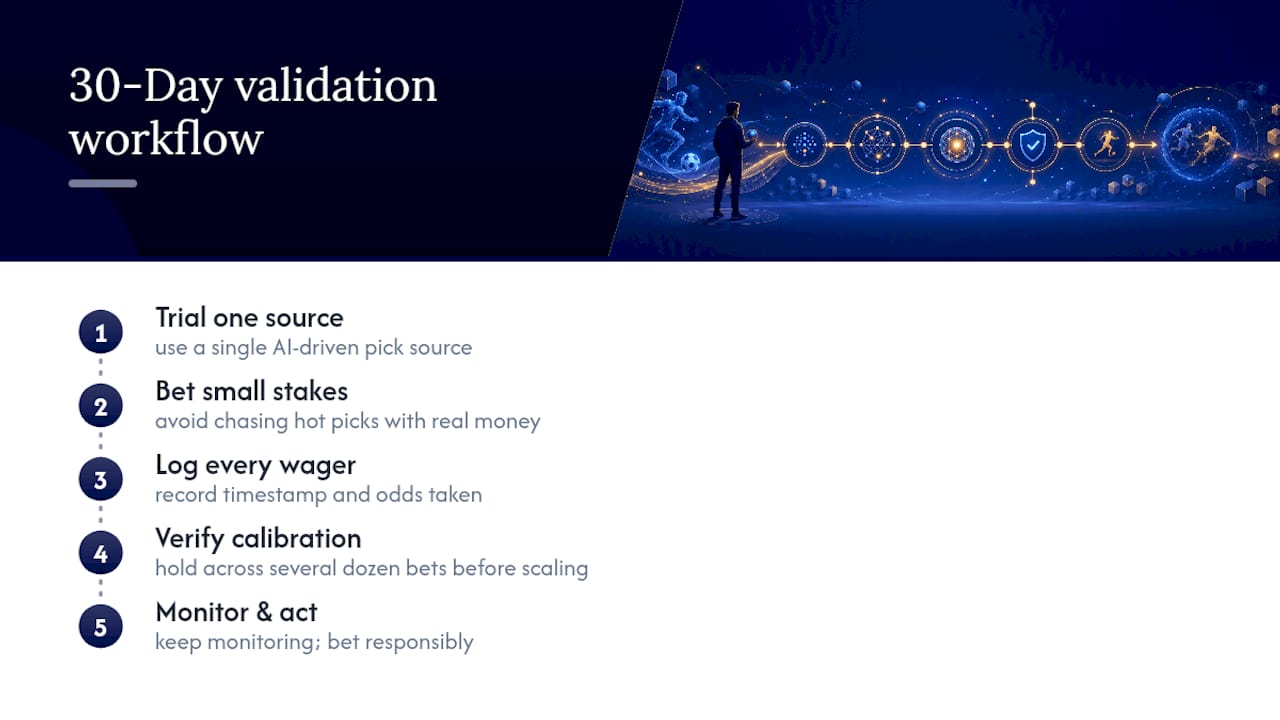
AI helps when models are calibrated, tested chronologically, and paired with fractional-Kelly staking, not when you chase a hot pick with real money. For the next 30 days: trial one AI-driven pick source, bet small stakes only, log every wager with timestamps and odds taken, and don’t scale up until you’ve verified the model’s calibration holds across at least a few dozen bets. Keep monitoring. Bet responsibly.
Where Is AI Sports Betting Headed Next?
Expect three shifts over the next few seasons. First, uncertainty-aware architectures, the dropout and ensemble methods already showing promise in NBA forecasting, will spread to soccer, tennis, and prop markets where data is noisier and calibration is harder to nail. Second, transparency will stop being optional. As systematic reviews of machine learning in sports betting keep flagging fairness and interpretability as unresolved problems, platforms that can’t explain their picks will lose credibility faster than platforms that occasionally miss.
Third, watch for market-blind forecasting agents, models that generate independent probability estimates without referencing the current betting line at all, then publish their Brier scores publicly for anyone to audit. One open-source example, predict-raven, already runs this way, treating public scoring as the trust mechanism instead of a marketing claim. That approach, forecasts generated blind to the market and graded openly, is probably where the credible end of this industry ends up, because it’s the only setup that lets a skeptical bettor check the math instead of taking someone’s word for it.
Real-time data integration will also tighten. Injury reports, weather shifts, and lineup changes will feed models within minutes instead of hours, narrowing the window where stale information creates false edges.
The Gap Between AI Hype and What Actually Works
Most coverage of AI sports betting treats “the model said so” as the end of the analysis. That’s backwards. The research consistently points to calibration, not accuracy, as the metric that actually predicts whether a model makes you money, and most bettors never ask a provider for that number.
The bigger blind spot is execution. A model can be genuinely well-calibrated and still lose money if you’re chasing stale odds, ignoring bookmaker limits, or sizing bets on emotion instead of fractional Kelly. Real-world friction, slippage, limited accounts, moving lines, quietly erodes theoretical edges that look great in a backtest and disappointing three months into live betting.
Prioritize transparency first. A platform willing to show its track record and explain its reasoning is worth more than one promising a bigger number. Betting well with AI isn’t about finding the smartest model. It’s about respecting the math enough to demand proof before you trust it with your bankroll.
— Thelma
Try AI-Backed Betting Without Betting Blind
ParlayGeeks gives you the piece most AI betting tools skip: a way to check the price before you commit, not just a prediction in isolation. Compare real-time odds across sportsbooks, unlock expert picks with visible reasoning instead of a bare confidence score, and build shareable BetSlips that keep a running record of exactly what you bet and why.
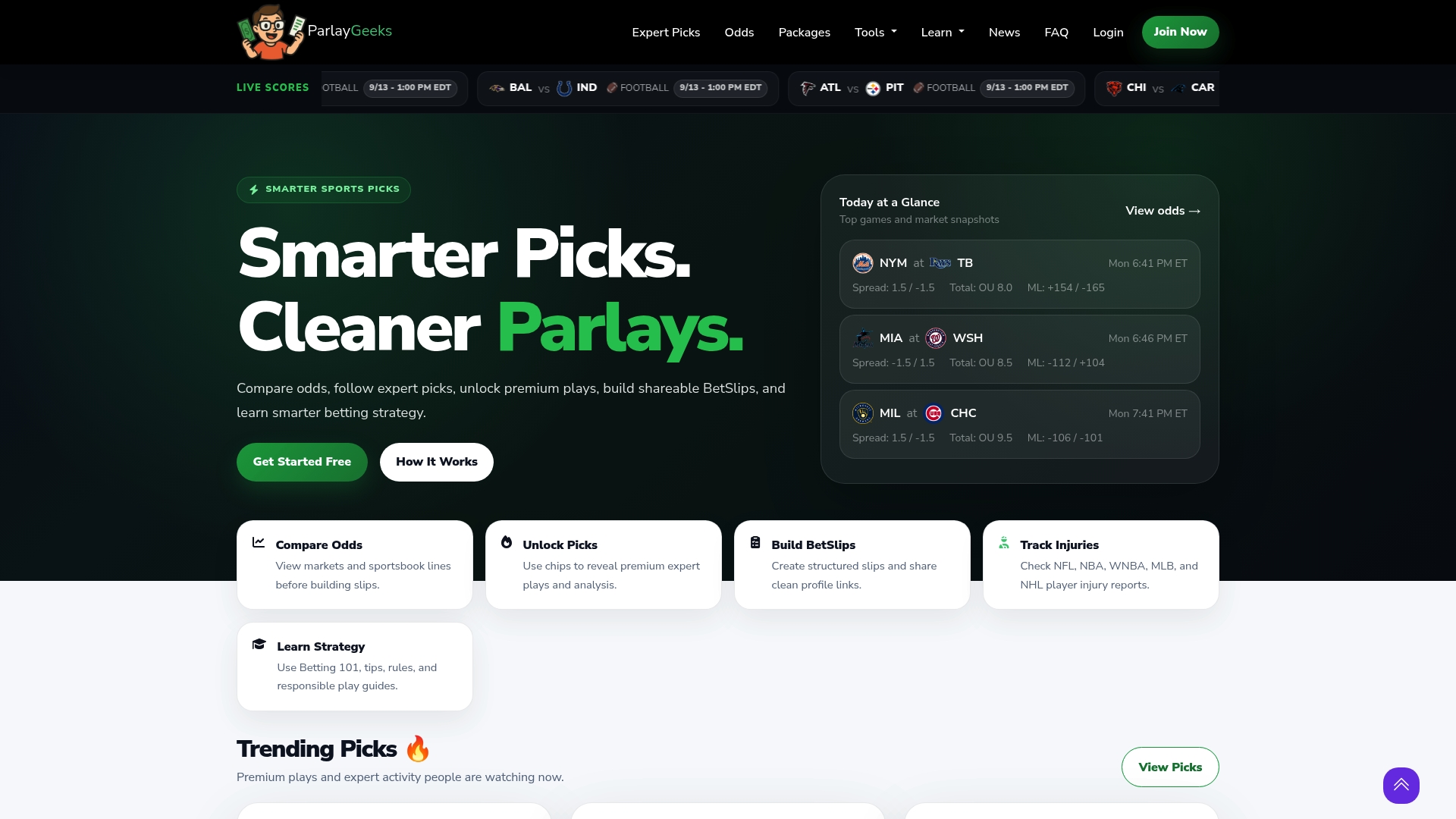
That combination matters because a well-calibrated pick loses its edge fast if you take a worse price than the one sitting on another book. ParlayGeeks’ odds comparison closes that gap automatically, while its injury updates and educational resources on bankroll management help you apply the staking discipline this article walked through, fractional Kelly, EV thresholds, consistent logging, without building your own tracking system from scratch. If you’re ready to test a value bet the disciplined way, start comparing lines and picks on ParlayGeeks before your next wager.