

Live Odds First: Build an 8–15 Shortlist for U.S. Golf Outright Betting
An outright is a bet on one player to win the tournament outright without hedging. Before you place a dollar, shop your price across multiple sportsbooks, decide whether to bet win-only or each-way based on the odds, and set your stake before the first tee shot on Thursday morning.
TL;DR:
- Betting early in the week can secure better odds, but it increases the risk of a player withdrawing before the tournament begins.
- Mid-priced contenders offer the best value for each-way betting, especially if your model shows a higher probability of top-10 finishes than implied by odds.
- Using a data-driven shortlist focused on strokes gained and recent form helps identify realistic contenders within the top 40 to 60 players.
- Comparing odds across multiple sportsbooks and setting alerts can improve value and reduce the impact of line movement as the tournament approaches.
- Managing bankroll with small fixed stakes and diversifying bets across several players increases longevity given golf’s high variance in outcomes.
Table of Contents
- What Is Golf Outright Betting and How Do the Markets Work?
- Reading Golf Odds: What Price Band Should You Bet?
- How Do You Build a Data-Driven Shortlist for Outright Bets?
- When Should You Place an Outright Bet, and How Do You Shop for the Best Price?
- How Should You Manage Your Bankroll for Outright Bets?
- How Do You Actually Place a Golf Outright Bet?
- How ParlayGeeks Supports Every Step of This Workflow
- Do You Owe Taxes on Golf Betting Winnings?
- What Other Strategies Work Beyond Building a Shortlist?
- How Do Withdrawals and Tournament Changes Affect Outright Bets?
- Why Process Beats Impulse in Outright Betting
- Get Started With ParlayGeeks for Golf Outright Betting
- Sources
- FAQ
What Is Golf Outright Betting and How Do the Markets Work?
Outright betting, also called tournament winner betting, is the most popular way to bet on golf because it is simple to understand: pick a golfer, and if that golfer lifts the trophy, you win. The outright market opens early in tournament week and covers the entire field, with favorites often priced in the +800 to +1500 range and longshots stretching out to +9500 or higher depending on the depth of the field.
Odds in American format tell you two things at once: your payout and the market’s implied probability. You convert odds to implied probability by dividing 100 by (odds + 100) for positive numbers, which is a habit worth building since it is the only way to know whether a price actually represents value or just a name you like.
Each-way betting splits your stake into two separate wagers: one on the win, one on the player finishing inside a set number of places. Place terms vary by tournament and sportsbook, but each-way structures commonly pay a fraction of the win odds, often 1/4 or 1/5, for finishes inside the top 5, top 8, or even top 10 at majors.
A few settlement wrinkles matter more in golf than in most sports:
- Dead heats split the payout when two or more players tie for a paying place, since golf frequently produces ties at the top and at the cutoff for each-way places.
- Playoffs still produce a single official winner for outright settlement purposes, regardless of how many extra holes it takes.
- Withdrawals before the first round typically void the bet and refund the stake, but withdrawals mid-tournament usually do not, since the wager already had a chance to win.
Outrights differ from futures (multi-event or season-long bets, like a Player of the Year market) and from props (single-round or head-to-head matchup bets), which settle faster and carry less variance.
Reading Golf Odds: What Price Band Should You Bet?
Not every price deserves the same approach. The field size in golf, often 120 to 156 players, means even the best golfers in the world lose most weeks. That single fact should shape every outright bet you make.
Here’s a practical breakdown by price band:
- Favorites (+300 to +800): Bet win-only or skip each-way, since the place fraction barely moves the needle when the win price is already short. A win bet here is a bet that the market’s top pick actually closes the deal, which happens less often than the odds might suggest given how deep modern fields are.
- Mid-price contenders (+1000 to +3000): This is where each-way betting earns its keep. A golfer at +2000 to win might be +400 or better to finish top 10, and that place portion cushions the far more common outcome of a strong finish without a win.
- Longshots (+4000 and up): Small stakes only, and lean each-way almost every time. The win portion is a lottery ticket, but a golfer priced this long who is trending in form can realistically crack a top-20 finish and still cash the place bet.
Pro Tip: Run the math before you bet, not after. If a golfer’s each-way place price pays down to a top-10 finish and your model has him finishing top-10 more than 20% of the time, that bet often carries more real value than the flashier win bet on the same player.
Favorites lose more often than casual bettors expect because a 150-man field has 149 ways to disappoint you, and even a hot putter can go cold for one weekend. That’s the entire argument for each-way coverage in the middle price bands.
How Do You Build a Data-Driven Shortlist for Outright Bets?
You cannot handicap 150 golfers with equal attention, so the goal is to filter a full field down to a shortlist of 8 to 15 realistic contenders before you ever look at a sportsbook price.
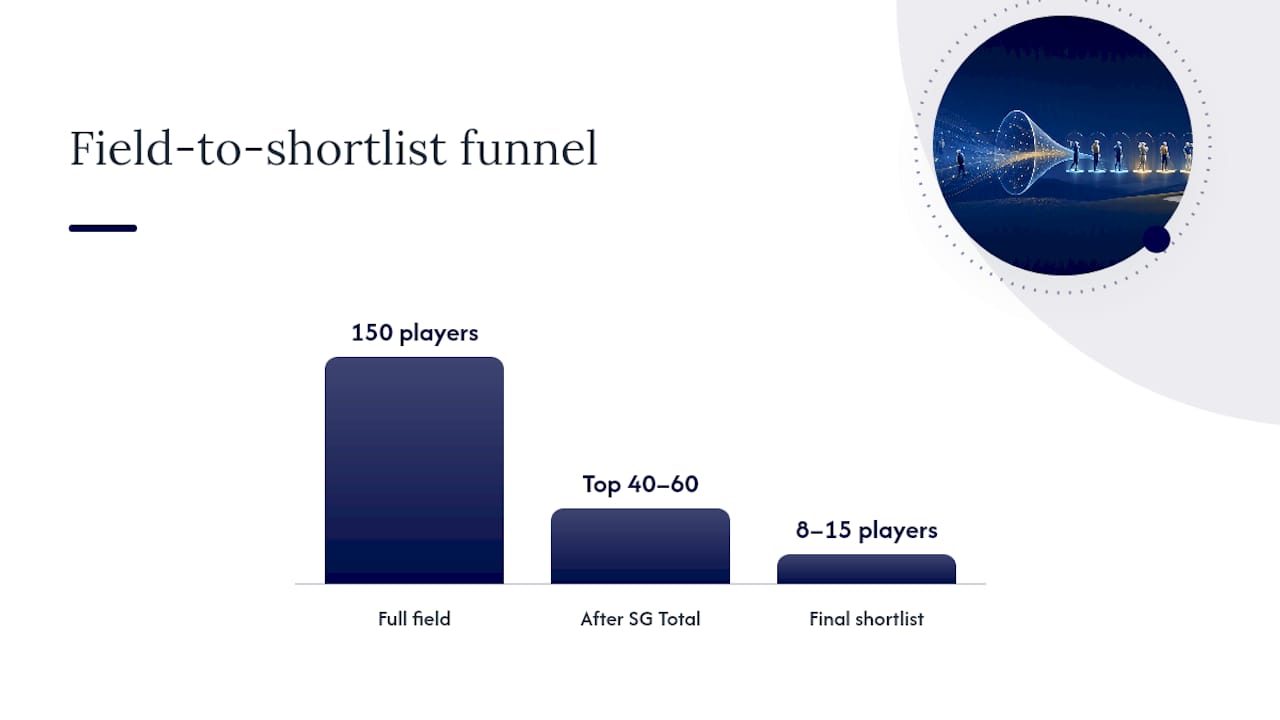
Start with strokes gained (SG) Total, the metric that measures a player’s performance against the field average across every part of the game: off the tee, approach, around the green, and putting. A structured filter that begins with SG Total and layers in additional signals turns an intimidating field into a manageable list.
The filter works in stages:
- Stage 1, SG Total: Cut the field to golfers ranked inside the top 40 to 60 in season-long strokes gained. This alone eliminates most of the field that has no realistic path to contending.
- Stage 2, recent form: Check strokes gained over the trailing 16 rounds, not the full season. A golfer whose season numbers look average but whose last month has been red hot deserves a second look, and vice versa for a fading former favorite.
- Stage 3, course fit: Match playing style to course demands. A bomber who struggles with accuracy off the tee is a bad fit for a narrow, tree-lined course, no matter how good his season numbers look elsewhere.
- Stage 4, trending metrics: Look at putting trends and short-game trends specifically, since those categories swing week to week more than ball-striking does.
Once you have a shortlist, convert your read into a rough win probability for each name, then compare it against the market’s implied probability from the odds. When your number is meaningfully higher than the market’s, that’s a bet worth making. When it’s lower, pass, no matter how much you like the player.
Before locking anything in, run a final checklist: weather forecast for the week (wind favors ball-striking over scoring, rain softens greens and helps bombers), confirmed tee times, and withdrawal risk for players carrying injury designations from recent events.
When Should You Place an Outright Bet, and How Do You Shop for the Best Price?
Timing is a real lever in outright betting, and it cuts both ways. Betting early in the week, sometimes even the weekend before a tournament starts, usually gets you a longer price on players who haven’t yet drawn public attention. The tradeoff is withdrawal risk: bet a golfer Monday and he pulls out Wednesday with a back issue, and you’re relying on the sportsbook’s non-runner policy to get your stake back.
Waiting until Wednesday or Thursday morning gives you confirmed fields, weather forecasts, and any late scratches, but prices tighten as the week goes on for any player picking up buzz, so you often pay more for the same certainty.
A workable line-shopping routine looks like this:
- Pick 2 to 4 sportsbooks to monitor regularly rather than trying to track every book that exists.
- Set price alerts on your shortlist names so you know when a number moves in your favor.
- Record the best available price the moment you see it, since golf odds can shift meaningfully within a single day as a tournament approaches.
- Check each book’s non-runner and void policy before betting early, since these rules are not standardized across the industry.
Pro Tip: A half-point difference in odds sounds small on one bet, but across a full golf season of outright wagers, consistently taking the best number instead of the first number is one of the most repeatable edges a golf bettor has.
Odds-comparison tools remove the manual grind of checking book after book, which matters most in the 48 hours before a major when lines move fastest.
How Should You Manage Your Bankroll for Outright Bets?
Golf outrights are about as high-variance as legal sports betting gets. Even a sharp handicapper who correctly identifies value will lose the outright bet on that player the overwhelming majority of the time, since only one golfer wins out of a full field every single week. That variance is exactly why stake sizing matters more here than in almost any other bet type.
A conservative, common approach among experienced golf bettors is to risk a small fixed percentage of total bankroll per outright bet, rather than betting a flat dollar amount regardless of bankroll size. Here’s how that plays out in practice:
- Set your unit size first. On a $1,000 bankroll, a conservative unit might be 1% to 2%, or $10 to $20 per outright bet.
- Grade your stake by conviction. A shortlist pick where your model shows a real edge over the market might get a full unit or even 1.5 units. A speculative longshot you like but haven’t fully modeled gets a half unit.
- Spread across multiple each-way picks rather than one large bet. Three or four $15 each-way bets on golfers you’ve shortlisted diversify your outcomes far better than one $60 bet on a single name, since golf’s variance means even good picks miss more often than they hit.
- Reserve full-conviction single bets for rare setups, like a course history and current form lining up perfectly on a player the market has underpriced.
That structure lets you stay in the game across a full season instead of one bad week wiping out a month of disciplined betting.
How Do You Actually Place a Golf Outright Bet?
The mechanics are simple once you know the sequence. Find the tournament in your sportsbook’s golf section, select the outright or tournament winner market, check the specific terms (each-way fractions, number of paying places, non-runner policy), place your bet, and confirm the slip before it locks.
A short pre-bet checklist saves headaches later:
- Confirm the sportsbook is licensed and legally operating in your state, since availability varies across the US market and not every book operates everywhere.
- Read the each-way place terms for that specific tournament before betting, since majors often expand paying places compared to a regular tour event.
- Check the non-runner, no-bet policy so you know exactly what happens if your golfer withdraws before the first round.
- Set a deposit limit if your sportsbook offers one, particularly useful during high-volume weeks like major championships when it’s easy to overextend.
- Complete any required identity verification early in the week rather than scrambling to confirm your account right before a deadline.
None of this replaces reading your specific sportsbook’s terms, but it covers the basics that trip up first-time outright bettors most often.
How ParlayGeeks Supports Every Step of This Workflow
Every step above, shopping odds, building a shortlist, timing your bet, and tracking your stake, is easier with the right tools instead of a dozen open browser tabs. ParlayGeeks is built around exactly that problem.
- Real-time odds comparison across multiple sportsbooks handles the line-shopping step automatically, surfacing the best available price on your shortlisted golfers instead of you checking book by book.
- Expert picks and unlockable analysis give you a second data point to weigh against your own strokes-gained and form research.
- Shareable BetSlips let you track and compare your outright bets and each-way plays in one place, and show your reasoning if you follow or get followed by other bettors on the platform.
- Injury and news updates flag withdrawal risk on shortlisted players before it costs you a wasted early bet.
A typical workflow looks like this: build your shortlist using SG Total and form, check ParlayGeeks for the best current price on each name, lock the value bet once you’re satisfied with the number, then track it through the weekend on your BetSlip.
Do You Owe Taxes on Golf Betting Winnings?
Yes. Gambling winnings, including golf outright bets, are taxable income under federal law, and the IRS expects you to report them regardless of the amount or whether the sportsbook sends you a tax form. Many bettors assume small wins fly under the radar, but the legal obligation to report exists on every dollar won, not just amounts that trigger a form.
Sportsbooks typically issue a Form W-2G when a single win hits certain thresholds, commonly $600 or more at odds of 300 to 1 or greater, though the exact triggers depend on bet type and payout structure. Even without a W-2G, you’re still required to report winnings on your federal return.
The flip side matters too: gambling losses can be deducted, but only if you itemize deductions and only up to the amount of your reported winnings. That means keeping records, bet slips, deposit and withdrawal history, and a simple log of wins and losses, is worth doing year round rather than scrambling every April.
State tax treatment varies, since some states tax gambling winnings differently or not at all, so check your specific state’s rules or talk to a tax professional if your golf betting volume is significant. This is general information, not tax advice, and a licensed preparer familiar with gambling income can help you handle it correctly for your situation.
What Other Strategies Work Beyond Building a Shortlist?
A strong shortlist gets you into the right conversation, but a few additional tactics separate bettors who show a long-term profit from those who just get lucky occasionally.
Fade the public on marquee names. Star players draw disproportionate betting volume, which can push their odds shorter than their actual win probability justifies. A disciplined bettor checks whether a famous name’s price has moved because of real form signals or just public money, and often finds value on the other side of that action.
Target course-history specialists at repeat venues. Some tournaments return to the same course year after year, and certain golfers post suspiciously consistent results there regardless of season-long form. That pattern, when it’s genuinely repeatable rather than a small sample coincidence, is worth weighting alongside strokes-gained data.
Consider correlated each-way portfolios. Instead of picking four unrelated names, some bettors deliberately spread each-way stakes across golfers with different playing styles, a bomber, a precision iron player, a strong putter, so that a wide range of course conditions still leaves at least one pick well-positioned.
Watch for major-specific pricing quirks. Majors often draw softer lines on lesser-known international players who perform well on tougher setups but get overlooked by casual bettors chasing recognizable names.
None of these replace the shortlist process. They sit on top of it, refining which names from your data-driven list actually get your money.
How Do Withdrawals and Tournament Changes Affect Outright Bets?
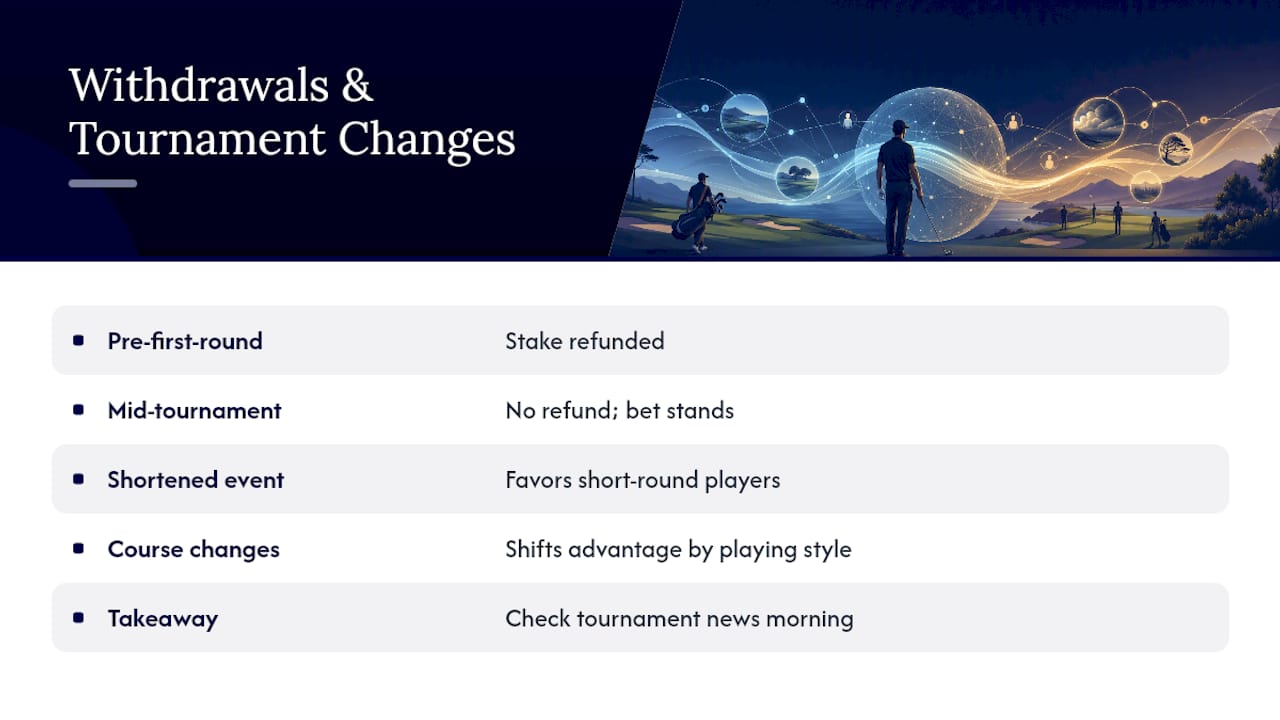
Player withdrawals are one of the biggest risks specific to golf outright betting, and they hit differently depending on timing. A withdrawal before the first round typically voids the bet entirely, with your stake refunded, since the golfer never had a chance to compete. A withdrawal mid-tournament, say after round two due to injury or illness, usually does not get refunded, because the bet already had action and the golfer simply failed to finish.
This asymmetry is exactly why early-week betting carries more hidden risk than it first appears. A great price on a golfer Sunday night looks attractive, but if that golfer withdraws Wednesday morning with a minor injury that wasn’t public knowledge, you’re now dependent on the sportsbook’s specific non-runner policy rather than your own handicapping.
Weather delays and course changes create a subtler risk. A tournament shortened to 54 holes due to weather can shift outcomes toward players who perform well in fewer rounds or under altered conditions, and it can also affect whether ties get settled by playoff or by scorecard. Course setup changes, like moved tee boxes or altered pin positions due to weather damage, can quietly shift the advantage toward or away from specific playing styles you accounted for in your original shortlist.
The practical takeaway: check tournament news the morning of your bet, not just the day you built your shortlist, and treat any player with recent injury news as a real risk factor even if that player hasn’t officially withdrawn yet.
Why Process Beats Impulse in Outright Betting
Most bettors lose to golf outrights not because they lack knowledge, but because they abandon their process the moment a hot tip or a gut feeling shows up. The bettors who show consistent long-term results treat the shortlist, the price comparison, and the stake plan as non-negotiable steps, every single week, regardless of how confident they feel about a particular name. Data doesn’t care about your confidence level, and neither does the field of 150 golfers you’re betting against. Build the shortlist, shop the price, size the stake, then let the tournament play out.
— Fogell
Get Started With ParlayGeeks for Golf Outright Betting
A practical way to run the exact workflow this guide just walked through, without ten browser tabs open at once, is to use a platform that pulls real-time odds comparison into one screen, so the line-shopping step that separates disciplined bettors from casual ones takes minutes instead of an hour.
Beyond odds comparison, some platforms offer expert picks to weigh against your own strokes-gained shortlist, injury updates to flag withdrawal risk before it costs you a bet, and shareable BetSlips to track every outright and each-way play you make through a tournament week. If you’re following the staking approach outlined above, start small: build your shortlist this week, compare live odds on ParlayGeeks, and place a modest, well-researched outright bet before you scale up your stakes.
Sources
- Golf Betting Guide 2026: How to Bet on Golf, Sites & Tips - CBS Sports
- Outright Golf Betting: How to Pick Winners | Statz Golf
- First
FAQ
What’s the Best Strategy for Betting on Golf?
The strongest approach combines a data-driven shortlist built from strokes-gained and recent form with disciplined price shopping across multiple sportsbooks. Pair that with each-way bets on mid-priced contenders and small, graded stakes based on conviction, since golf’s deep fields make pure win bets on favorites riskier than they look.
Who’s Favored in This Week’s PGA Tournament?
Favorites change weekly based on the field, course setup, and current form, so check live outright odds close to tee-off rather than relying on outdated rankings. Tools like ParlayGeeks show real-time price comparisons so you’re working from current numbers, not last week’s line.
How Does Betting on Golf Work?
You pick a market, most commonly the outright winner market, then choose a golfer and decide between a win-only bet or an each-way bet that also pays if your golfer finishes inside a set number of places. Odds represent both your payout and implied probability, and prices shift throughout tournament week as form and field news develop.
What Are the Different Types of Bets in Golf?
The main categories are outright or tournament winner bets, each-way bets, head-to-head matchups between two players, and props like top nationality or top amateur finisher. Outright betting remains the most popular format because it’s straightforward and covers the entire field in one market.
Do I Have to Report Small Golf Betting Wins on My Taxes?
Yes, all gambling winnings are taxable income regardless of size, even if the sportsbook doesn’t issue a W-2G form. Keeping a simple record of bets and outcomes throughout the year makes tax season considerably easier, especially if you plan to deduct losses against reported winnings.