
Lock Profit in 3 Hedging Bets Using Live Odds for U.S. Bettors
Hedging bets means placing a new wager against a position you already hold, so the combined outcome guarantees a return or caps your loss no matter what happens. Sportsbooks and bettors alike use it to protect profit or limit damage before final results are known. The trade-off is fixed: you trade some upside for certainty, and the right call depends on how much of that upside you’re willing to give up.
TL;DR:
- Hedging is most effective when executed before the game or event begins, especially with large, high-value bets to avoid unnecessary risk.
- Accurate hedge calculations depend on four key figures: original stake, original odds, current hedge odds, and your payout goal, which should be decided before placing the hedge.
- Partial hedging is generally safer for sharp bettors, as it reduces downside while still allowing for some upside, unlike full hedges which eliminate all risk.
- Market liquidity, bet limits, and line movements across multiple sportsbooks significantly influence hedge timing and profitability, making real-time odds comparison crucial.
- Hedging involves taxable income reporting, and keeping detailed records of all wagers, stakes, and outcomes is essential for accurate tax filings.
Table of Contents
- How Does Hedging Bets Actually Work?
- What Are Common Scenarios for Hedging Bets?
- How Do You Calculate a Hedge Amount?
- When Should You Hedge a Bet (and When Should You Not)?
- What Hedging Strategies Work, and What Pitfalls Should You Avoid?
- How Do Bankroll Math and Kelly Sizing Fit Into Hedging?
- Do You Have to Pay Taxes on Hedged Bets?
- How Do Sportsbook Features Affect Your Ability to Hedge?
- The ParlayGeeks Take on Fast, Precise Hedging
- Lock In Your Next Hedge With Better Odds Data
- Where to Learn More About Hedging Bets
- Sources
How Does Hedging Bets Actually Work?
The sequence is always the same. You have an open bet, something shifts (odds move, a team advances, a game swings live), and you place a second wager on the opposing outcome to change your payout profile. That’s the entire mechanism behind hedging as a risk-reduction tool.
There are two versions of this:
- Full hedge: You size the second bet so you win the same amount regardless of outcome. Net risk drops to zero, but so does any chance of a bigger payout.
- Partial hedge: You bet less than the full hedge amount. You still carry some risk, but you’ve cut your downside while keeping a piece of the original upside alive.
The math starts with your original stake times your original odds, which gives you your potential payout. From there you work backward: decide what combined payout you want across both outcomes, then solve for the hedge stake that gets you there. It’s algebra, not guesswork, and once you see it done once, you can do it on a phone between innings.
What Are Common Scenarios for Hedging Bets?
Three situations come up again and again for U.S. bettors:
- Futures bets. You put $100 on a team to win the championship at +1000 preseason. They make the final. Now the opposing team is favored at -150 to win it all. Betting enough on the other side locks in profit no matter who takes the title.
- The last leg of a parlay. You’ve hit five of six legs. The final leg is live. Hedging against that leg protects the guaranteed money you’ve already effectively won.
- Live, in-play swings. A longshot moneyline bet is up big at halftime, and the in-game price on the other side has moved in your favor. That gap is your hedge window.
Line movement and operator liability limits shape how wide that window stays open. Sportsbooks actively manage exposure, and risk teams adjust prices to control liability, which is exactly why hedge prices sometimes shift fast during a live event. The futures example above, done right, can turn a modest preseason underdog bet into a guaranteed profit regardless of the final score.
How Do You Calculate a Hedge Amount?
Every hedge calculation starts with four numbers: your original stake, your original odds, the current hedge odds, and your goal. That goal is either “guarantee I get my stake back” or “lock in profit no matter what.”
The logic behind most tools looks like this:
- Calculate your total potential payout from the original bet (stake × odds).
- Decide the payout you want on the hedge side.
- Divide that target payout by the hedge odds to get your required hedge stake.
- Compare the two possible outcomes to confirm your worst case is acceptable.
Worked example: you bet $50 at +800 on a futures market, giving you a potential payout of $450 in profit plus your $50 back, or $500 total. Your team reaches the final, and the other side is now priced at -200. To guarantee an even payout, you’d hedge roughly $333 on the other side. Win or lose the final, you walk away with close to $167 in guaranteed profit. Tools like the Action Network hedging calculator automate this so you don’t have to solve it under pressure.
Pro Tip: Run the numbers before the game starts, not during it. Knowing your hedge trigger price in advance means you’re not doing algebra while your heart rate spikes.
When Should You Hedge a Bet (and When Should You Not)?
Hedging makes sense when a few conditions line up at once. Run through this before you touch a hedge bet:
- The bet represents a meaningful chunk of your bankroll, not a rounding error.
- The remaining upside if you let the original bet ride isn’t worth the added variance.
- The hedge side itself isn’t a terrible price. A hedge at a bad number still locks in a worse outcome than it should.
- The market has enough liquidity that you can actually get the bet on at the price you see.
Skip hedging when the original bet is small relative to your bankroll. Multi-outcome markets (a golf tournament with 40 live contenders, for instance) are also messy to hedge cleanly, since one hedge bet rarely covers the field. And if you’re reaching for a hedge purely because you’re anxious about losing, that’s a signal to step back, not place a bet. Sporting News has flagged emotion-driven hedging as one of the more common ways bettors erode their own edge. If hedging (or betting generally) starts feeling compulsive rather than strategic, the National Council on Problem Gambling offers free, confidential support.
What Hedging Strategies Work, and What Pitfalls Should You Avoid?
Partial hedging is the strategy most sharp bettors lean on. Instead of betting the full amount needed for a dead-even outcome, you bet a fraction of it, similar in spirit to how fractional Kelly staking reduces risk without fully killing your edge. You keep some skin in the original bet while cutting your worst-case scenario down substantially.
Middles are the more advanced play: you bet both sides of a spread or total at different lines, aiming to win both if the final result lands between them. It’s attractive when a line moves several points in your favor, but it requires two winning outcomes to hit, so it’s a lower-probability, higher-reward version of hedging.
Cashout offers, meanwhile, almost always pay less than a manual hedge would. The sportsbook builds its own margin into that number.
Common pitfalls:
- Over-hedging out of nervousness rather than math.
- Ignoring bet limits or fees that eat into the guaranteed profit.
- Chasing a “perfect” hedge and missing the window while the price moves against you.
Pro Tip: Check the hedge math against the cashout offer side by side. The difference is often bigger than bettors expect.
How Do Bankroll Math and Kelly Sizing Fit Into Hedging?
Hedging works best when it’s part of a broader staking system, not a one-off reaction. The Kelly criterion calculates an ideal bet size based on your edge and the odds, but full Kelly is volatile. Fractional Kelly, usually half-Kelly, trims that volatility while still growing your bankroll efficiently over time.
Treating your open bets like a small portfolio helps too. Each position carries its own risk profile, and a hedge is really a rebalancing move, shifting exposure away from one outcome and toward certainty.
Do You Have to Pay Taxes on Hedged Bets?
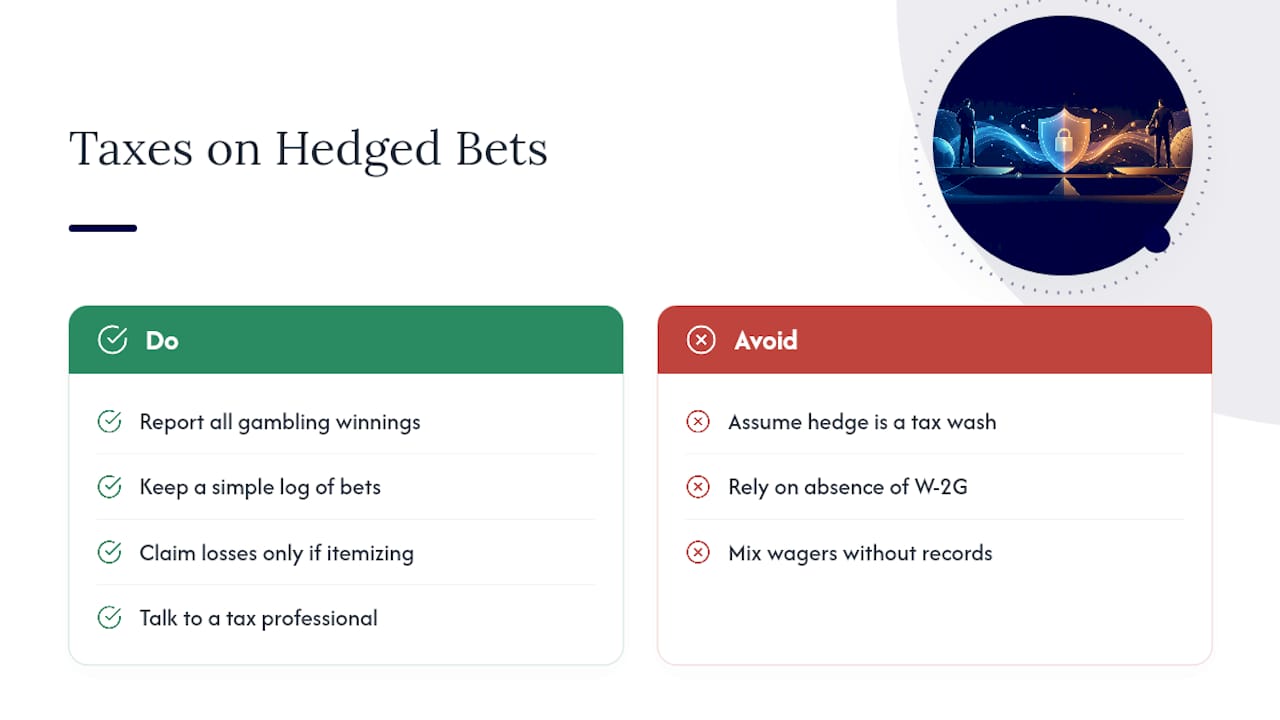
Yes. Every winning bet counts as taxable gambling income in the United States, and hedging doesn’t change that basic rule. If you place a bet, hedge it, and end up with a net win across both wagers, that net win is income. If one leg of your hedge produces a taxable win and the other leg is a loss, the two are not automatically netted against each other on your tax forms the way they are in your head.
Sportsbooks issue Form W-2G for certain winning bets that clear specific payout and odds thresholds, but you’re legally required to report all gambling winnings even when no form is issued. Losses, including the losing side of a hedge, can potentially be deducted, but only if you itemize deductions and only up to the amount of your reported winnings. That distinction trips up a lot of bettors who assume a “flat” hedge (equal profit either way) means a tax wash. It doesn’t.
Keep a simple log: date, event, original stake and odds, hedge stake and odds, and the net result. That record matters more with hedged bets than straight ones, because you’re reconciling two separate wagers that together produced one financial outcome. A tax professional familiar with gambling income is worth the conversation if you’re hedging regularly or hedging large futures positions, since state rules on gambling income can also vary. Nothing here substitutes for that conversation. It’s a framework for keeping your records clean, not a tax filing guide.
How Do Sportsbook Features Affect Your Ability to Hedge?
Not every platform makes hedging equally easy, and the features matter as much as the strategy itself.
Cashout availability is the most visible one. A built-in cashout button gives you a quick, no-math way to lock in a partial result, but as mentioned earlier, the number it offers usually undercuts what a manual hedge would pay. Cashout exists for convenience, not for maximizing your return.
Bet limits control how much hedge you can actually place. Futures markets, in particular, often carry lower maximum bet sizes than mainstream game lines, especially as a book’s liability on a popular team grows. If your original bet was large, you may not be able to fully hedge on a single platform, which pushes many serious bettors toward spreading action across multiple sportsbooks. Live betting adds another wrinkle: odds move fast during play, and platforms sometimes pause bet acceptance during key moments (a scoring drive, a red card, an injury timeout) exactly when you’d want to move.
Odds availability across books matters most of all. The hedge price at one sportsbook can differ meaningfully from another book’s price on the same market, and that gap is often the difference between a profitable hedge and a break-even one. Bettors who only check a single app are working with incomplete information at the exact moment precision counts most. Comparing live lines across multiple books before you commit to a hedge stake is one of the simplest ways to improve the outcome of every hedge you place.

The ParlayGeeks Take on Fast, Precise Hedging
Hedging lives and dies on timing. A price that works at kickoff might be gone three minutes later, and checking five apps manually costs you the exact seconds that matter. Real-time odds comparison closes that gap by surfacing the best hedge price across books instantly, instead of after the fact. Parlaygeeks builds around that need, pairing live odds comparison with expert picks, injury updates, and shareable BetSlips so you can size a hedge with current information rather than a stale line. If you’ve never run a hedge under real time pressure, the free tools are worth testing before you need them for real money.
— Biff
Lock In Your Next Hedge With Better Odds Data
Parlaygeeks gives you one advantage that pure gut-feel hedging never will: the ability to see live odds across multiple sportsbooks side by side, so you’re hedging against the best available price instead of whatever number happens to be on the app you already have open. That gap between books, shown earlier, is often where a hedge goes from break-even to genuinely profitable.

Beyond odds comparison, Parlaygeeks lets you build and share BetSlips, follow expert bettors for pick ideas, and pull injury updates that can shift a hedge decision before the line even moves. None of that requires guesswork, since the tools are built for exactly this kind of decision. If you’re ready to see how a real hedge opportunity looks with live odds side by side, try Parlaygeeks free and run your next hedge with better information than you had last time.
Where to Learn More About Hedging Bets
- Skrill’s breakdown of hedging: plain-language definitions and common use cases.
- Academic review of staking strategies: Kelly and fractional Kelly explained for practical bankroll use.
- National Council on Problem Gambling: confidential help if betting starts feeling out of control.