
Implied Probability to +$12.50 EV: Calculator First Betting Workflow
Implied probability converts posted odds into the percent chance the market is pricing for an outcome. For positive American odds, divide 100 by the odds plus 100. For negative American odds, divide the absolute value of the odds by that absolute value plus 100. For decimal odds, just flip the fraction: 1 divided by the decimal number. One catch worth remembering before you calculate anything: the number you get already has the bookmaker’s cut baked in.
TL;DR:
- Implied probability for American odds involves dividing 100 by (odds plus 100) for positive odds and dividing the absolute value of the odds by (the absolute value plus 100) for negative odds, aligning with the bookmaker’s margin.
- The sportsbook’s margin, called the vig, causes the sum of implied probabilities for all outcomes in a market to exceed 100 percent, typically around 4.5 to 5 percent on standard spreads.
- To estimate true winning probabilities, de-vigging involves normalizing implied probabilities by dividing each by the total sum of market probabilities, which is an average but not exact method.
- Calculating expected value relies on comparing your own probability estimate to the de-vigged implied probability, then applying the EV formula to identify positive expected value bets.
- Market factors such as betting volume, line movement, and injury news influence implied probabilities, with closing lines representing the most informed market prices.
Table of Contents
- What Is Implied Probability in Sports Betting?
- Converting Common Betting Lines Step by Step
- Why Implied Probabilities Add Up to More Than 100%
- Turning Implied Probability Into Expected Value
- How to Use an Implied Probability Calculator the Right Way
- How Sportsbooks Actually Set Their Odds
- What Implied Probability Doesn’t Tell You
- Implied Probability vs. Other Ways to Estimate Odds
- How Line Movement and Betting Volume Change the Numbers
- Why This Math Matters More Than Most Bettors Think
- Put These Calculations to Work With ParlayGeeks
- Sources
- FAQ
What Is Implied Probability in Sports Betting?
Every price a sportsbook posts is really a probability statement wearing a disguise. Implied probability strips off that disguise and shows you the percentage the book is quoting for a given outcome to happen.
The three formulas you’ll use constantly:
- Positive American odds: 100 / (odds + 100). A line of +200 becomes 100 / 300 = 33.33%.
- Negative American odds: |odds| / (|odds| + 100). A line of -150 becomes 150 / 250 = 60%.
- Decimal odds: 1 / decimal odds. Decimal 2.50 becomes 1 / 2.50 = 40%.
- Fractional odds: denominator / (numerator + denominator), the same math translated into British-style pricing.
The decimal reciprocal method is the cleanest of the three because there’s no sign-flipping to trip over. Round to two decimal places once you’ve converted to a percentage, not before. Calculators handle the plus/minus sign and format detection for you, but knowing the underlying formulas means you can sanity-check any tool that spits out a number that looks off.
Converting Common Betting Lines Step by Step
Here’s the arithmetic behind lines you’ll see on almost any given slate.
- +200 (underdog price): 100 / (200 + 100) = 100 / 300 = 33.33% implied win probability.
- -150 (moderate favorite): 150 / (150 + 100) = 150 / 250 = 60.00% implied win probability.
- -110 (standard point-spread pricing): 110 / (110 + 100) = 110 / 210 = 52.38% implied win probability.
- Decimal 2.50: 1 / 2.50 = 0.40, or 40% implied probability.
- Fractional 4/1: 1 / (4 + 1) = 1 / 5 = 0.20, or 20% implied probability.
Notice that -110, the price attached to nearly every spread and total in American sports betting, implies a 52.38% chance rather than a clean 50%. That extra 2.38 points isn’t noise. It’s the sportsbook’s built-in edge showing up before you even factor in the other side of the bet. Most calculators display results as a percentage, but some display raw decimal probability (0.5238 instead of 52.38%). Know which format you’re reading before you compare two books side by side.
Why Implied Probabilities Add Up to More Than 100%
Add up the implied probability of both sides of almost any two-way market and you’ll land somewhere above 100%. That gap is the overround, commonly called the vig or the juice, and it represents the built-in cut a sportsbook takes for taking your action.
A typical three-way soccer market illustrates it well: if a home win prices out to 45%, a draw to 30%, and an away win to 32%, the market sums to 107%. That extra 7% is the vig.
Across most mainstream sportsbooks, the overround on a standard -110/-110 spread market runs around 4.5% to 5%, meaning the book’s expected hold on that market sits in that range before line movement or promotions change the math.
Stripping out the vig to estimate fair probability, called de-vigging, is simpler than it sounds:
- Add up the implied probabilities of every outcome in the market.
- Divide each individual outcome’s implied probability by that total sum.
- Multiply by 100 to normalize the set back to exactly 100%.
This proportional method is an estimate, not gospel. More sophisticated de-vig models weight favorites and underdogs differently, since sportsbooks don’t always distribute their margin evenly across a market.
Turning Implied Probability Into Expected Value
Once you can de-vig a market, you’re one short step from actual expected value math, which is where implied probability stops being trivia and starts making or losing you money.
The EV formula: EV = (True Probability × Profit if Win) - (Probability of Loss × Stake). True probability is your own honest estimate of an outcome’s odds, informed by research, injury news, or a model. Profit if win is what the bet pays out on your stake. Probability of loss is simply 1 minus your true probability.
The workflow looks like this:
- Build your own probability estimate for the outcome, independent of the posted line.
- Convert the market’s posted odds into implied probability using the formulas above.
- De-vig that number if you’re comparing across a multi-way or juiced market.
- Plug both numbers into the EV formula and see which side of zero you land on.
Betting $100 at +150 pays $150 profit on a win. EV = (0.45 × $150) - (0.55 × $100) = $67.50 - $55 = +$12.50 per $100 wagered.
Pro Tip: Track closing lines, not just your bet slip results. If your numbers consistently beat the closing line, you’re finding real value regardless of whether any single bet wins or loses that week.
Small samples lie. A handful of +EV bets losing doesn’t mean your math was wrong, and a handful of winning doesn’t confirm it was right either.
How to Use an Implied Probability Calculator the Right Way
Most online converters follow the same basic sequence, whether it’s a browser tool or a mobile app.
- Pick the odds format you’re working with (American, decimal, or fractional) before entering anything.
- Enter the number carefully, paying attention to the plus or minus sign on American odds since flipping it gives you a completely different probability.
- Read the implied percentage the tool returns.
- De-vig if you’re comparing that number against another sportsbook’s line on the same outcome.
The most common mistake is flipping the numerator and denominator on fractional odds, which quietly inverts your probability. A close second is comparing one book’s raw implied probability against another’s without de-vigging either, which compares two different margins rather than two fair prices. Rounding too aggressively during an intermediate step is a smaller but real error too. For fast cross-book comparisons, decimal format tends to be easier to scan at a glance than American odds.
How Sportsbooks Actually Set Their Odds
Sportsbooks don’t just publish their best guess at true probability and call it a day. Setting a line involves balancing several forces at once, and probability is only one input among several.
Risk exposure matters as much as accuracy. A book adjusts pricing to manage how much money is landing on each side of a market, because a lopsided book means real financial exposure if the heavier side wins. This is why a line can move even when nothing has changed about the actual matchup, purely because bettors are hammering one side.
Market-making also plays a role that has nothing to do with who’s actually favored. Books often shade a line slightly to balance action rather than to reflect their true probability estimate, especially on popular public games where one side attracts disproportionate betting volume regardless of merit.
Information asymmetry factors in too. Sharp bettors and syndicates who move real money on early lines often carry more weight in shaping a number than the betting public does, because books have learned which sources of action tend to be right more often. A line moving sharply overnight, especially on lower-profile games, is frequently a signal that a small number of well-informed bets came in rather than any shift in the actual game itself.
Finally, the vig itself is a risk buffer, not just a profit margin. It gives the book cushion against being wrong on its probability estimate while still expecting to profit across enough volume.
What Implied Probability Doesn’t Tell You
Implied probability is a useful number, but it’s not a crystal ball, and treating it like one is where a lot of recreational bettors go wrong.
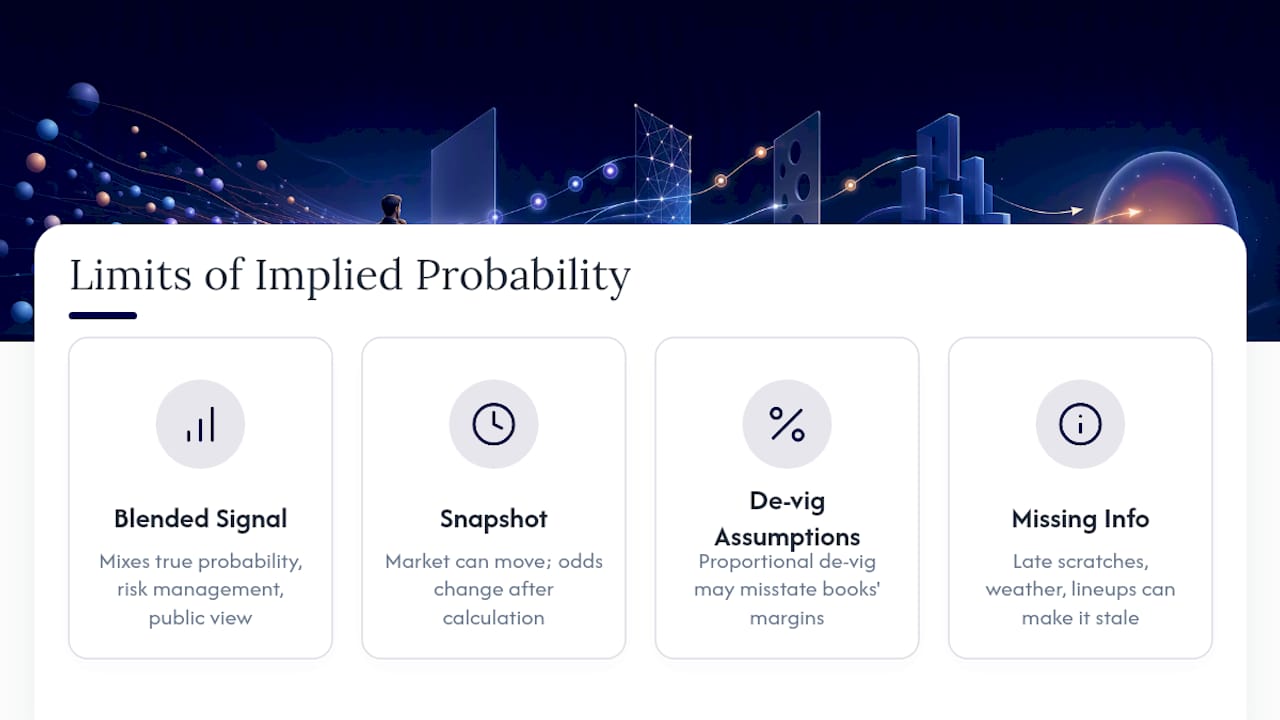
It assumes the market’s pricing reflects genuine probability rather than a mix of true probability, risk management, and public perception. Two of those three ingredients have nothing to do with which team is actually more likely to win, which means the implied number you calculate is really a blend, not a pure read on outcome likelihood.
It’s also a static snapshot. The moment you calculate a number, the market may have already moved. Line movement between when you check a price and when you place a bet can shift implied probability by a point or more on volatile markets, particularly close to game time.
De-vig methods add another layer of assumption. The proportional method treats the vig as distributed evenly across outcomes, which isn’t always how a book actually structures its margin. Favorites and underdogs sometimes carry different amounts of built-in juice, meaning your de-vigged number is an estimate of fair probability, not a precise one.
Implied probability also can’t account for information you don’t have. It reflects the market’s collective knowledge at that moment, not everything knowable about a game. A late scratch, weather shift, or lineup change after you’ve calculated your number renders that calculation stale until the market catches up and reprices.
Treat implied probability as a starting reference point for comparison, not a finished verdict on what will happen.
Implied Probability vs. Other Ways to Estimate Odds
Implied probability isn’t the only way bettors try to estimate how likely an outcome is, and it’s worth knowing how it stacks up against the alternatives.
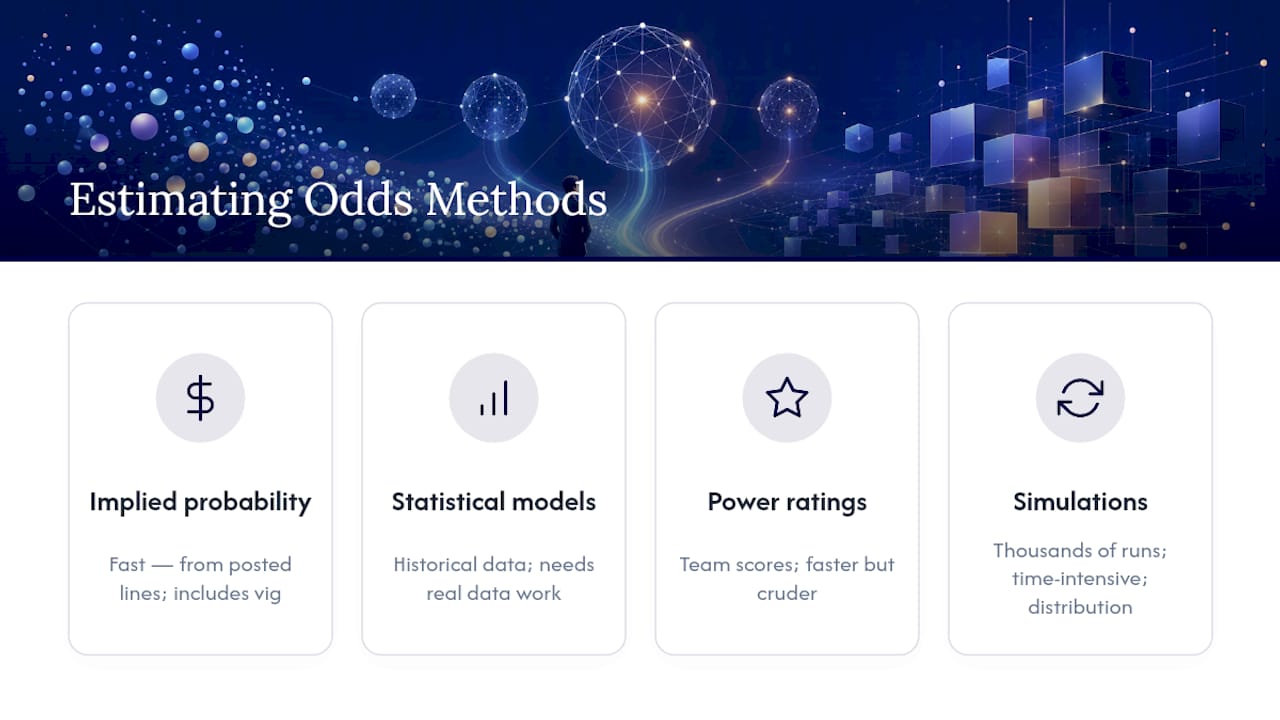
Statistical and predictive models build probability from historical data, such as team efficiency ratings, pace, or matchup-specific trends, independent of what any sportsbook has priced. These models can catch value the market hasn’t fully adjusted for yet, but they require real data work and are only as good as the inputs feeding them.
Power ratings and rankings systems, common in college sports handicapping, assign each team a numeric score and derive a probability from the gap between two teams’ ratings. They’re faster to apply than a full statistical model but tend to be cruder, since they compress a lot of context into a single number.
Simulation-based approaches run a matchup thousands of times with randomized variables to generate a probability distribution rather than a single point estimate. These are more sophisticated but also more time-intensive, and they’re mostly the domain of serious quantitative bettors rather than casual ones.
Implied probability’s advantage over all of these is speed and universality. Every posted line already contains it, so you don’t need your own model to get a number. Its disadvantage is that it reflects the market’s blended judgment, vig included, rather than a clean independent estimate. The strongest bettors tend to use implied probability as a benchmark and compare it against their own model or rating system, looking for gaps between the two rather than trusting either number alone.
How Line Movement and Betting Volume Change the Numbers
Implied probability isn’t fixed the moment a line goes up. It shifts constantly as money and information flow into the market, which is exactly why the closing line is treated as the most informed price a market produces.
Heavy betting volume on one side of a market pushes the line, and therefore the implied probability, even when the underlying likelihood of the outcome hasn’t changed at all. A popular team drawing lopsided public money can see its price shorten purely from betting pressure, temporarily inflating its implied probability beyond what a neutral model would suggest.
Sharp money moves lines differently than public volume does. A relatively small but well-placed bet from a bettor a book respects can move a number more than a much larger volume of public action, because books weight the source of the money, not just its size.
Injury news, weather updates, and lineup changes trigger rapid repricing as new information hits the market. The gap between the opening implied probability and the closing implied probability on a given outcome is often the single best data point for judging whether your own read on a game was sharp or off, since the closing number represents the market’s most complete information.
This is also why the same game can carry different implied probabilities across different sportsbooks at the same moment. Each book manages its own liability and its own customer base, so pricing rarely stays perfectly aligned across the market until closing time forces convergence.
Why This Math Matters More Than Most Bettors Think
Most bettors treat implied probability as trivia rather than a working tool, which is a mistake given how directly it connects to whether a bet is actually worth making. The gap between your own probability estimate and what the market is quoting is the entire game. Everything else, research, injury reports, situational spots, only matters insofar as it sharpens that estimate.
Where most people fall short isn’t the math itself, since the formulas are genuinely simple. It’s the discipline of actually running the numbers before placing a bet rather than after. A tool like ParlayGeeks can help by pulling odds across multiple books into one view, so the comparison step that usually gets skipped becomes automatic instead of optional. Run these formulas on a few real lines this week and watch how differently you see a betting slip.
— Thelma
Put These Calculations to Work With ParlayGeeks
Doing this math by hand works fine for one bet. It gets tedious fast once you’re comparing a full slate across several sportsbooks, checking for de-vigged value, and trying to remember which line moved overnight. ParlayGeeks was built around exactly that friction point: real-time odds comparison across multiple sportsbooks in one place, so you’re not tab-switching to find the number that matters.

Beyond raw odds, the platform gives you access to unlockable expert picks and analysis, live injury updates, a free parlay calculator, and a structured BetSlip builder you can share publicly. If you’d rather have the implied probability and de-vig work done for you alongside expert reasoning on each pick, the Silver, Gold, and Platinum plans at $49, $99, and $199 per month respectively unlock different tiers of picks and analysis. None of this replaces the formulas in this guide. It just saves you the manual lookup every time you want to check a line. Head to ParlayGeeks to see the free tools before deciding whether a premium tier fits how you bet.
Sources
For a deeper technical breakdown of the decimal reciprocal formula and overround mechanics, Wikipedia’s implied probability entry is a solid reference. The Market Math conversion guide covers all three odds formats in more depth, and Omni Calculator’s tool lets you check your own math instantly. If betting volume or frequency ever starts feeling less like a hobby, the National Council on Problem Gambling offers free, confidential support resources.
- Implied Probability Calculator: 3 Formulas to Convert Any Odds Format | Market Math
- Implied probability — Wikipedia
FAQ
What Does +200 Implied Probability Mean?
It’s the market’s way of pricing an underdog: the higher the positive number, the lower the implied probability and the bigger the payout if it hits.
What Counts as a Good Implied Probability Percentage?
There’s no fixed “good” number, since it depends entirely on whether your own probability estimate for that outcome is higher than what the market implies.
What Is the 80/20 Rule in Sports Betting?
The common notion is that a small share of your bets, research, or bankroll decisions tends to drive most of your results, which is really an argument for disciplined bankroll management over any single specific ratio.
What Does a 75% Implied Probability Look Like in Odds?
You can verify it yourself: 300 / (300 + 100) = 0.75, confirming the 75 percent implied probability.
How Do I Remove the Vig to Find Fair Odds?
Add up the implied probabilities of every outcome in the market, then divide each individual outcome’s number by that total and multiply by 100.