

Kelly Criterion Betting for Sports Bettors: Use Half Kelly, Track Bets
Kelly is worth using as a sizing framework, not a strict order to follow. The formula tells you exactly how much of your bankroll to risk when you know your true edge, but almost nobody knows their true edge with the precision the math assumes. Run the full Kelly number, then bet a fraction of it, typically half, and cap your stake before you touch the sportsbook app.
TL;DR:
- Betting full Kelly can lead to significant bankroll volatility and substantial losses if your true edge or probability estimate is inaccurate.
- Using fractional Kelly, such as half or quarter, reduces risk and drawdowns but also limits long-term growth, making it the practical choice for most bettors.
- Proper estimation and calibration of your win probability are crucial for Kelly’s effectiveness; tracking outcomes helps refine your model over time.
- Betting on correlated outcomes without adjustment can double or triple your risk exposure, so applying correlation cutoffs is essential for safe sizing.
- Relying on the Kelly formula without careful input validation, bankroll management, and record keeping often results in overconfidence and suboptimal betting decisions.
Table of Contents
- What Is Kelly Criterion Betting? The Formula Explained
- How to Calculate Kelly Criterion for a Real Bet
- Why Fractional Kelly Beats Full Kelly in Practice
- Managing Correlated Bets Without Blowing Up Your Bankroll
- How to Estimate Your Real Win Probability
- Using a Kelly Calculator Without Misreading the Output
- Where Kelly Betting Goes Wrong
- A Step-by-Step Checklist for Applying Kelly to Your Next Bet
- How ParlayGeeks Fits Into a Kelly Workflow
- The Overrated Formula That Still Deserves a Place in Your Toolkit
- Sources
What Is Kelly Criterion Betting? The Formula Explained
The Kelly criterion is a bet sizing formula that tells you what fraction of your bankroll to wager based on your edge and the odds offered. It was built to maximize the expected logarithm of your wealth, not your expected dollar winnings, and that distinction is the whole point. Kelly’s formula targets geometric growth over repeated bets rather than the biggest possible single payout, which is exactly why it avoids the ruin that comes from swinging for the fences on every play.
Maximizing expected dollars sounds appealing until you realize it leads to betting your entire bankroll on any positive-edge wager, since a bigger stake always raises the expected dollar value. One bad beat and you’re done. Maximizing expected log-wealth instead asks: what stake grows my bankroll fastest over many repeated bets without risking total wipeout? That’s a fundamentally different question, and it’s the one sports bettors actually care about.
For a single bet with two outcomes, win or lose, the formula is:
f = (bp − q) / b*
- f* is the fraction of your bankroll to wager
- b is the net odds received on the bet (decimal odds minus 1)
- p is your estimated probability of winning
- q is the probability of losing, or 1 − p
Investopedia’s breakdown of this formula is a good reference if you want the general mathematical version applied outside of sports betting too, since the same logic shows up in trading and portfolio theory. The formula only works if your estimate of p is honest. Overestimate your win probability, even slightly, and Kelly will happily tell you to bet more than you should.
How to Calculate Kelly Criterion for a Real Bet
Here’s a step-by-step example using a bet you might actually place this weekend.
- Identify your decimal odds. Say a sportsbook offers 2.10 on a team you like. That means b = 2.10 − 1 = 1.10.
- Estimate your win probability. Through your own model or research, you land on p = 0.55, meaning q = 0.45.
- Plug into the formula. f* = (1.10 × 0.55 − 0.45) / 1.10 = (0.605 − 0.45) / 1.10 = 0.155 / 1.10 ≈ 0.141.
- Apply it to your bankroll. With a $5,000 bankroll, full Kelly says to bet 14.1%, or $705.
- Scale it down. Half Kelly cuts that to 7.05%, or $352.50. Quarter Kelly brings it to 3.5%, or roughly $176.
- Round to what the book allows. Most sportsbooks accept whole-dollar or five-dollar increments, so you’d round $352.50 down to $350.
A single bad week at full Kelly, even with a legitimate edge, can chop your bankroll by a third or more before variance turns back in your favor.
Statistic callout: A five-percentage-point overestimate in your win probability, say you plug in p = 0.55 when the true figure is closer to 0.50, doesn’t just shrink your edge modestly. It can flip the Kelly output from a healthy stake to a bet you should never have placed, since the formula is directly sensitive to that gap between b, p, and q.
The math doesn’t care that $705 felt reasonable when you typed it in. It only cares whether your 0.55 was actually correct.
Why Fractional Kelly Beats Full Kelly in Practice
Full Kelly is the theoretical growth-optimal stake, but almost no serious bettor actually uses it. Fractional Kelly, betting some consistent multiple of the full Kelly stake such as one-half or one-quarter, is the practical standard, and research on optimal bet sizing shows why the trade-off favors going smaller.
Half Kelly gives up roughly a quarter of the theoretical long-run growth rate compared to full Kelly, but it cuts bankroll volatility dramatically. That’s a trade most bettors should take without hesitation.
The reasons practitioners downsize go beyond pure math:
- Estimation error is unavoidable. Your p is a guess dressed up as a number, and Kelly amplifies mistakes in that guess.
- Psychological drawdowns are real. A string of full-Kelly losses can push even disciplined bettors into panic sizing or chasing losses.
- Sportsbooks impose limits. Full Kelly stakes on soft lines sometimes exceed what a book will let you bet anyway.
- Bankrolls fund real life. Most bettors can’t treat their entire bankroll as pure risk capital the way the math assumes.
Pro Tip: Start at half Kelly for at least your first 100 tracked bets. You’ll get a feel for how the stake sizes move with your confidence level before you ever consider going closer to full Kelly.
Betting at exactly double your true Kelly fraction produces zero expected excess growth, according to the same underlying Kelly math. Go past that and you’re destroying value despite holding a genuine edge. That’s the ceiling fractional Kelly protects you from ever approaching.
Managing Correlated Bets Without Blowing Up Your Bankroll
Kelly’s formula assumes each bet is independent, and most parlay bettors violate that assumption constantly without realizing it. If you bet the same team’s moneyline and their star player’s over on receiving yards, those outcomes move together. Treat them as independent Kelly bets and you’ll size both as if they were unrelated risks, which quietly doubles or triples your real exposure to a single outcome.
Full multivariate Kelly solves this with a covariance matrix, a mathematical map of how every bet in your portfolio moves relative to every other one. You don’t need to build that matrix by hand to protect yourself, though. Practical adjustments exist that get you most of the benefit without the linear algebra.
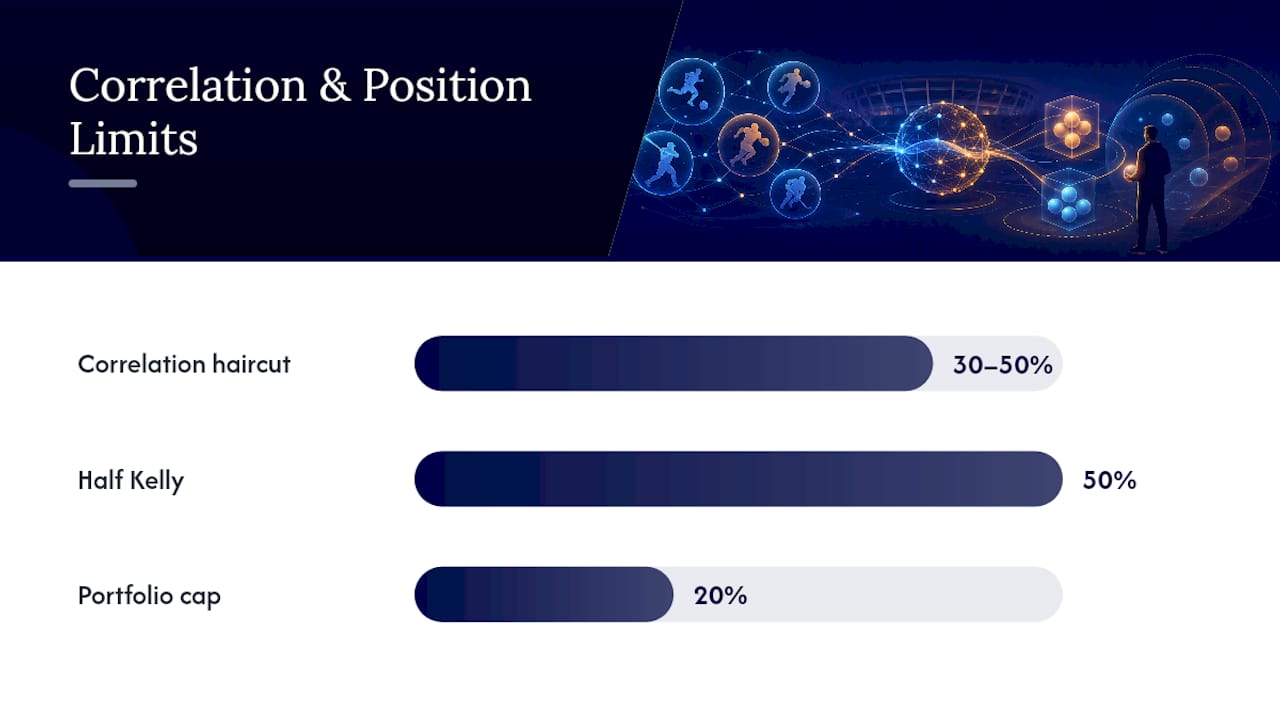
- Apply a correlation haircut. If two bets share an obvious driver (same game, same player, same weather condition), cut each individual Kelly stake by 30% to 50% before placing both.
- Scale proportionally across your slate. If you have five correlated bets open at once, treat your total exposure to that correlated cluster as one combined Kelly calculation, not five separate ones.
- Cap total portfolio Kelly exposure. Set a hard ceiling, say 20% of bankroll, on aggregate stakes across all open positions regardless of how attractive each looks individually.
- Stack fractional Kelly with the haircut. Half Kelly plus a correlation adjustment on top gives you two independent layers of protection against overconfidence.
Here’s a quick example. That’s still meaningful action, but it doesn’t quietly bet your bankroll twice on the same outcome dressed up as two different markets.
How to Estimate Your Real Win Probability
Everything in the Kelly formula flows from p, your estimated win probability, and it’s the input bettors get wrong most often. Estimation error is the single biggest practical limitation of applying Kelly to any real-world bet, sports included, because unlike a casino game with fixed odds, nobody hands you the true probability of an NFL team covering a spread.
A few defensible methods for getting closer to an honest p:
- Backtest any model out of sample. If you built a projection model, test it on games it never saw during training as explained in the cash alternative or the car trade-offs to better understand value estimations. In-sample accuracy always looks better than real performance.
- Track closing line value religiously. If you’re consistently getting better numbers than the closing line, that’s one of the strongest signals your probability estimates hold up over time, independent of whether any single bet won or lost.
- Calibrate against outcome frequency. Bucket your past picks by confidence level. If your “60% confident” bets have actually won closer to 52% of the time, that’s your model telling you to trust it less.
- Respect sample size. Twenty bets tell you almost nothing about your true win rate. You need hundreds of tracked outcomes before variance settles down enough to draw real conclusions.
Pro Tip: Log every bet with your predicted p, the odds you got, and the actual result in a simple spreadsheet or through your BetSlip history. After 50 bets, compare your average predicted win rate to your actual win rate. The gap between those two numbers is your personal estimation error, and it’s the single most useful thing you can learn about your own betting.
Record-keeping isn’t optional if you’re serious about Kelly. Without a written history of what you predicted versus what happened, you’re just guessing whether your model works, and Kelly punishes guesses that turn out wrong.

Using a Kelly Calculator Without Misreading the Output
A Kelly calculator needs four inputs to function: your odds format and value (decimal, American, or fractional), your estimated win probability, your current bankroll, and the fractional multiplier you want applied. Free calculators built for sports betting typically output a suggested percentage of bankroll and a dollar stake, sometimes alongside a warning when the math produces an unusual result.
Watch for these common misreadings:
- f greater than 1 is not an instruction to leverage.* If a calculator spits out a fraction above 100% of your bankroll, that’s a mathematical artifact of an implausibly large edge, almost always caused by a bad p input, not a real signal to borrow money.
- The calculator has no idea about your other open bets. It treats every calculation in isolation, so correlation adjustments are entirely on you.
- A confident-looking output doesn’t validate your p. The calculator will happily compute a precise dollar figure from a probability you pulled out of thin air.
The safest workflow: compute the raw Kelly output, apply your fractional multiplier (half or quarter), round down to your sportsbook’s minimum stake increment, and log the bet with your reasoning before you forget why you liked it in the first place.
Where Kelly Betting Goes Wrong
Kelly fails bettors in predictable ways, and most of them trace back to one root cause: treating an estimate like a fact.
- Overconfidence in p. This is the primary failure mode. A model that’s 5 points off in either direction changes your optimal stake substantially, and there’s no way to fully eliminate this uncertainty.
- Betting above your true Kelly fraction. Doubling your actual Kelly stake doesn’t just add risk, it drives your expected long-run growth rate to zero even with a real edge intact.
- Ignoring operational limits. Betting limits, tax reporting thresholds, and simple liquidity (you need cash for rent too) all constrain what “optimal” sizing looks like in your actual life.
- Forcing Kelly onto a single, one-off bet. The whole framework assumes repeated betting over time. If you’re placing one Super Bowl prop you’ll never repeat, growth-rate optimization matters far less than simply deciding how much you’re comfortable losing.
A Step-by-Step Checklist for Applying Kelly to Your Next Bet
Before you place anything, run through this sequence.
- Confirm you actually have an edge. Compare your estimated probability against the market-implied probability from the odds. No edge, no bet.
- Shop the line across sportsbooks. A better price directly increases your b, which increases your optimal stake and your long-run growth.
- Calculate full Kelly, then apply your fraction. Half or quarter Kelly, consistently, every time, not just when you’re feeling cautious.
- Cap the stake and check correlation. Does this bet share an outcome with anything else you have open right now?
- Round to your sportsbook’s increment and place it.
- Log the result and update your calibration. Every bet is a data point for your next probability estimate.
| Stage | Action | Why it matters |
|---|---|---|
| Pre-bet | Verify edge, shop odds, compute Kelly fraction | Bad inputs produce confidently wrong stakes |
| Bet placement | Round stake, check correlation with open bets | Prevents accidental over-exposure to one outcome |
| Post-bet | Log result, update win-rate model | Turns every bet into future calibration data |
How ParlayGeeks Fits Into a Kelly Workflow
Kelly only works as well as the numbers feeding it, and that’s exactly where a platform built around odds and tracking earns its keep. A platform that compares real-time odds across multiple sportsbooks can improve your b in the Kelly formula since a better price on the same bet raises your net odds and your optimal stake. Educational resources can cover bankroll management fundamentals for bettors still building their calibration process, and shareable BetSlips can give you a running, dated record of what you actually bet and predicted, which is the raw material any honest p-estimation process needs.
A workable routine: find the best available price on Parlaygeeks, run your Kelly calculation using that price, apply your chosen fractional multiplier, then log the bet through a BetSlip so it’s tracked automatically instead of buried in a notes app you’ll forget to check.
The Overrated Formula That Still Deserves a Place in Your Toolkit
Kelly gets treated two ways online: as a magic number that guarantees profit, or as an academic curiosity too fragile for real betting. Both takes miss the point. The math itself isn’t in question, it’s well established, but the inputs almost always are, and that’s where most conventional advice quietly falls apart. Articles that hand you the formula and stop there are giving you a car with no brakes.
What the research actually supports is narrower and more useful: Kelly is a sizing discipline, not a probability oracle. It will tell you, once you’ve done that harder work, roughly how much to risk without torching your bankroll on the way to being right. That’s a meaningful distinction conventional wisdom skips past.
If you take one thing from this, make it record-keeping before fraction selection. Bettors argue endlessly over half Kelly versus quarter Kelly while sitting on zero tracked history to calibrate either choice against. Fix that first. The stake size matters less than knowing whether your edge is real, and reports about figures like Warren Buffett using Kelly-style methods remain unverified for a reason worth remembering: even the pros who might use this math don’t advertise their exact inputs, because the inputs are the hard part.
— Fogell