
Live Betting Strategy: Win With 3 Live Bets Per Game
Live betting can be profitable, but only for bettors who anchor every in-play decision to a pre-game number and trade solely on clear mispricings. The math works against you by default: higher vig, execution delays, and market suspensions eat into any edge you think you have. The bettors who come out ahead treat live markets as a selective add-on to pre-game handicapping, not a separate game of reflexes.
TL;DR:
- Live markets typically have a higher house hold (6 to 10 percent) than pre-game lines, requiring a higher success rate to break even.
- Key value signals include early game dominance, chaotic overreactions, second-half fatigue, substitution lag, and visual advantages not yet reflected in odds.
- Speed alone does not create an edge; carefully staged bets across multiple books and adherence to strict timing and size limits are essential for profitability.
- Watching the game and verifying odds across two or three sportsbooks within 30 to 90 seconds significantly improves betting accuracy.
- Limiting bets to three per game, setting loss caps, and taking deliberate breaks help control tilt in the fast-paced, high-vig environment of live betting.
Table of Contents
- What Is Live Betting Strategy and Why It’s Harder Than Pre-Game
- Core Live-Betting Value Signals and Decision Rules
- Sport-Specific Tactics: NBA, NFL, MLB, Tennis, and Soccer
- Execution and Tools: Multi-Book Setup and Bet-Acceptance Checks
- Bankroll, Frequency Limits, and Tilt Control
- A Step-by-Step Live-Betting Session Checklist
- Why Patience Beats Speed in Live Betting
- How Parlaygeeks Fits Your Live-Betting Session
- Sources
- FAQ
What Is Live Betting Strategy and Why It’s Harder Than Pre-Game
A live betting strategy is a set of pre-decided rules for when and how you bet on a game already in progress, built to survive the specific disadvantages of in-play markets rather than pretend they don’t exist. Sportsbooks continuously re-price live markets, often multiple times per minute, using feeds with play-by-play data and models. Significant events may cause a market suspension for several seconds to update odds before reopening.
That reopening comes with friction. Books typically build in a 3 to 8 second acceptance delay on live wagers, giving them room to adjust the price before your bet locks in. Submit at 65 and get accepted at 60. That’s not a glitch, it’s the system working as designed.
The bigger issue is structural: live markets typically hold 6 to 10 percent, roughly double the 4 to 5 percent hold on most pre-game lines. That gap directly raises the hit rate you need just to break even.
- Pre-game markets: closer to 4 to 5 percent hold, break-even hit rate near 52 to 53 percent
- Live markets: 6 to 10 percent hold, break-even hit rate often climbing past 55 percent
The one real advantage you get in exchange is information timing. Watching the actual broadcast, not a delayed data feed or box score, lets you see injuries, fatigue, and tactical shifts before the market fully prices them in. That gap between what you see and what the algorithm has processed is where the entire edge lives. Bettors who never watch the game and just click numbers off a feed are playing a worse version of pre-game betting with a bigger house cut attached.
Core Live-Betting Value Signals and Decision Rules
Value in live markets shows up in a handful of repeatable patterns, not a hundred different ones. The signal framework from OddsMint identifies five worth building rules around: early dominance the market hasn’t caught up to, overreactions to chaotic moments, second-half fatigue, substitution-driven market lag, and mismatches between what you see and what the model shows.
- Early dominance, unpriced. A team is out-shooting, out-possessing, or out-executing its opponent early, but the live line still reflects the pre-game number almost exactly. The window here runs roughly the first 8 to 10 minutes of a game. Safest markets: game total, moneyline on the dominant side. Skip it if the dominance is mostly variance-driven (three lucky bounces, not sustained pressure).
- Chaos overreaction. A turnover, a missed dunk, a controversial call, and the market swings harder than the actual win probability shift justifies. The window is short, often under two minutes. Fade the overreaction on the next available number, and skip if the event genuinely changed a starter’s availability.
- Fatigue patterns. Bench depth, minutes load, and travel schedule create predictable second and third-quarter drop-offs the market underweights. Best exploited in totals and player props, not moneylines.
- Substitution lag. A key player exits, and the market takes 60 to 90 seconds to fully reprice. If a rotation player of real quality enters and the line hasn’t moved after 90 seconds, compare the moneyline across two or three books and act if the gap clears your value threshold.
- Eye-test versus model mismatch. You see something the algorithm hasn’t weighted yet: a defender who looks compromised, a pitcher losing velocity, a server missing spots. Trust this only when it’s visually obvious, not a hunch.
Pro Tip: Run every signal through a two-question filter before betting: would I take this position pre-game with this same information, and has the line actually failed to move? If either answer is no, pass.
Sport-Specific Tactics: NBA, NFL, MLB, Tennis, and Soccer
Generic in-play advice falls apart fast once you compare sports, because line movement frequency varies enormously by sport. NBA and tennis reprice constantly. Baseball and soccer give you fewer opportunities, but the ones that show up tend to carry more weight.
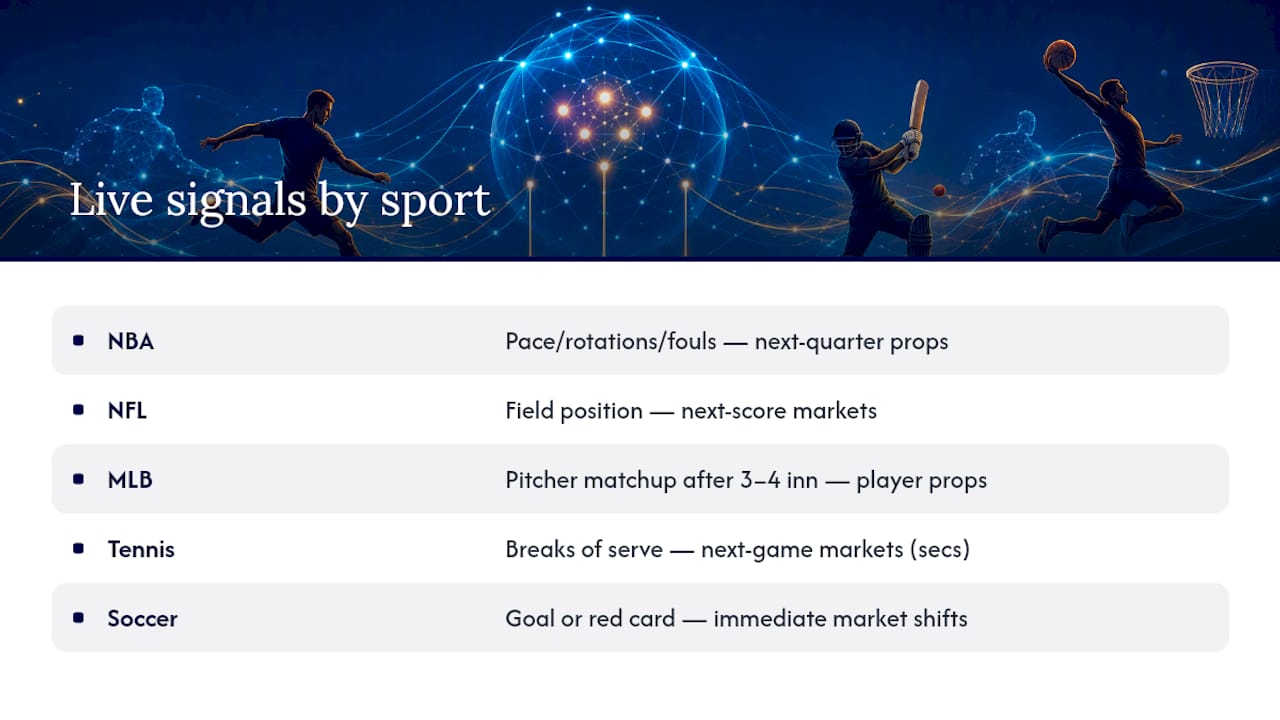
NBA. Pace, rotation patterns, and foul trouble drive nearly every live number. Watch for garbage-time benching in blowouts, where the total and player props detach from the score margin. Live totals and short-window player props (points or rebounds over the next quarter) tend to offer better value than moneylines on heavy favorites.
NFL. Field position and drive context matter more than the scoreboard. Next-score markets reward bettors who track red-zone efficiency and time-of-possession trends rather than reacting to a single big play. Be selective on momentum swings after one explosive play. One 60-yard run does not usually change a team’s underlying talent gap.
MLB. Wait until the pitcher matchup and bullpen usage becomes clear, usually after the third or fourth inning. Count-based props and player props (next at-bat outcomes, strikeout totals) offer cleaner windows than live run lines, which move slowly and rarely mispriced.
Tennis. Breaks of serve are the single biggest live signal in the sport, and the value window closes in seconds, not minutes. Next-game markets react faster and more reliably than full-match moneylines, which barely budge on a single break in a best-of-three.
Soccer. A goal or red card is the clearest live trigger in the sport. Match winner and total-goals markets shift meaningfully once a team goes down a man or takes a lead, and the shift often overcorrects in the first few minutes after the event.
Execution and Tools: Multi-Book Setup and Bet-Acceptance Checks
Speed alone doesn’t create an edge, but slow execution absolutely kills one. If you’ve identified a real mispricing and it takes you 45 seconds to place the bet across three open tabs, the number you wanted is gone.
- Use a sportsbook app with low reported latency, not just a familiar brand.
- Stage your BetSlip before the trigger event happens, if the market allows it, so confirmation takes one tap.
- Keep two or three sportsbook accounts funded and logged in simultaneously, since live lines diverge more than pre-game lines and the book you’d normally use isn’t always the one with the best number in-play.
- Check your account’s live betting limits ahead of time. Some books cap in-play stakes far below pre-game limits, especially on newer accounts.
Reconcile differences across books quickly: if one book hasn’t moved and two others have, that’s often your substitution-lag or chaos-overreaction signal confirming itself. When a book suspends the market mid-bet or re-offers you a worse price, don’t chase it. A re-offer means the algorithm already caught up, and you’re no longer betting the mispricing you identified.
Pro Tip: Keep a simple execution log: trigger event, time to placement, price you wanted versus price you got. If your average delay exceeds 10 seconds, your tools or process are the leak, not your signal-reading.
Bankroll, Frequency Limits, and Tilt Control
Live betting’s fast feedback loop is exactly what makes it dangerous. A bad beat 30 seconds ago is still fresh when the next betting window opens, and that’s when loss-chasing happens. Tilt is the single biggest risk in live betting, and it’s controlled far more reliably with hard rules than with willpower in the moment.
- Cap your bet size at 0.5 to 1 percent of bankroll per live wager, smaller than a typical pre-game unit.
- Set a hard cap of three live bets per game, decided before kickoff, not adjusted mid-game.
- Set a session loss limit (a fixed dollar amount or percentage of bankroll) that ends your live betting for the day once hit.
- Force a break between periods or quarters, even five minutes away from the screen, to reset before the next window opens.
- Use your sportsbook’s built-in deposit and session limit tools as enforcement, not just intention.
Cash-out offers usually build in extra margin for the book, making it a negative-EV move on average. It’s still a reasonable tool when a game state has genuinely changed in a way your original bet didn’t account for, such as a starter going down for the season.
| Rule | Recommended Limit | Why It Matters |
|---|---|---|
| Bet size | 0.5–1% of bankroll | Live vig is higher, so smaller stakes protect against variance |
| Bets per game | 3 max | Prevents reactive, low-value wagers late in close games |
| Session loss limit | Set pre-game, dollar or percent | Stops loss-chasing before it compounds |
| Mandatory break | Between periods/quarters | Resets emotional state before next decision |
A Step-by-Step Live-Betting Session Checklist
A workable live session follows the same shape every time: anchor, watch, verify, act, review.
- Before kickoff: Record the pre-game line and total for the game you plan to bet. This is your anchor number for every in-play comparison.
- Set your entry threshold: Decide the minimum value gap (in points or price) you need to see before you’ll act, and write it down.
- During the game: Watch the broadcast, not just a data feed. Bettors who don’t actually watch rarely find a reliable edge.
- On a trigger event: Confirm injury or substitution status, check the number across two or three books, and place only if your threshold is cleared.
- After the session: Log every bet, the trigger, the price you got, and the outcome, then compare your reads against results.
| Step | Action | Time Window |
|---|---|---|
| Pre-game | Set anchor line and entry threshold | Before kickoff |
| Live monitoring | Watch broadcast, confirm live events | Continuous |
| Verification | Compare 2–3 books, check latency | 30–90 seconds |
| Post-session | Log outcomes, adjust thresholds | After final whistle |
Consider running new signals through a backtesting tool before committing real stakes, since historical validation catches overfitted patterns that only looked good in one or two games.
Why Patience Beats Speed in Live Betting
The bettors who actually make money in-play aren’t the fastest clickers. They’re the ones who treat live betting as an extension of pre-game handicapping, waiting for the market to hand them a number that doesn’t match what they already believed before the game started. Most live bets should never be placed. That’s not a failure of the strategy, it’s the strategy working. The psychological pull to bet on every timeout and every commercial break is the real opponent here, not the sportsbook’s algorithm.
— Elaine
How Parlaygeeks Fits Your Live-Betting Session
You can use platforms that offer a fast, side-by-side view of odds across multiple sportsbooks, so you’re not tab-switching while a mispricing closes. Real-time odds comparison tools let you check two or three books in seconds during a live-signal window, and some platforms offer BetSlip builders to stage a wager before you even need it.
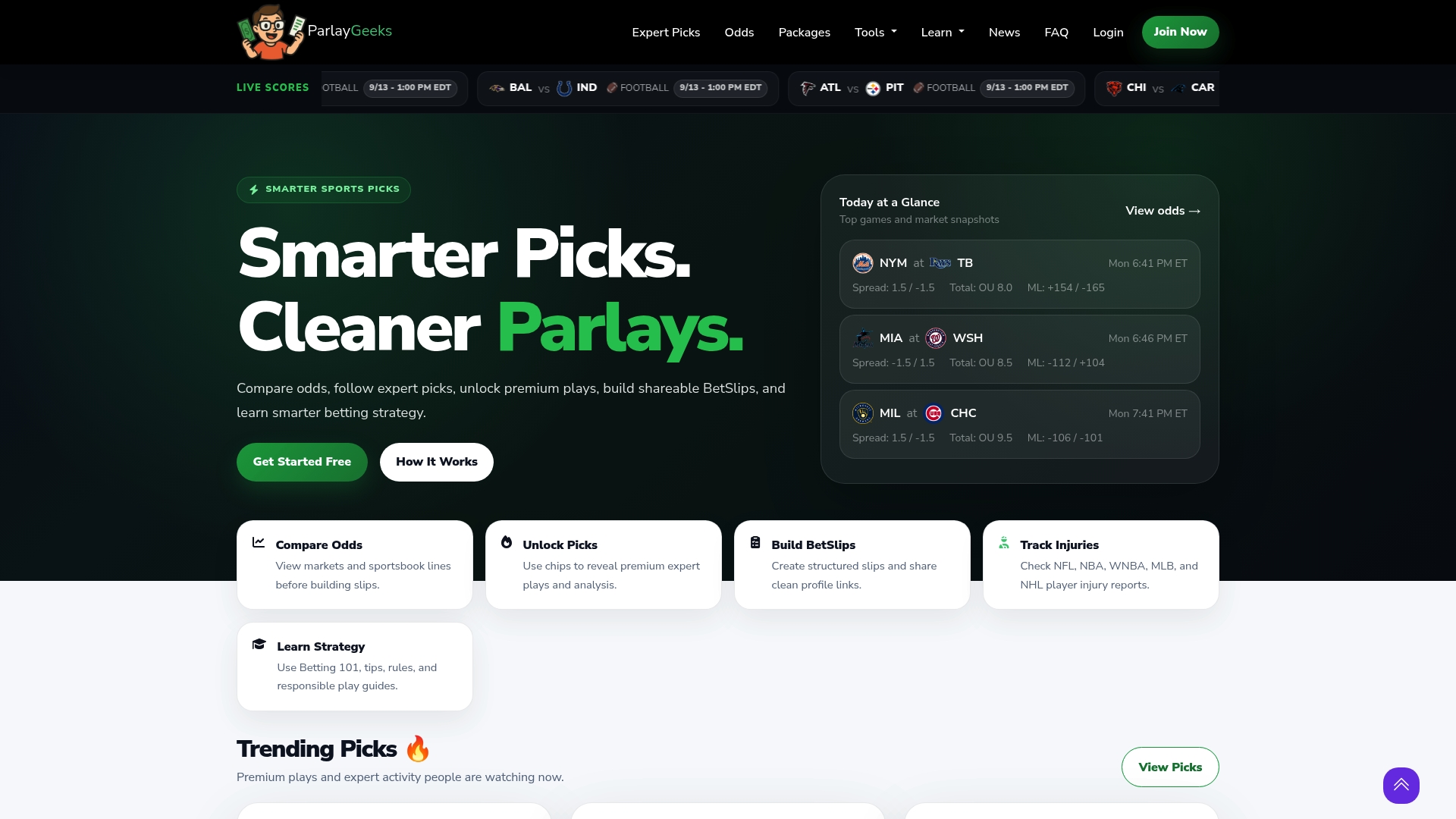
Some platforms provide injury updates, expert picks for various markets, and educational resources for bankroll management. None of this replaces watching the game yourself. It just removes the friction between spotting a signal and acting on it.
Try it on a single game tonight: set your pre-game anchor, pull up Parlaygeeks during the first live window, and compare odds across books before you place a single in-play bet.
Sources
- Live betting, explained: A complete guide to in-play sports wagering | Sporting News
- Live In-Game Betting Strategy: A 2026 Guide for Bettors | DC
- Live Betting Strategy (2026): How to Spot Value in Real Time
- Backstedge — Backtest your strategy. Validate your edge.
- GambleAware
FAQ
Is Live Betting Actually Profitable?
It can be, but only for selective bettors who anchor decisions to pre-game numbers and accept that live markets carry higher hold, typically 6 to 10 percent, versus 4 to 5 percent pre-game.
What Is the Biggest Live Betting Mistake?
Betting reactively on every momentum swing without a pre-set threshold, which is the fastest route to tilt and loss-chasing during a single game.
How Many Live Bets Should I Place Per Game?
Cap it at three per game, decided before kickoff, since higher frequency compounds vig and increases variance without adding real edge.
Why Do Sportsbooks Delay Bet Acceptance?
Books build in a 3 to 8 second delay to adjust prices after you submit a wager, which is why the number you click isn’t always the number you get.
Can Tools Like Parlaygeeks Help With Live Betting?
Yes. Comparing odds across sportsbooks in real time through a platform like Parlaygeeks reduces the execution lag that erodes value during fast-moving live windows.