
Win First Round Edges: March Madness Betting Strategy for U.S. Bettors
The most reliable March Madness betting strategy is targeted spread and total betting in the first round, built on situational mismatches sportsbooks underprice, layered with strict bankroll rules. Skip the seed-number guessing and chase specific edges instead: line shopping across books, live halftime and timeout plays, and a bankroll split that saves ammunition for the second week. Everything else in this guide builds on that.
TL;DR:
- The strongest betting edges occur on spreads and totals in the first round, especially for 9 to 12 seeds and first-round unders, due to bookmaker inefficiencies.
- Line shopping across sportsbooks and monitoring live market movements are crucial for identifying value during short windows when lines lag game realities.
- Bankroll management should allocate 1 to 2% per pregame bet early, with at least 30% reserved for later rounds, and involve setting strict loss limits per session.
- Focusing on matchup-specific stats like efficiency, tempo, turnover margin, and recent form yields more predictive power than seed number alone.
- Parlay bets should be limited, structured around correlated outcomes, and represent a small portion of the total bankroll to avoid high variance losses.
Table of Contents
- What Is a March Madness Betting Strategy, and Why the Round of 64 Matters Most
- Spreads, Totals, Moneyline, Futures, and Props: Matching the Bet to the Round
- How to Play Live Betting Without Getting Burned
- Building a Staking Plan That Survives All Six Rounds
- The Handful of Stats That Actually Predict Upsets
- The Mistakes That Quietly Drain Every Bracket-Season Bankroll
- Tools That Turn Analysis Into Actual Bets
- Reading the 12-vs-5 and 11-vs-6 Upset Lines Correctly
- Parlay and Accumulator Strategy Built for a 68-Team Field
- Spotting Market Inefficiencies Before They Disappear
- One Habit Worth More Than Any Single Pick
- Put This Strategy to Work With Parlaygeeks
- Sources
What Is a March Madness Betting Strategy, and Why the Round of 64 Matters Most
A March Madness betting strategy is really just a plan for allocating risk across 67 games in three weeks, most of it built around 32 first-round matchups that get priced almost simultaneously. That crunch is exactly why the Round of 64 produces the tournament’s biggest inefficiencies.
Sportsbooks have to hang lines on 32 games in roughly 48 hours, using a mix of computer models and limited human review. Public money floods in on brand-name programs and popular bracket picks, which pushes lines away from true value on mid-major teams nobody watched all season. That gap between perception and performance is where profit lives.
Three plays consistently show up in that window:
- 9 through 12 seed spreads. These teams often finished strong in mid-major conference tournaments and face major-conference opponents who limped into March. The public bets the brand name; the line often doesn’t fully account for the mismatch in recent form.
- First-round unders. Tournament pressure, unfamiliar opponents, and tighter officiating in win-or-go-home games tend to suppress scoring, and Yahoo Sports notes first-round unders have historically hit at a rate slightly above half in various analyses.
- Selective moneylines, not blanket underdog bets, on teams with a specific tempo or rebounding advantage over their seed-line opponent.
As the bracket narrows, that edge shrinks. Sharp bettors and other books catch up on lines by the Sweet 16, and public attention shifts to fewer games, meaning less mispricing to exploit. That’s the moment to scale back volume and get more selective rather than betting every remaining matchup at the same size. Save some of your bankroll and your best research hours for that stretch. It won’t offer as many opportunities, but the ones it does offer are usually cleaner.
Spreads, Totals, Moneyline, Futures, and Props: Matching the Bet to the Round
Different bet types carry different value at different points in the bracket, and picking the wrong one for the moment is one of the quieter ways bettors leak money.
- Spreads tend to be the cleanest early-round tool because they isolate a specific margin instead of asking you to predict an outright winner. Standard juice at 10 to 1 means you need to win roughly 52.4 percent of your spread bets just to break even, so the mismatch you’re betting on has to be real, not a hunch.
- Totals work best in the first two rounds, where tempo mismatches and tournament nerves genuinely suppress scoring. A total built for a 70 possession game between two teams that both play at 62 possessions is a total worth betting.
- Moneyline bets belong in your toolkit for small, specific underdog plays where you’ve identified a real situational edge, not as a blanket “upsets are fun” strategy. Betting every double-digit seed’s moneyline across a 68-team field is a fast way to donate money.
- Futures (national championship, Final Four, region winners) carry a heavier house edge and should be sized small and placed early, before the field narrows and value disappears. Treat a futures bet as a lottery ticket inside your plan, not a core position.
- Props are entertainment bets more than strategy. Fine in small amounts, but they shouldn’t compete with your spread and total bankroll for size.
ESPN’s tournament betting coverage recommends focusing on spreads over seed numbers and cutting games into halves for live betting, which lines up with how most of the tournament’s real value gets found.
How to Play Live Betting Without Getting Burned
Live betting during March Madness rewards preparation more than instinct, because the windows where value appears are short and specific. Live lines can lag the true game state by 15 to 45 seconds in some in-play markets, according to analysis of live tournament betting, and that lag is where the opportunity sits.
- Check the halftime reset before betting a comeback. If a favorite trails at the break, look at whether the deficit is driven by cold three-point shooting (likely to regress toward the mean) or a real matchup problem, like an undersized front line getting beaten on the glass. The first situation is often a live betting opportunity; the second usually isn’t.
- Wait out the run, then bet against the crowd’s panic. When a team goes on an 8-0 or 10-2 stretch, the live line overcorrects almost every time. Betting the trailing team right after the ensuing timeout, once the line has partially snapped back but not fully, is one of the more repeatable in-game plays.
- Watch foul trouble on a star player closely. Two quick fouls on a team’s leading scorer inside the first six minutes often moves the live spread more than the actual on-court impact justifies, especially if that player only sits briefly. That overreaction is exploitable if you’re watching the bench, not just the scoreboard.
- Cut your unit size for live bets. Variance is higher, information is incomplete, and the temptation to bet every possession is real.
- Set a hard stop for the final two minutes of close games. Line movement in that window gets chaotic and mostly reflects free-throw variance, not skill or information edges.
Pro Tip: Mute the broadcast commentary and watch the bench during a run. Coaches often signal a defensive adjustment before the box score shows it, and that’s your cue to bet before the line catches up.
Building a Staking Plan That Survives All Six Rounds
A round-aware bankroll plan matters more than picking winners, because even a sharp bettor with a losing bankroll strategy goes broke before the Final Four. Betting guides commonly recommend percent-of-bank staking rather than fixed dollar amounts, since your unit size should scale with your actual bankroll, not your confidence level.
A workable structure looks like this:
- 1 to 2% of your total bankroll per pregame straight bet during the Round of 64 and Round of 32, when you’re placing the highest volume of bets.
- 0.5 to 1% per live bet, reflecting the added variance and incomplete information of in-game markets.
- Reserve at least 30% of your starting bankroll for the Sweet 16 onward, so a rough opening weekend doesn’t wipe out your ability to bet the rounds where your research has the most time to pay off.
- Set a session loss limit (commonly two to three units) for any single day of games, and stop betting once you hit it regardless of how good the next matchup looks.
On a $500 bankroll, that’s roughly $5 to $10 per pregame straight bet in the early rounds and $2.50 to $5 per live bet. It looks small on paper. It’s the difference between betting round six and busting out during round two.
The Handful of Stats That Actually Predict Upsets
Seed number is a committee’s opinion, not a betting signal. The metrics that actually separate real value from public hype are narrower than most bettors think.
- Adjusted offensive and defensive efficiency (points per 100 possessions, adjusted for opponent strength) tells you more than raw scoring average ever will.
- Tempo. A slow, defensive team facing a fast, mistake-prone team creates a total that’s often mispriced, and a style clash that favors the slower team more than the seed suggests.
- Turnover margin, especially against pressure defenses that mid-major teams rarely see in their regular conference schedule.
- Three-point dependence. A team living and dying by the three is volatile enough to be a live betting target in both directions.
- Bench depth, which matters more in a six-games-in-three-weeks format than it does in a random Tuesday in January.
Layer in situational checks before you bet: recent injuries, a short turnaround after an exhausting conference tournament run, and whether the head coach has actual tournament experience versus a first trip to the Big Dance. Combine efficiency splits, three-point reliance, and turnover margin into a three-factor mental checklist for every matchup instead of leaning on the seed line. NCAA statistics offer the raw team-level numbers to run this check yourself in about five minutes per game.
The Mistakes That Quietly Drain Every Bracket-Season Bankroll
Parlay tickets can be a common trap in the tournament. Stacking multiple legs at standard odds reduces the true win probability below what the payout implies, due to the sportsbook’s hold compounding on every leg. A four-team parlay isn’t four times the fun; it’s a much steeper hill to climb for a payout that feels bigger than it is.
- Chasing losses after a bad Thursday leads directly into worse decisions on Friday. Set your stakes before tip-off, not after a loss.
- Recency bias makes one blown call feel like a pattern. It usually isn’t.
- Public bias inflates lines on popular brands and popular bracket-buster picks alike. When a line feels off compared to the matchup data, that gap is often the public leaning on one side, not the market being wrong.
- Fading the public only works when you’ve done the matchup work first. Fading blindly is just betting on a hunch with extra steps.
Pro Tip: Write your stakes down before the first tip-off of the day. Bettors who commit to a number on paper are far less likely to double up after a bad beat.
Tools That Turn Analysis Into Actual Bets
Good tournament betting runs on a short list of tools, each doing one job well. KenPom and Bart Torvik give you the adjusted efficiency and tempo numbers that matter more than raw stats. NCAA statistics fill in the official team and game-level data behind those models.
Turning that research into a placed bet is where most bettors slow down, and that’s a key challenge many face.
- Odds comparison across sportsbooks can help you avoid taking a worse number on the same bet just because it’s the book you happened to open first.
- Expert picks can provide a second opinion on matchups you haven’t had time to fully break down yourself.
- Shareable BetSlips allow comparison of notes with other bettors before committing.
- Injury updates help flag late scratches and limited-minutes situations before they move the line against you.
The efficient workflow: run your matchup checklist, compare odds to find the best number, confirm nothing changed with a last injury check, then size the bet with a parlay calculator if you’re combining legs.
Reading the 12-vs-5 and 11-vs-6 Upset Lines Correctly
The 12-vs-5 upset is the tournament’s most famous betting angle for a reason. Twelve seeds have won roughly 35 percent of their matchups against five seeds across decades of tournament history, which is a real, repeatable rate, not a myth built on a couple of memorable years.
That doesn’t mean betting every 12 seed blindly. The upset rate is a starting point, not a strategy. The 12 seeds that actually cover, and occasionally win outright, tend to share specific traits: a veteran roster that’s played together for multiple seasons, a defense built around forcing turnovers against teams unused to that pressure, and a five seed that limped through its conference tournament with a losing record in its last four games.
Eleven-vs-six matchups follow a similar but slightly milder pattern. Elevens often get into the tournament through a strong late-season run or a conference tournament title, which means they’re playing their best basketball of the year exactly when the bracket starts. Six seeds, by contrast, sometimes backed into their seed line on reputation built earlier in the season.
The matchup factors worth checking before betting either upset line: recent form over the last six to eight games rather than the full season, tempo fit (a five or six seed that wants to run into a defense that forces turnovers is a bad matchup for the favorite), and whether the lower seed has tournament-tested guard play, since backcourt experience shows up disproportionately in close, single-elimination games. Bet the specific matchup, not the seed number on the bracket.
Parlay and Accumulator Strategy Built for a 68-Team Field
Parlays aren’t off limits during March Madness, but they need tighter rules than the ones bettors apply the rest of the year. The tournament’s single-elimination format and compressed schedule make variance high enough on their own without stacking four uncorrelated legs and hoping.
The better approach is a correlated, two-leg parlay: pairing a spread with a total in the same game, where the two outcomes actually relate to each other. If you like a favorite to cover comfortably, that same game is often more likely to go under, since a comfortable win frequently comes with the losing team’s offense stalling out. That correlation gives the parlay a real logical foundation instead of just multiplying odds for a bigger number.

Keep parlay stakes small and separate from your straight-bet bankroll, treating them as a distinct, capped category rather than your main betting activity. A useful rule: no more than 10 to 15 percent of your total tournament bankroll should ever touch parlay tickets, and never build a parlay around games you haven’t independently researched as straight bets first. If a leg wouldn’t be a bet on its own, it doesn’t belong in a parlay just because it makes the payout bigger.
Spotting Market Inefficiencies Before They Disappear
Market inefficiencies in March Madness show up in three predictable places, and knowing where to look beats scanning every line hoping something jumps out.

The first is early in the week, right after Selection Sunday, when books post initial numbers fast and public money hasn’t yet piled onto brand-name teams. Lines shift meaningfully in the 48 hours before tip-off as sharp money and public money push in different directions, and tracking that movement tells you which side the smart money is actually on.
The second is across different sportsbooks at the same moment. Books don’t always agree, especially on mid-major matchups they haven’t spent much time modeling, and that gap is free value if you’re set up to shop for it rather than betting the first number you see.
The third is in live markets during runs and momentum swings, covered above in the live-betting section. All three reward the same habit: checking multiple numbers before you bet, rather than accepting whatever line loads first on a single app.
One Habit Worth More Than Any Single Pick
Pick one strategy from this guide, first-round spreads or disciplined live betting, and track your results on it for the full tournament before adding a second approach. Bettors who spread themselves across every tactic at once rarely learn which one actually works for them.
Set your stakes before the day starts, and use the tools built for that, including the National Council on Problem Gambling’s helpline if betting ever stops feeling like a game. The tournament rewards patience more than it rewards conviction. Bet the matchup, not the bracket sheet on your fridge.
— Thelma
Put This Strategy to Work With Parlaygeeks
Every tactic above depends on seeing the best number and acting on it fast, making odds comparison across multiple sportsbooks a valuable tool. Instead of checking five sportsbook apps to find the best spread on a 10-vs-7 matchup, having aggregated odds comparison on one screen helps avoid taking a worse line out of convenience.
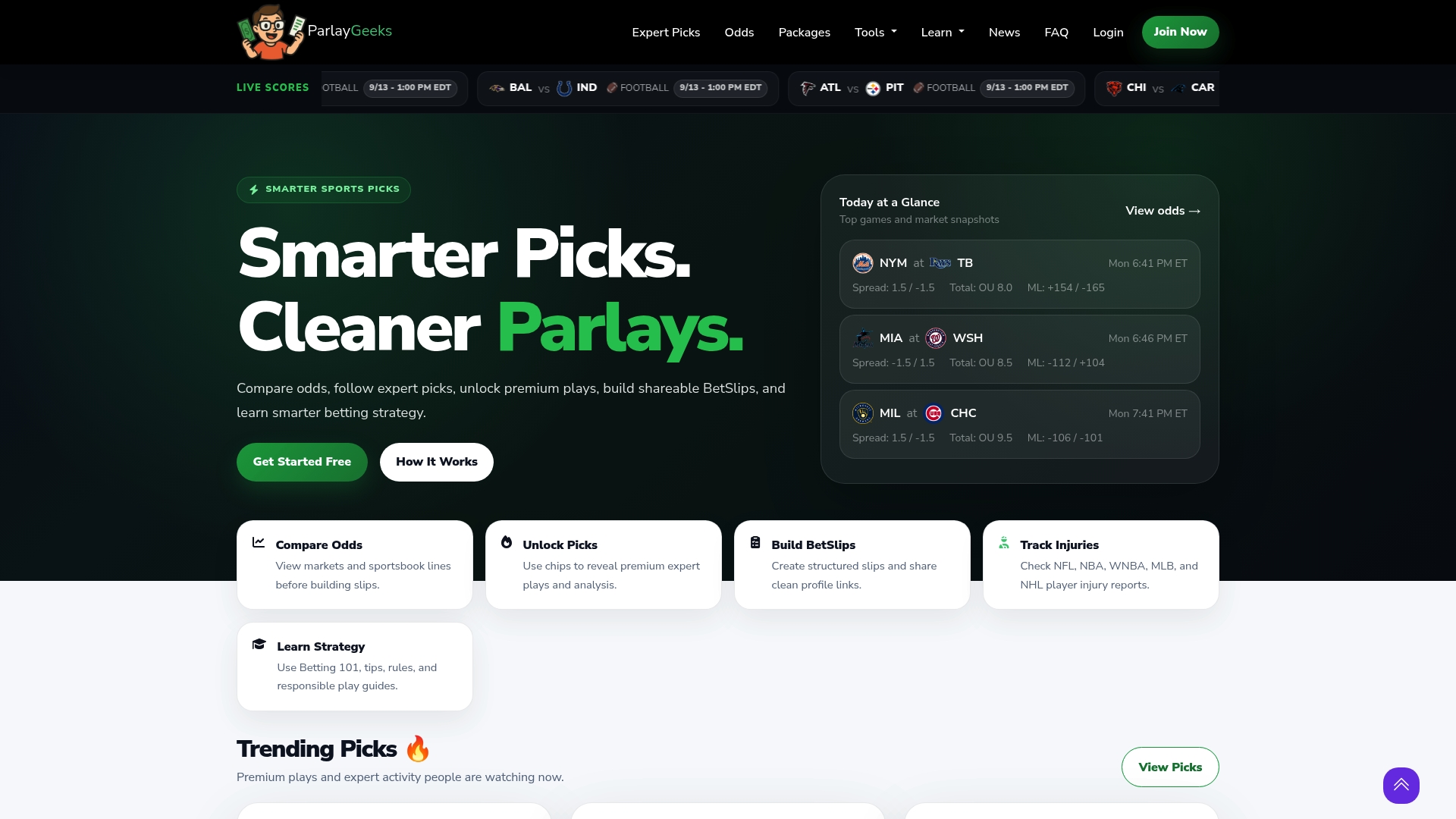
Combining access to expert picks, live injury updates before betting a lineup that’s about to change, and tools like a parlay calculator for sizing tickets can enhance your betting process. Features that enable sharing betslips facilitate note comparison with other bettors instead of betting in isolation. If you’re curious about deposit flexibility, including crypto options, background on crypto gambling legality is worth a read before you commit funds anywhere. Head to Parlaygeeks to compare live odds and build your first BetSlip before the Round of 64 tips off.