

Middling Betting for U.S. Bettors: Use NFL’s 3 and 7 to Win Both Sides

Middling means placing two opposing bets on the same game at different lines, creating a narrow window where both wagers can win. It works best when a spread or total moves enough to cross a key number or leave a real gap between your two numbers. Most attempts end with one win and one loss, costing you the standard vig, but the occasional double win is what makes the strategy worth learning.
TL;DR:
- Middling involves placing bets on opposing sides of the same game at different lines, often crossing key numbers like 3 and 7 in NFL to increase profitability.
- The strategy relies on line movement caused by pregame drift, live in-game swings, mismatches between sportsbooks, or late injury and weather news.
- Successful middling requires quick execution, monitoring multiple books, and timing the second bet once the gap covers the vig and reaches a meaningful movement threshold.
- The expected value improves significantly when the middle spans the NFL’s most common scoring margins, particularly 3 and 7 points, due to game clustering.
- Risks include the high cost of the vig, account restrictions from sportsbooks, operational delays, and the need for disciplined stake sizing to avoid large losses.
Table of Contents
- What is a middle in sports betting?
- How middles actually form during a game week
- Why key numbers make some middles better bets
- The math: stake sizing and payout scenarios
- What can go wrong when you try to middle
- Where and when middling actually pays off
- How ParlayGeeks helps you spot and act on middles
- When middling earns a place in your betting plan
- Get faster odds tracking with ParlayGeeks
- Sources
- FAQ
What is a middle in sports betting?
A middle is not arbitrage. Arbitrage locks in a guaranteed profit by betting both sides of a gap with no overlap risk. A middle accepts the chance of a small loss in exchange for a shot at winning both bets.
- Point spread example: You bet a favorite at minus 7 early in the week, then the line moves and you bet the underdog at plus 10 later. If the favorite wins by 8 or 9, both bets cash.
- Totals example: You bet the over at 44.5, then the total climbs to 47.5 and you bet the under. A final combined score of 45, 46, or 47 wins both sides. Totals typically need more movement than spreads to create a usable gap, since scoring swings tend to run larger than single-possession margins.
How middles actually form during a game week
Middles show up in four recurring situations, each with its own rhythm.
- Pregame line drift: Public money or a lineup change pushes a number several points over a few days.
- Live in-game swings: A turnover, injury, or scoring run moves the live line fast, often within seconds.
- Cross-book mismatches: One sportsbook is slow to adjust while another has already moved, leaving a gap you can bet immediately.
- Injury or weather news: A late scratch or a wind report shifts a total or spread sharply right before kickoff.
The execution sequence is the same regardless of scenario:
- Place your first bet at the best available number.
- Track the line across multiple books rather than waiting on one.
- Place the second bet once the gap is wide enough to justify the vig on a loss.
- Confirm both tickets and record the stakes before kickoff.
Live middles demand speed. A gap that exists for thirty seconds on a mobile app can close before a slower connection finishes loading the bet slip, so pregame middles are more forgiving for anyone still building the habit.
Why key numbers make some middles better bets
Football scoring produces predictable clustering around certain margins, and that clustering is the real reason middling works better in the NFL than in most other sports.
- Three-point margins: NFL games finish with an exact 3-point margin a significant portion of the time, tied to the value of a single field goal, according to empirical margin data.
- Seven-point margins: Exact 7-point finishes happen 9.0% of the time, reflecting the value of a touchdown plus extra point, per the same key-number analysis.
- A middle that spans the number 3 or the number 7 carries meaningfully better expected value than one that spans, say, 4 to 5, because more games actually land on those exact numbers.
- Practical thresholds worth targeting: roughly one to one and a half points of movement for spreads and a few points for totals, based on guidance from Sporting News.
Crossing 3 or 7 turns a mediocre middle into one worth the extra capital tied up.
The math: stake sizing and payout scenarios
Sizing bet two comes down to two approaches. Equal stakes keep the math simple and cap your downside at a fixed dollar amount. Proportional stakes, sized to make both outcomes pay similarly, protect the underdog side of the middle but require more careful calculation before you place the second bet.
- Double win: Both bets at standard $110-to-win-$100 pricing pay out $200 in profit combined.
- One win, one loss: You net a loss of roughly $10, the standard commission a sportsbook charges on a losing side.
- Push plus win: One bet is refunded, the other wins, netting roughly $100 profit with no downside from the push leg.
A conservative rule: only middle when the potential double win clearly outweighs the near-certain vig cost of the single win and loss outcome, and size both legs so a full loss on one side never threatens your working bankroll. Worked payout math like this mirrors the kind of stake calculations found in gambling math explainers such as WildSlotz’s worked example, which walks through similar staking arithmetic step by step.
What can go wrong when you try to middle
The vig is the baseline cost of every attempted middle that does not land, and it adds up fast if you chase gaps without discipline. Beyond that, several other risks deserve attention.
- Operational risk: Pushes cut into your profit scenario, capital gets tied up across two bets instead of one, and lines can lock or move against you before the second bet lands.
- Account risk: Sportsbooks track betting patterns and may limit or restrict accounts that repeatedly bet both sides of the same game.
- Behavioral risk: Treating every line move as a middle opportunity leads to overtrading and volume-driven losses rather than disciplined selection.
- Safeguards: Set deposit and time limits before you start, and know that self-exclusion tools exist at most licensed operators, consistent with industry responsible-gambling standards.
Anyone feeling out of control should call the National Problem Gambling Helpline at 1-800-GAMBLER.
Where and when middling actually pays off
Not every sport or market is worth the effort. NFL spreads built around 3 and 7 remain the strongest fit, with select college football and basketball totals offering secondary opportunities when a total crosses a common scoring number.
- Line-shopping: Monitor several sportsbooks at once rather than one, since gaps often appear because one book is slower to react than another.
- Timing windows: Pregame moves triggered by injury news or weather reports tend to open the widest, most stable gaps.
- Live betting: Offers more frequent but shorter-lived middles, requiring faster execution than pregame markets.
Execution checklist: confirm the first bet is locked, watch the gap widen across books, place the second bet once movement clears your threshold, and log both stakes immediately.
Pro Tip: Set line alerts on your primary markets so you get notified the moment a number crosses 3 or 7, rather than checking manually between games.
How ParlayGeeks helps you spot and act on middles
Finding a middle fast usually matters more than finding one at all. Real-time odds comparison tools let you see line movement across sportsbooks in one place instead of tab-hopping between apps while a gap closes. Some betting platforms offer shareable BetSlips that simplify logging both legs of a middle and tracking the combined stake. Injury updates can highlight news that often triggers the line moves that create these gaps, giving bettors a head start on pregame scenarios.

When middling earns a place in your betting plan
Middling works best as an occasional play, not a weekly habit. I treat it as a bonus opportunity reserved for real line gaps around key numbers, not a substitute for a core betting strategy built on research and disciplined bankroll rules. Allocate a small, separate portion of your bankroll to middles so a string of near-misses never threatens your main strategy.
— Big C
Get faster odds tracking with ParlayGeeks
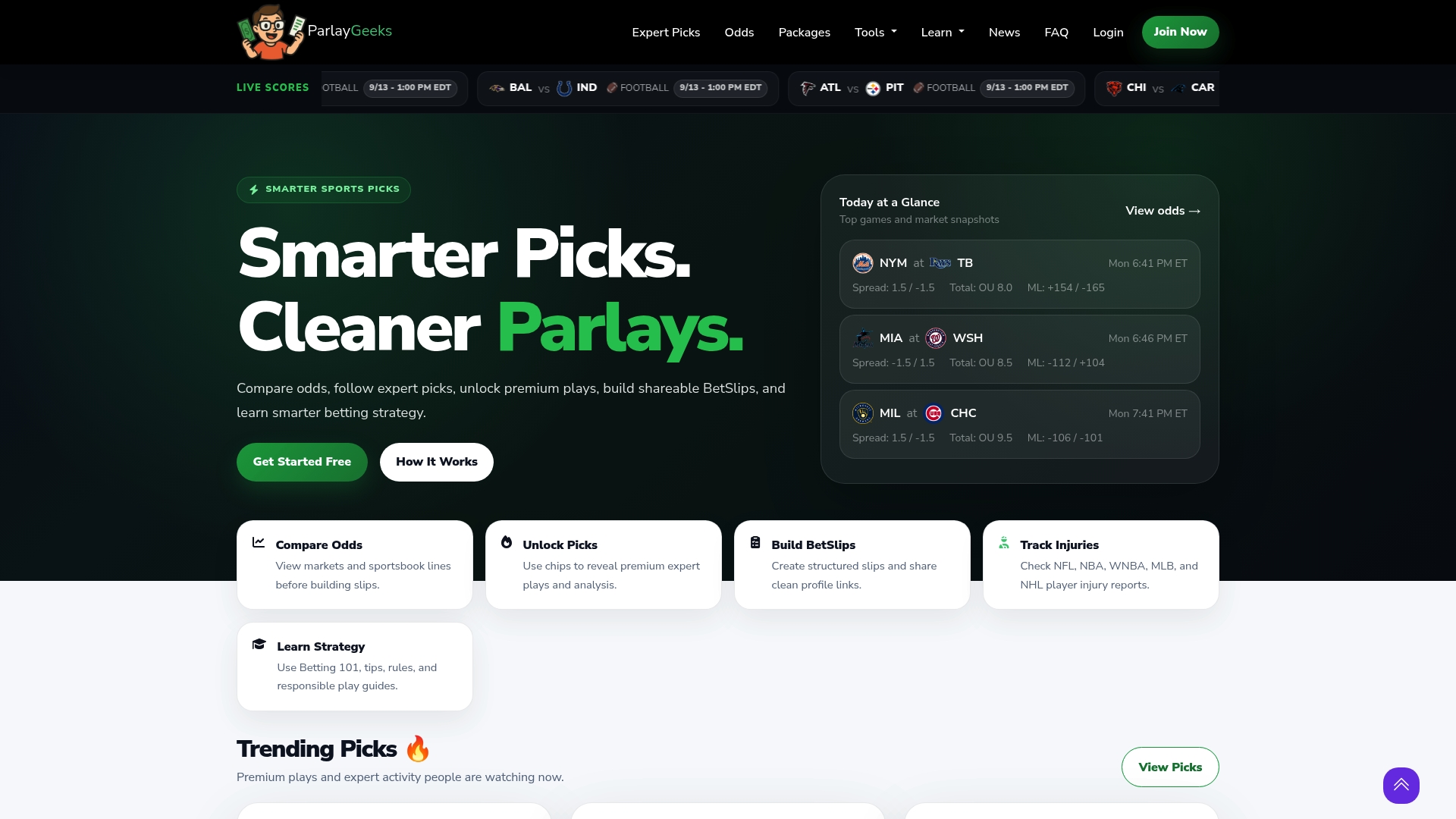
Spotting a middle before the gap closes depends on how fast you can compare lines across sportsbooks, and that is exactly what ParlayGeeks is built to do. The platform’s real-time odds comparison, shareable BetSlips, and injury updates cut the time between spotting a line move and placing your second bet.
- Real-time odds comparison across multiple sportsbooks in one screen.
- Shareable BetSlips for logging and tracking both legs of a middle.
- Injury updates that flag the news behind sudden line moves.
Casual bettors can start with the free tools at ParlayGeeks, while anyone middling regularly may find the faster picks and deeper market data in the Silver, Gold, or Platinum plans worth the cost. Check the plans page for current pricing before you commit.
Sources
- NFL middling, explained: How to profit from line movement in football betting | Sporting News
- Why 3 and 7 Are the NFL’s Key Numbers | NFL Analytics
- Responsible Play - American Gaming Association
FAQ
What is middling in sports betting?
Middling means betting both sides of the same game at different lines so that a specific final result wins both bets. It differs from arbitrage because there is no guaranteed profit, only a chance at a double win against a small, controlled loss in most other outcomes.
What are middles compared to hedges or arbitrage?
A middle creates a range where both bets can win, while a hedge simply locks in a smaller guaranteed profit or reduced loss on an existing bet. Arbitrage, by contrast, guarantees a profit regardless of outcome by exploiting a pricing gap between books, with no risk of losing both legs.
How do arbitrage bettors get caught by sportsbooks?
Sportsbooks track betting patterns and flag accounts that consistently bet both sides of the same game across different books at unusual volumes. This kind of pattern often leads to limited stakes or account restrictions, which is one of the practical risks of frequent middling or arbitrage activity described by Sporting News.
Is middling legal for bettors in the United States?
Middling itself is simply placing two separate legal wagers, so its legality depends entirely on whether sports betting is licensed in your state and whether you are using an authorized operator. Consumer protections and availability vary by state, so check your local regulatory framework before wagering.