

Win More Bets: 5 Step Moneyline vs Spread Checklist for Beginners
A moneyline bet only asks you to pick who wins. A spread bet asks you to pick who wins by how much. If the favorite is a heavy one, the spread usually gives you better pricing; if you like an underdog, the moneyline usually pays more than the spread does for the same opinion. When in doubt: bet dogs on the moneyline, bet chalk on the spread.
TL;DR:
- Betting the underdog on the moneyline offers higher payouts than spread betting, especially when the favorite’s odds exceed -200, but the underdog’s chance of winning outright remains low.
- In games where the winning margin is near key numbers like 3 or 7, half-point spreads eliminate the push risk and can significantly influence potential returns.
- Large favorites with odds above -300 risk high stakes for little reward, making spread bets more cost-effective on such lines unless you’re confident in an upset.
- Comparing live odds across multiple sportsbooks quickly reveals value opportunities created by mismatches between spread and moneyline pricing.
Table of Contents
- Moneyline Vs Spread: How the Odds Work and What You Win
- How Point Spreads Work: Lines, Pushes, and Juice
- Moneyline Vs Spread Side by Side: Mechanics, Risk, and Fit
- A Beginner’s Decision Checklist: Moneyline or Spread?
- Converting Spreads to Moneylines: The Math Behind the Line
- Bankroll Rules and Mistakes That Cost Beginners Money
- How Parlaygeeks Helps You Compare These Two Markets Fast
- Compare Odds and Build Smarter Bets With Parlaygeeks
- Where to Learn More and Get Help if Betting Becomes a Problem
- Sources
- FAQ
Moneyline Vs Spread: How the Odds Work and What You Win
The moneyline strips out margin entirely. You’re betting on one outcome: who wins the game, full stop. A three-point win and a thirty-point win pay the same. That simplicity is exactly why moneyline betting strategy tends to appeal to newer bettors comparing moneyline to spread for the first time.
American odds tell you the whole story once you know the code. A minus sign means you’re backing a favorite, and the number tells you how much you’d need to stake to win $100. A plus sign means you’re backing an underdog, and the number tells you how much a $100 bet would win. Favorites get negative odds, underdogs get positive odds, and the number attached tells you exactly what a $100 wager returns.
Here’s how that plays out with real numbers:
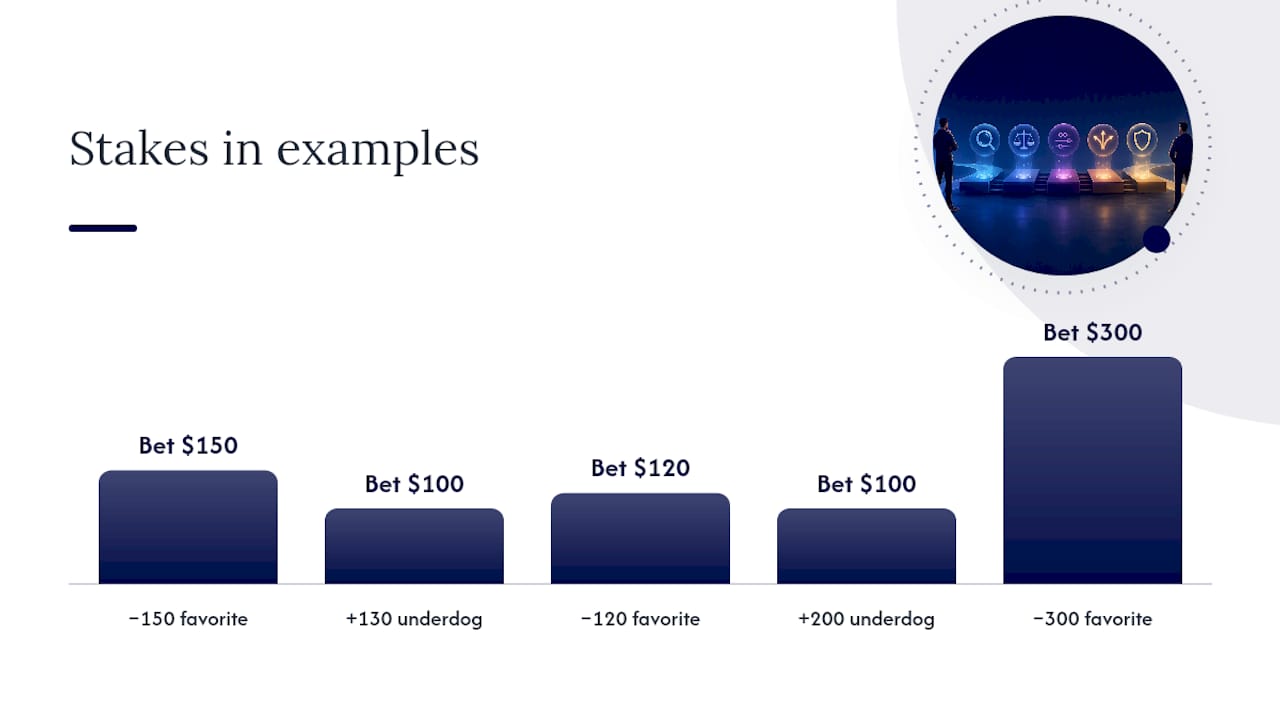
- −150 favorite: Bet $150 to win $100 (total return $250). Bet $15 to win $10.
- +130 underdog: Bet $100 to win $130 (total return $230). Bet $10 to win $13.
- −120 favorite: Bet $120 to win $100, a smaller favorite than −150 but still requiring you to risk more than you stand to win.
- +200 underdog: Bet $100 to win $200. A $20 bet returns $60 total.
Pro Tip: Scale everything to a $10 stake in your head. If you see −150, that’s “risk $15 to win $10.” If you see +200, that’s “risk $10 to win $20.” Once you can do that math instantly, every odds board on every sportsbook becomes readable.
The moneyline earns its keep in three situations. First, underdog betting, where a live dog with a puncher’s chance pays far more than laying points against them would ever return. Second, parlays, where combining moneyline legs on underdogs can produce big multipliers without needing every leg to cover a margin. Third, live betting, where win probability shifts fast and the moneyline reacts to game state more intuitively than a spread does.
The tradeoff shows up on short-priced favorites. Betting a −300 favorite to win outright means risking $300 to win $100, and one bad bounce, one missed field goal, one bullpen meltdown wipes out three times your potential profit. That’s the scenario where the spread often makes more financial sense, and it’s the pivot point for the entire moneyline vs point spread decision.
How Point Spreads Work: Lines, Pushes, and Juice
A point spread doesn’t ask who wins. It asks whether the favorite wins by more than a set margin, or whether the underdog loses by less than that margin (or wins outright). The spread exists to level two mismatched teams so both sides of the bet look close to a coin flip. Spreads handicap the favorite by a set number of points specifically to push both sides toward 50/50 odds.
Reading the line is simple once you see it laid out. A team listed at −3.5 has to win by 4 points or more for that bet to cash. The team on the other side, at +3.5, cashes if they win outright or lose by 3 or fewer. “Covering the spread” just means clearing that number, favorite or underdog.
Whole-number spreads introduce a wrinkle: the push. If a favorite is −3 and wins by exactly 3, every spread bet on that game is refunded, no winner, no loser. Sportsbooks often add a half point, turning −3 into −3.5, specifically to eliminate that outcome. Bettors call that half point “the hook,” and these half-point hooks are why sportsbooks favor them: they remove the push entirely.
Then there’s the juice, also called the vig. Spreads are typically priced at −110 on both sides, meaning you risk $110 to win $100 no matter which team you take. That −110 isn’t the sportsbook picking a side. It’s the sportsbook’s built-in fee for taking the bet at all, and it’s the same on every spread from the NFL to college basketball.
- −3.5 favorite wins by 7: Cover. Bet wins.
- −3.5 favorite wins by 3: No cover. Bet loses.
- −3 favorite wins by exactly 3: Push. Stake returned in full.
- +7 underdog loses by 3: Cover. Bet wins, even though the underdog lost the actual game.
Pro Tip: Always check for the half point before you place a spread bet. A line at −3 carries real push risk on a huge chunk of football outcomes; the same game at −3.5 removes that risk completely. If a book offers −3 and another offers −3.5 at the same price, take the −3 as the underdog side and the −3.5 as the favorite side, whichever helps you.
Moneyline Vs Spread Side by Side: Mechanics, Risk, and Fit
The core difference boils down to what you actually need to happen. A moneyline bet needs one thing: your team crosses the finish line first, regardless of margin. A spread bet needs a specific margin threshold, which means a team can win the game and still lose you the bet, or lose the game and still win you the bet.
That distinction changes your exposure to variance. Moneyline underdogs are high-variance, low-frequency winners, they don’t win often, but when they do, the payout reflects it. Spread bets on either side sit closer to a coin flip in probability terms, with the price staying near −110 regardless of who you pick, which is why spread betting advantages show up most clearly on games where the two teams are closer in talent than the moneyline suggests.
| What you need to win | Typical pricing behavior | Risk and variance | Best use case | How payout is calculated | |
|---|---|---|---|---|---|
| Moneyline | Outright winner, any margin | Favorites carry steep negative odds; underdogs carry appealing positive odds | High variance on underdogs; low variance but poor risk/reward on heavy favorites | Underdog plays, live betting, parlays | Stake divided by odds ratio (e.g., risk $150 to win $100 at −150) |
| Spread | Winner against the margin (the “cover”) | Stays close to −110 on both sides regardless of favorite/underdog | Moderate, steadier variance; push risk on whole-number lines | Heavy favorites, games near key numbers (3, 7 in football) | Standard −110 juice: risk $110 to win $100 on either side |
A few sports lean naturally toward one market over the other. Baseball runs almost entirely on the moneyline, since the run line (baseball’s version of a spread) rarely moves off 1.5 runs and often distorts value on lopsided pitching matchups. Football and basketball lean spread-heavy, since scoring margins are wide enough that the spread genuinely separates good bets from bad ones, and NFL games in particular cluster around key numbers like 3 and 7 because those are the most common margins of victory.
A quick way to spot value between the two markets:
- Convert the spread to an implied moneyline in your head, then check if the sportsbook’s actual moneyline is more generous.
- If a favorite is −7 on the spread but only −250 on the moneyline, that’s often a mismatch worth investigating.
- Watch for public-heavy games, where lopsided betting volume pushes spreads and moneylines further apart than the true probability supports, creating openings for the disciplined bettor.
- Never assume the two markets are priced in perfect agreement. They usually aren’t, and that gap is where value lives.
A Beginner’s Decision Checklist: Moneyline or Spread?
Staring at a game with both numbers in front of you doesn’t have to be complicated. Run through this in the order listed, and you’ll land on the right market almost every time.
- Are you betting the underdog? If yes, lean moneyline. You get paid more for the same opinion, and you don’t need to worry about margin at all.
- Is the favorite’s moneyline shorter than −200? If a favorite is that expensive, ask whether the spread gets you the same side at a fairer price near −110 instead of laying $200 or more to win $100.
- Is the spread sitting on a key number? In football, spreads at 3 or 7 deserve extra scrutiny since those margins occur more often than any other final-score gap. A half-point on either side of 3 or 7 can matter more than it looks.
- Have you checked more than one sportsbook? Line shopping across books, even a small sample, routinely turns up better numbers on the same game. A −3 at one book and a −2.5 at another isn’t rare, and that half point adds up over a season.
- Does the game total change anything? In a low-scoring matchup, every point on the spread carries more weight, since tight totals make each individual point more decisive to the outcome, which can flip your preference toward the spread even on a moderate favorite.
Pro Tip: Bookmark two or three sportsbooks and get in the habit of checking all of them before you bet anything. The five extra minutes it takes to compare lines will save you more money over a season than any single “sharp” pick ever will.
The general heuristic holds up across sports: pick the moneyline for underdogs and close spreads, and pick the spread when you want to avoid overpaying for a heavy favorite. It’s not a perfect rule, but it’s the right default when you’re staring at a line with thirty seconds to decide.
Converting Spreads to Moneylines: The Math Behind the Line
Every point spread has a rough moneyline equivalent hiding inside it. Sportsbooks don’t publish this conversion directly, but you can estimate it, and knowing the pattern helps you catch a mispriced line before you bet it.
These conversions are approximations, not fixed formulas, and they shift depending on the sport, the total, and how the market is betting. A −7 favorite in a high-scoring shootout converts differently than a −7 favorite in a defensive slugfest, since scoring volatility changes how often that specific margin actually happens.
Walking through the math on a real slate makes the pattern click. Say a football favorite sits at −7 on the spread at standard −110 juice, and the same team is −290 on the moneyline.
Spread bet, $50 stake: Risk $50 to win $45.45 (standard −110 payout math: stake ÷ 1.10). If the favorite wins by 8 or more, you collect $95.45 total. Win by exactly 7, you push and get your $50 back. Win by 6 or fewer, or lose outright, you lose the $50.
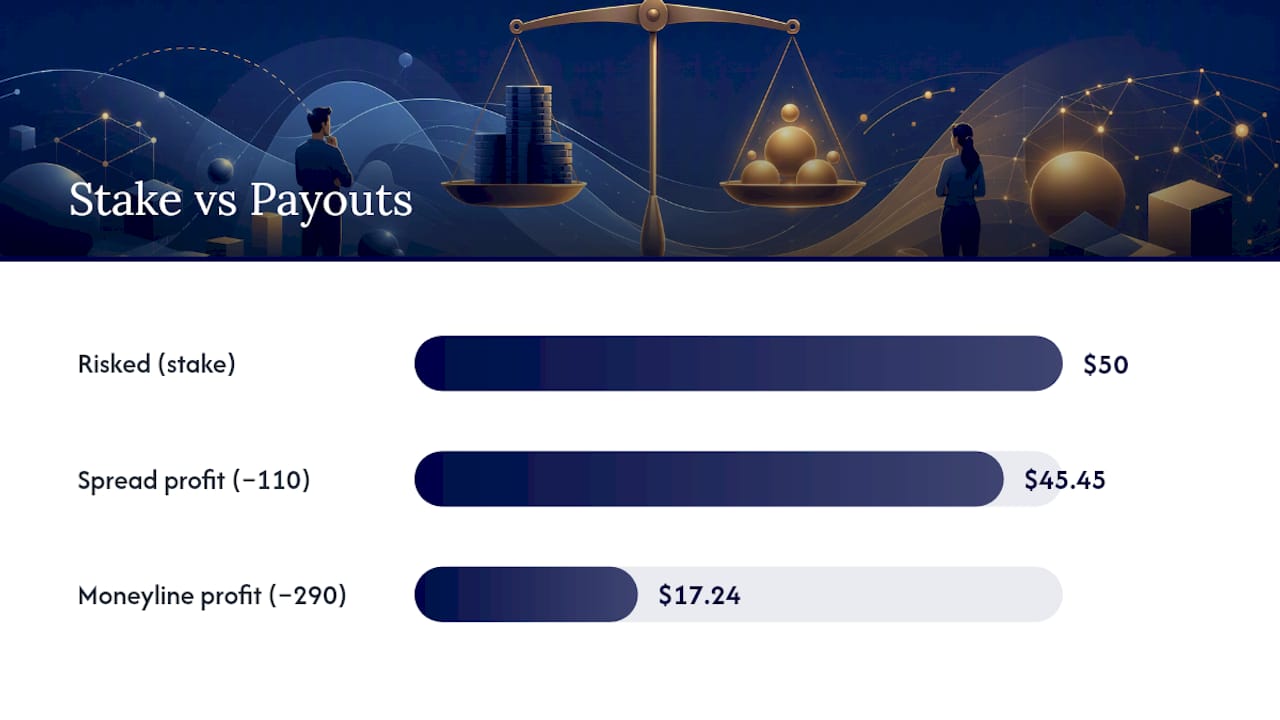
Moneyline bet, $50 stake: At −290, you’d need to risk $145 to win $50, so a straight $50 stake only returns $17.24 in profit ($67.24 total) if the favorite wins by any margin at all, including a single point.
That gap is the entire moneyline vs spread decision in miniature. The spread bettor needs a 7-plus point win but gets nearly double the payout rate. The moneyline bettor needs almost nothing, just a win, but gets paid far less for it. Neither choice is universally correct; it depends on how confident you are in the size of the win versus just the win itself.
- Home-field edge typically shaves half a point to a point and a half off a true spread number, which matters most on lines sitting right at 3 or 7.
- A rising game total (more expected points) tends to widen the gap between spread and moneyline pricing, since larger winning margins become statistically more plausible.
- A falling total tends to tighten that gap, pushing spread and moneyline value closer together.
Bankroll Rules and Mistakes That Cost Beginners Money
Stake size matters more on the moneyline than most beginners realize. A heavy favorite’s moneyline offers a small return for a large risk, so oversizing that bet turns one bad beat into a multi-bet loss. A common rule is capping any single wager at 1 to 3 percent of your total bankroll, and shrinking that further on short-priced favorites where the downside dwarfs the upside.
The most common beginner mistakes all trace back to the same root cause: skipping steps that feel optional but aren’t.
- Chasing losses by doubling up after a bad beat, which turns one mistake into two.
- Ignoring the juice on spread bets and assuming −110 is negligible; over a full season, that vig adds up to a real dent in your bottom line.
- Betting only one sportsbook instead of line shopping, leaving free value on the table every single week.
- Misreading which side covers, especially on underdog spreads where “losing by less” still means winning the bet.
- Ignoring the gap between spread-implied odds and posted moneylines, which is often where the sharpest value hides.
Pro Tip: When a spread and its converted moneyline disagree by a wide margin, look for a middle. Betting the underdog on the spread and the favorite on the moneyline (or vice versa, depending on the numbers) can let you win both bets if the final score lands in the gap between them.
— Elaine
How Parlaygeeks Helps You Compare These Two Markets Fast
Spotting the gap between a spread and its implied moneyline is easier with real-time numbers in front of you instead of mental math on the fly. The platform pulls live odds across multiple sportsbooks into one view, so you can see the moneyline and spread on the same game side by side before you decide which market fits.
The BetSlip builder lets you lock in a comparison and share it, and the parlay calculator handles the payout math automatically once you’ve settled on your legs. Expert picks and injury updates round out the picture when a late scratch or a weather shift changes which market makes more sense. None of it replaces your own judgment; it just gives you better information to apply it with.
Compare Odds and Build Smarter Bets With Parlaygeeks
Parlaygeeks turns the guesswork of checking five different sportsbook apps into one screen. Instead of toggling between tabs to see whether a favorite’s moneyline is out of line with its spread, you get the comparison already sitting in front of you, alongside expert picks, injury updates, and a free parlay calculator that does the payout math for you.

Shareable BetSlips also make it easy to show a friend exactly why you like a particular angle, spread or moneyline, without screenshotting three different apps and losing track of the numbers. If you’ve read this far and want to see how your next game’s lines actually stack up against each other, compare live odds on Parlaygeeks and build your first BetSlip before kickoff.
Where to Learn More and Get Help if Betting Becomes a Problem
For deeper reading on odds mechanics, Sporting News breaks down moneyline basics and Covers covers point spread fundamentals in more depth. If betting stops feeling fun, the National Problem Gambling Helpline offers confidential support, and state-level sites like Maryland’s gambling help resource provide region-specific referrals.
Sources
- Moneyline betting, explained: Complete guide to how to read odds and bet favorites vs. underdogs | Sporting News
- Moneyline vs. Spread: How to Know Which Bet Offers More Value - Bettorsworld
- About the National Problem Gambling Helpline | NCPG
FAQ
What’s better, moneyline or spread?
Neither is universally better. Moneyline usually wins for underdogs and close matchups; spread usually wins when a favorite is heavily favored and you want fairer pricing near −110.
What does a +200 moneyline mean?
A +200 underdog pays $200 profit on a $100 bet, or $20 profit on a $10 bet, if that team wins the game outright.
What does a +7 spread mean?
A +7 underdog covers if they win outright or lose by 6 points or fewer; losing by exactly 7 is a push if there’s no half point attached.
What is the difference between moneyline, spread, and total?
Moneyline bets the winner, spread bets the margin of victory, and totals bet the combined score of both teams against a set number, three separate markets on the same game.