
3 NBA Line Movement Patterns and Tracker Signals Bettors Need
NBA line movement is the change between an opening betting line and the current number, and the rule is simple: use that movement to confirm your own analysis, not to chase it. A spread that opens at 4.5 and drifts to 6 by tip-off, or a total that gets hammered from 224 to 219 within an hour, is data. Some platforms display that opening line, the current line, and timestamps side by side precisely so you can check your read against the market instead of reacting to it blind.
TL;DR:
- Steam moves within 15 to 30 minutes across multiple sportsbooks typically indicate informed, sharp betting actions.
- Lines shifted due to public volume grow gradually over 48 hours, while news-driven moves happen swiftly within seconds of an injury or lineup change.
- Small point or odds shifts on high-liquidity markets reflect more accurate information, whereas low-liquidity markets are prone to exaggerated reactions.
- Confirmed last-hour moves based on injuries or lineups provide more reliable signals than early or inconsistent market fluctuations.
- Tracking line movement with timestamps, open-to-current ranges, and cross-checking injury reports enhances decision accuracy and long-term betting edge.
Table of Contents
- How to Read Common Movement Patterns
- Why Lines Move: Bookmakers, Public Money, and News
- How Movement Shows Up Across Spread, Totals, and Moneyline
- When Line Movement Is Actually Worth Acting On
- A Simple Workflow: Record, Cross-Check, Confirm
- What to Look for in a Live Line-Movement Tracker
- How Parlaygeeks Puts This Into Practice
- How Line Movement Changes Your Payout
- Why Market Liquidity Drives How Far Lines Move
- Confirm, Don’t Chase
- Where to Watch Line Movement Yourself
- Sources
How to Read Common Movement Patterns
Three patterns show up constantly on NBA boards, and each tells a different story.
Steam moves happen when several sportsbooks shift the same number within minutes of each other, usually because a coordinated group of sharp bettors hit multiple shops at once. Reverse line movement is the line moving opposite to where the public money is flowing. If 70% of bets are on the home team but the line drops in favor of the road team, that’s a signal that sharp money is countering the crowd. Drift is the slower, boring version: gradual movement over hours or days with no single trigger, usually just accumulated public betting or roster clarity settling in.
Distinguishing these matters more than spotting movement itself. A study of handicap line behavior notes that coordinated moves across books almost always point to informed money, while isolated shifts at one shop are often just that book managing its own liability.
- Steam: fast, cross-book, often within a 15 to 30 minute window
- Reverse: line moves against the betting percentage majority
- Drift: slow, single-book or gradual, tied to volume rather than information
Pro Tip: Check the timestamp on any move before you react. A shift that started six hours before tip-off carries more weight than one that popped 90 seconds after you refreshed the page, because early movement has already survived scrutiny from other sharp bettors.
Why Lines Move: Bookmakers, Public Money, and News
Sportsbooks don’t set lines to predict the final score. They set them to balance action on both sides of a bet so their liability stays manageable regardless of outcome. When one side gets overloaded with bets, the book adjusts the number to make the other side more attractive.
That adjustment can come from three different sources, and telling them apart is the whole game:
- Public volume: a popular team draws heavy recreational betting, pushing the number even without any new information
- Sharp or informed money: professional bettors place fewer, larger wagers that carry more weight per dollar, often moving lines even against the public tide
- News-driven shifts: an injury report, a lineup change, or a late scratch can move a total or spread within seconds of the announcement
Timing separates these. A move that appears the moment a star player is ruled out is information-driven and worth acting on quickly. A move that creeps over 48 hours with no news attached is almost certainly volume.
How Movement Shows Up Across Spread, Totals, and Moneyline
A half-point move on a spread and a half-point move on a total aren’t equivalent, and neither compares directly to a moneyline shift. Spreads and totals move in fixed increments, typically half points or full points, so a jump from 6 to 7.5 is a much bigger signal than 6 to 6.5. Moneyline movement works differently: it shifts in odds format, and converting those odds into implied probability is the only fair way to compare a moneyline swing to a point-based move.
This is where the “range” display matters. Good trackers show open, current, and range together rather than just the live number, so you can see how far a line has traveled, not just where it landed.
- A total opening at 222 and hitting a range of 217 to 224 before settling at 219 tells you far more than the 219 alone
- A moneyline moving from minus 150 to minus 180 reflects roughly a 5 to 6 percentage point shift in implied win probability, even though the spread might barely have budged
When Line Movement Is Actually Worth Acting On
Not every shift deserves your attention. Timing and consistency decide which ones do.
- Early week movement (48 plus hours out) usually reflects public positioning and is the least urgent to react to.
- Mid week movement often carries injury or lineup information and deserves a quick cross check against the injury report.
- Last hour movement is the highest stakes window. Confirmed scratches, load management news, and closing sharp action concentrate here, and books tighten their numbers fast.
Watch for red flags that suggest a move is noise rather than signal: a line wobbling by a quarter point with no clear direction, a tracker showing inconsistent numbers across only two or three books, or a board with no visible timestamp. Any of those should lower your confidence in the move, not raise it.
A Simple Workflow: Record, Cross-Check, Confirm
Treat line movement like a checklist, not a gut reaction.
- Capture the opening line the moment it posts.
- Log the number again 24 hours later, then once more about two hours before tip-off.
- Note the exact moment movement begins. That timestamp usually tells you whether it’s news or volume.
- Cross-check the direction against public betting percentages and the day’s injury report before adjusting your position.
Set a rule for yourself before the season starts: require at least two corroborating signals (say, reverse movement plus a confirmed injury) before you change a stake. Log every result. Over a full season, that log lets you calculate your closing line value, which is simply whether the number you bet was better than the number available at tip-off.
Pro Tip: Track closing line value separately from win or loss record. A bettor who consistently beats the closing number is making sharp decisions even in a losing week, because CLV is the strongest predictor of long-term edge in a market this liquid.
What to Look for in a Live Line-Movement Tracker
A tracker is only as good as its transparency. Prioritize boards that show a timestamp on every update, the number of sportsbooks feeding the data, and a full open to current to range history rather than just a single live number. Alerts for large moves and mobile updates matter too, since the biggest swings often happen fast and away from your desk.
Update frequency and book coverage directly affect signal quality. A board pulling from a dozen sportsbooks and refreshing every few minutes gives you a far more reliable read than one syncing hourly from three books, since wider coverage filters out one-off liability adjustments that don’t reflect the broader market.
A fast slate scan looks like this: pull up the day’s board, sort by biggest pregame move, verify the shift shows up across multiple books rather than one outlier, then check that book’s injury feed and public betting split before deciding whether to act.

How Parlaygeeks Puts This Into Practice
Some sports betting platforms build their odds comparison around this framework: real-time lines pulled across multiple sportsbooks, timestamped so you always know how fresh a number is, and structured to show where a line opened against where it sits now. Shareable BetSlips let you log a position the moment you place it, which solves the record-keeping step most bettors skip entirely.
Some platforms also surface expert picks and live injury updates in the same feed as the odds themselves, so you’re not toggling between five browser tabs to cross-check a reverse-movement signal against a scratch report. That pairing, odds plus context in one place, is the practical version of the workflow outlined above.
How Line Movement Changes Your Payout
A moving line doesn’t just shift the number on the screen. It changes what you actually collect if you win, and it changes whether your bet even qualifies for the outcome you thought you were betting.
Spread bets settle against the number you locked in, not the closing number. Bet a team at plus 6.5 on Tuesday and the line drifts to plus 4 by tip-off, you still get the extra 2.5 points of cushion, even though everyone betting Thursday doesn’t. That gap is the entire concept of closing line value, and it’s why timing a bet against a live line matters more than most casual bettors realize.
Moneyline movement hits your payout even more directly. A team at minus 150 pays out $100 on a $150 bet. If sharp money pushes that same team to minus 180 before you bet, your same $150 now only returns about $83. The team didn’t get better in an hour. The market’s confidence in that team did, and your payout on the same wager shrinks accordingly.
Totals work the same way in reverse. Betting the over at 224 versus 219 changes how far the combined score has to travel to cash your ticket, even though the odds attached to each number (usually close to even money) look similar on the surface. The number you get locked in on is doing as much work as the pick itself.
Why Market Liquidity Drives How Far Lines Move
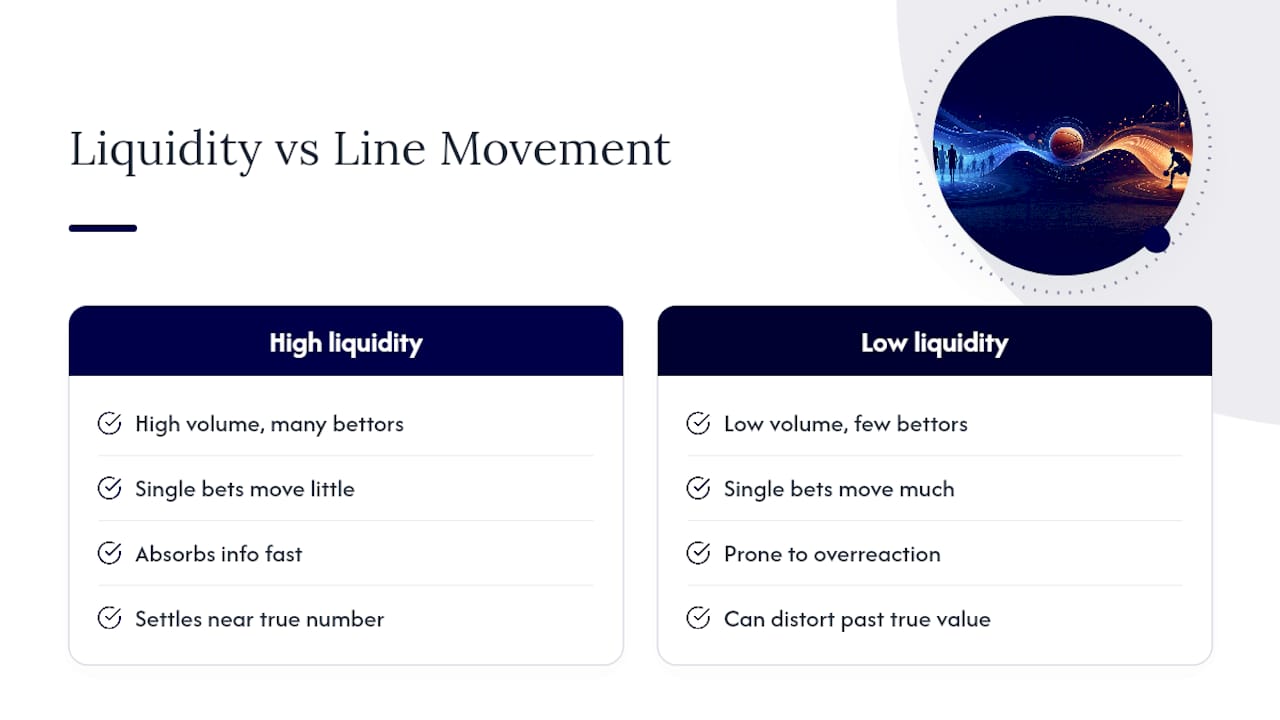
Liquidity, meaning how much money is flowing through a given market, determines how easily a line moves and how far a single bet can push it. A marquee Lakers versus Celtics game on a Saturday night attracts heavy volume from casual and sharp bettors alike, which means it takes real money to move the number even a half point. A Tuesday night game between two non-contending teams sees a fraction of that volume, so a single well-placed sharp bet can shift the line noticeably.
This is why the same size wager produces wildly different effects depending on the game. High-liquidity markets are more efficient. They absorb information faster and settle closer to a “true” number because more bettors with more perspectives are pushing against each other. Low-liquidity markets are more prone to overreaction, where one sharp bettor or one heavy public lean can distort the line further than the actual information justifies.
That’s also why steam moves on a nationally televised game carry more weight than the same-looking move on an obscure afternoon slate. The former required real capital from multiple sources to shift a deep market. The latter might just be one account moving a thin one. Reading liquidity alongside the movement itself is what separates a bettor who understands the number from one who’s just watching it change.
Confirm, Don’t Chase
The biggest mistake I see in how bettors talk about line movement is treating it as a tip sheet instead of a cross-check. Movement is useful precisely because it’s independent of your opinion. If you like a team before the line moves and the market agrees afterward, that’s real confirmation. If you only like a team because the line moved, you’re borrowing conviction you didn’t earn.
Start small. Log five games this week, note when movement began, and compare it to your own picks before betting. Track your closing line value over a month, not a single slate, and let the pattern tell you whether you’re reading the market well or just reacting to it.
— Fogell
Where to Watch Line Movement Yourself
A handful of resources cover the mechanics above in more depth if you want to keep learning past this guide.
- ESPN’s NBA odds page for live open, spread, total, and moneyline snapshots across the slate
- The Basketball Review’s handicap movement guide for a deeper explainer on steam and reverse movement
- A live sportsbook line movement tracker for ranked pregame moves across multiple books
- Should I Take the Over’s totals tracker for open to current to range history on every game
- BetMzansi’s betting glossary if you need quick definitions for terms like vig or implied probability
Use these to monitor the market, not as a substitute for your own read on the game, and keep responsible gambling resources in mind since no market signal is a guarantee.