
4 Picks, 6 Parlays: Round Robin Parlay Calculator and Checklist
A round robin parlay takes a group of picks and splits them into every smaller parlay combination possible, so you can still cash even if one leg loses. You need at least three selections to build one, and the tradeoff is straightforward: you buy insurance against a single bad leg, but you pay for it with a higher total cost and a lower ceiling than one big parlay would pay if everything hit.
TL;DR:
- Round robin parlays reduce risk by splitting bets into smaller combinations, offering partial payouts when only some legs win, but require higher total stakes.
- The total cost depends on the number of selections, combination size, odds, and stake per parlay, making it essential to calculate before placing the bet.
- Round robins are most useful when you trust most but not all legs, especially with 3 to 5 selections, to balance protection and potential payout.
- Most sportsbooks allow round robin placement with options to select combination sizes and check total wager and payout ranges before confirming.
- Using calculators or tools helps plan and test your round robin bets, ensuring stakes align with your bankroll and risk tolerance.
Table of Contents
- What Is a Round Robin Parlay and How Does It Work?
- Round Robin Parlay Examples: Worked Payout Math
- How Do You Calculate Round Robin Cost and Payout?
- When Should You Use a Round Robin Instead of a Straight Parlay?
- How Do You Place a Round Robin Bet on a Sportsbook App?
- What Tools Help You Plan a Round Robin Parlay?
- Round Robin vs. Parlay, Teasers, and System Bets: What’s the Difference?
- Are Round Robin Parlays Legal Where You Bet?
- Is a Round Robin Parlay Worth the Extra Cost?
- Build and Test Your Round Robin Before You Bet It
- Sources
What Is a Round Robin Parlay and How Does It Work?
A round robin takes your picks and automatically wagers every possible smaller parlay from that group, instead of forcing all of them into one all-or-nothing bet. Pick four teams and choose “by 2s,” and the sportsbook builds six separate two-team parlays behind the scenes, each with its own stake and its own payout.
The math behind the labels is simple combinatorics, not guesswork:
- 3 picks, by 2s: 3 possible two-team parlays
- 4 picks, by 2s: 6 possible two-team parlays
- 4 picks, by 3s: 4 possible three-team parlays
- 5 picks, by 2s: 10 possible two-team parlays
- 5 picks, “all combinations”: every by-2, by-3, and by-4 parlay bundled into one bet slip
That last option, sometimes just called “round robin,” fires every combination size at once, which multiplies your total stake fast. Most sportsbooks also block you from pairing two selections from the same game inside a round robin, a restriction FanDuel applies to prevent correlated same-game outcomes from inflating payouts artificially. Check your bet slip’s total wager count before confirming. It’s the fastest way to confirm the sportsbook built what you actually intended.
Round Robin Parlay Examples: Worked Payout Math
Numbers make this click faster than definitions do. Say you pick three teams at plus-150 odds each (2.50 in decimal) and go “by 2s” with a $10 stake per parlay.
- Team A + Team B: $10 × 2.50 × 2.50 = $62.50 payout
- Team A + Team C: $10 × 2.50 × 2.50 = $62.50 payout
- Team B + Team C: $10 × 2.50 × 2.50 = $62.50 payout
Total cost: $30 (three parlays at $10 each). If Team C loses but A and B both win, only parlay #1 cashes, and you get $62.50 back on a $30 outlay, a $32.50 profit despite missing a leg entirely.
Quick stat check: A 4-team round robin by 2s creates six mini-parlays. At $10 each, that’s a $60 total stake, versus $10 for one straight four-leg parlay covering the same picks.
Now stretch it to four teams, same odds, “by 2s,” six parlays at $10 each ($60 total). If three of the four teams win and one loses, three of the six two-team combinations survive, since each surviving pair excludes the loser. Those three winners each pay $62.50, for $187.50 back on a $60 stake, a $127.50 profit. Compare that to a single straight four-team parlay at $10: it would have paid roughly $244 if all four hit, but that one loss wipes it out completely, leaving you with $0. The round robin traded a chunk of that ceiling for a payout that survives a miss, which FanDuel’s breakdown of round robin math shows is the entire point of the structure.
How Do You Calculate Round Robin Cost and Payout?
The cost formula never changes: stake per parlay × number of parlays = total cost. Five picks by 2s means 10 parlays, so a $5 stake per parlay runs you $50 total, not $5.
For payout math on any single mini-parlay, multiply the decimal odds of each leg together, then multiply by your stake. Two legs at 2.00 and 1.91 decimal odds with a $10 stake pay $10 × 2.00 × 1.91 = $38.20 if both win.
Before you place anything, run the break-even math. If you’re spending $60 across six two-team combos, you need enough of those combos to cash and clear $60 in returns just to break even, which usually means at least two or three of the six need to hit depending on your odds. TopendSports notes that total cost is the single most important number to check before confirming a round robin, since it’s easy to focus on potential payout and lose track of what you’re actually risking.
- Number of selections
- Combination size (by 2s, by 3s, etc.)
- Odds for each leg
- Stake per individual parlay
Pro Tip: Run your picks through a calculator before you touch the bet slip. Seeing the total cost in dollars, not just “10 parlays,” changes how people size their stakes.
When Should You Use a Round Robin Instead of a Straight Parlay?
Round robins work best with 3 to 5 selections you genuinely like, but don’t fully trust as a unit. If you’re confident in every leg, a straight parlay pays more when it hits and costs less to place. The round robin earns its keep when one leg feels shakier than the rest and you want a structure that survives that leg losing.
Bankroll discipline matters more here than with a single bet, since the combination count multiplies your exposure fast. A reasonable approach: decide your total risk first, then divide by the number of combinations to set your per-parlay stake, rather than picking a stake and discovering the total afterward.
Common mistakes to avoid:
- Adding too many selections, since 6 picks by 2s already creates 15 parlays
- Ignoring total cost while focused on the advertised max payout
- Sizing stakes per parlay too aggressively relative to bankroll
- Using a round robin when you actually trust every leg (a straight parlay is cheaper and pays more)
If you’re not sure your bankroll can absorb the full combination count, stick to single bets or a smaller parlay instead.
How Do You Place a Round Robin Bet on a Sportsbook App?
The sequence is nearly identical across major sportsbooks, and DraftKings’s own help documentation lays out the standard flow clearly.
- Add three or more selections to your bet slip.
- Select the “Round Robin” bet type option.
- Choose your combination size (by 2s, by 3s, or all combinations).
- Enter your stake per individual parlay, not a total amount.
- Review the total number of parlays and total cost the app calculates.
- Confirm potential payout ranges, then place the bet.
Before you tap confirm, double-check that none of your selections come from the same game, since most books reject or flag those pairings automatically. Also glance at whether cash-out is available on the individual mini-parlays. It’s not universal, and it can matter if one combination is running hot mid-slate.
What Tools Help You Plan a Round Robin Parlay?
Building a round robin by hand works fine for three picks. It gets error-prone fast once you’re past five. ParlayGeeks’ free parlay calculator handles the combination count and total cost automatically, so you enter your picks, choose by 2s or by 3s, and see exact stake and payout numbers before you touch a real bet slip.
- Enter selections and odds to see every mini-parlay’s individual payout
- Compare total round robin cost against a straight parlay covering the same picks
- Build a shareable BetSlip so others can review your combination before you place it
- Browse ParlayGeeks’ educational library on bankroll management and parlay structure
Shareable BetSlips are particularly useful here since a second set of eyes catches same-game conflicts or oversized combination counts before money is on the line. Testing scenarios with a calculator before staking real money is a habit worth building regardless of which tool you use.
Round Robin vs. Parlay, Teasers, and System Bets: What’s the Difference?
A straight parlay is the simplest comparison point: every leg must win, the payout is highest, and one loss kills the entire bet. A round robin softens that risk by splitting the same picks into smaller combinations, but that variance reduction comes at the cost of a lower maximum payout if everything wins, since you’re spreading your stake across multiple parlays instead of concentrating it in one.

Teasers move the point spread or total in your favor on each leg, in exchange for reduced payout odds. They’re built for confidence in direction, not for hedging against one leg failing. Where a round robin protects you from a single wrong pick, a teaser makes each individual pick easier to hit in the first place. Different problem, different tool.
System bets, common on European and Asian-facing books, are the broader family round robins belong to. “Trixie” and “Yankee” bets are essentially named round robin structures with fixed selection counts (three and four picks respectively) covering all combinations. If you’ve heard those terms, you’re looking at a round robin with a different name and a fixed shape.
The practical takeaway: pick a straight parlay when you trust every leg, a round robin when you trust most of them, and a teaser when you want easier lines rather than partial-win protection. Bettors experimenting with structured wagering across different markets sometimes explore other structured game formats too, like the table games available through Cardano Casino, where similar combination logic shows up in bet spreads and side wagers.
Are Round Robin Parlays Legal Where You Bet?
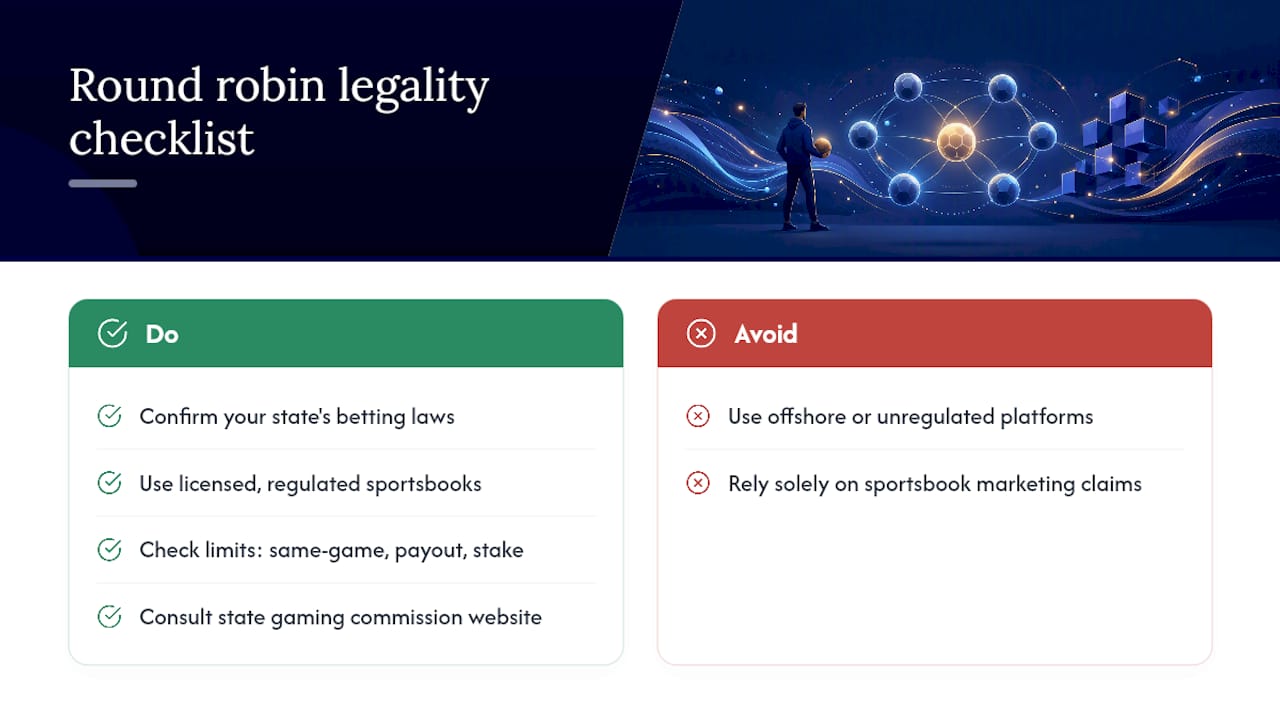
Round robin parlays are legal anywhere sports betting itself is legal and regulated, since they’re simply a structured combination of standard bets rather than a distinct wagering category requiring separate approval. In the United States, that means legality tracks state by state. If your state has legalized and regulated online or retail sports betting, licensed operators there offer round robins as a standard bet slip option.
The restrictions that matter more in practice are sportsbook-level rules, not government ones. Same-game restrictions on round robin combinations, maximum payout caps on individual sportsbooks, and minimum/maximum stake limits per parlay all vary by operator and by state licensing terms. A book operating in New Jersey might structure its round robin options slightly differently than the same company’s product in Michigan, based on that state’s specific regulatory requirements.
If you’re betting through an offshore or unregulated platform, the legal protections that apply to licensed, regulated books (dispute resolution, verified payout guarantees, responsible gambling tools) may not apply at all. Sticking to sportsbooks licensed in your state is less about the round robin bet type itself and more about ensuring you have recourse if something goes wrong with any bet you place. When in doubt about your jurisdiction’s specific rules, your state’s gaming commission website is the authoritative source, not a sportsbook’s marketing page.
Is a Round Robin Parlay Worth the Extra Cost?
The real tradeoff isn’t complicated: you’re buying a cushion against one wrong pick, and that cushion costs real money in stake multiplication. Most bettors overestimate how much protection they’re actually buying and underestimate the total dollars leaving their account. Run the numbers before you fall in love with the concept.
A quick checklist before you place one:
- Does your total stake across all combinations match what you’re actually willing to risk?
- Have you checked the total cost number, not just the potential max payout?
- Are all your selections picks you’d make individually, not just ones you’re hoping pan out?
- Do you have a stop-loss in mind if the slate goes badly?
— Thelma
Build and Test Your Round Robin Before You Bet It
Guessing at combination counts on a bet slip is how bettors end up staking more than they meant to. ParlayGeeks’ free calculator does the combination math for you: enter your picks, pick “by 2s” or “by 3s,” and it shows exact stake totals and payout ranges before you commit real money.

Odds comparison across sportsbooks means you’re not locked into whatever number one app happens to show, and the shareable BetSlip builder lets you send your round robin to a friend for a sanity check before it’s live. Pair that with ParlayGeeks’ expert picks and injury updates if you want a second opinion on the legs themselves, not just the structure around them. Head to ParlayGeeks to build your first round robin and see the real numbers before you touch a sportsbook’s bet slip.
Sources
FanDuel explains round robin mechanics and same-game restrictions. Sporting News covers minimum picks and combination sizing. Fox Sports breaks down the variance tradeoff. TopendSports details the cost formula.