
12 Essential Sports Betting Terms: Quick Start Glossary for Beginners
This sports betting glossary covers every term you need to place your first bet with confidence, but if you only remember one thing, remember this: odds are a price, and every price implies a probability. Learn to read that relationship and the rest of the vocabulary, from moneylines to closing line value, falls into place fast. Start with the quick-start essentials below, then use the full A-Z reference whenever a term trips you up.
TL;DR:
- The implied probability of an outcome is calculated by converting odds, with negative odds indicating how much you risk and positive odds showing potential profit.
- The closing line provides the most accurate market price, and consistently beating it signals genuine value rather than luck.
- Betting limits vary by sport and bettor history, with larger or sharper bets often facing tighter caps at most sportsbooks.
- Focusing on core concepts like odds, implied probability, and line movement allows for better line shopping and value identification across bookmakers.
- Managing your bankroll with fixed unit sizes and utilizing safety features like deposit limits is essential to prevent gambling from becoming problematic.
Table of Contents
- What Are the Most Important Sports Betting Terms for Beginners?
- Full A-Z Glossary of Sports Betting Terms
- How Do Odds and Payouts Actually Work?
- What’s a Safe Bankroll and How Do You Set Betting Limits?
- Betting Exchanges vs. Traditional Sportsbooks: What’s the Difference?
- Understanding Betting Limits and Maximum Bets
- A Publisher’s Perspective on Why Clear Definitions Matter
- Where to Learn More About Sports Betting Terms
- Sources
What Are the Most Important Sports Betting Terms for Beginners?
You don’t need to memorize a hundred phrases before your first bet. You need about a dozen, and they all connect to the same idea: price tells you probability, and probability tells you value.
- Moneyline — a bet on which team wins outright. Odds use negative numbers to show how much you must risk to win $100, and positive numbers to show how much a $100 bet wins.
- Point spread — a handicap that levels two mismatched teams. The favorite must win by more than the spread for the bet to cash.
- Total (over/under) — a bet on combined points scored, set at a predetermined number.
- Parlay — multiple bets combined into one ticket; all legs must win, and payouts multiply accordingly.
- Prop bet — a wager on a specific event within a game, unrelated to the final score.
- Futures — a bet on a season-long or long-term outcome, like a championship winner.
- Juice (vig) — the sportsbook’s built-in fee, embedded in the odds to ensure a house edge.
- Bankroll — the total money you’ve dedicated specifically for betting.
- Unit — a fixed percentage of your bankroll used to size bets consistently.
- Push — a tie against the number, which results in your stake being returned without profit or loss.
- Handle — the total amount of money wagered on an event across the market.
- Implied probability — the win chance suggested by a betting line’s odds.
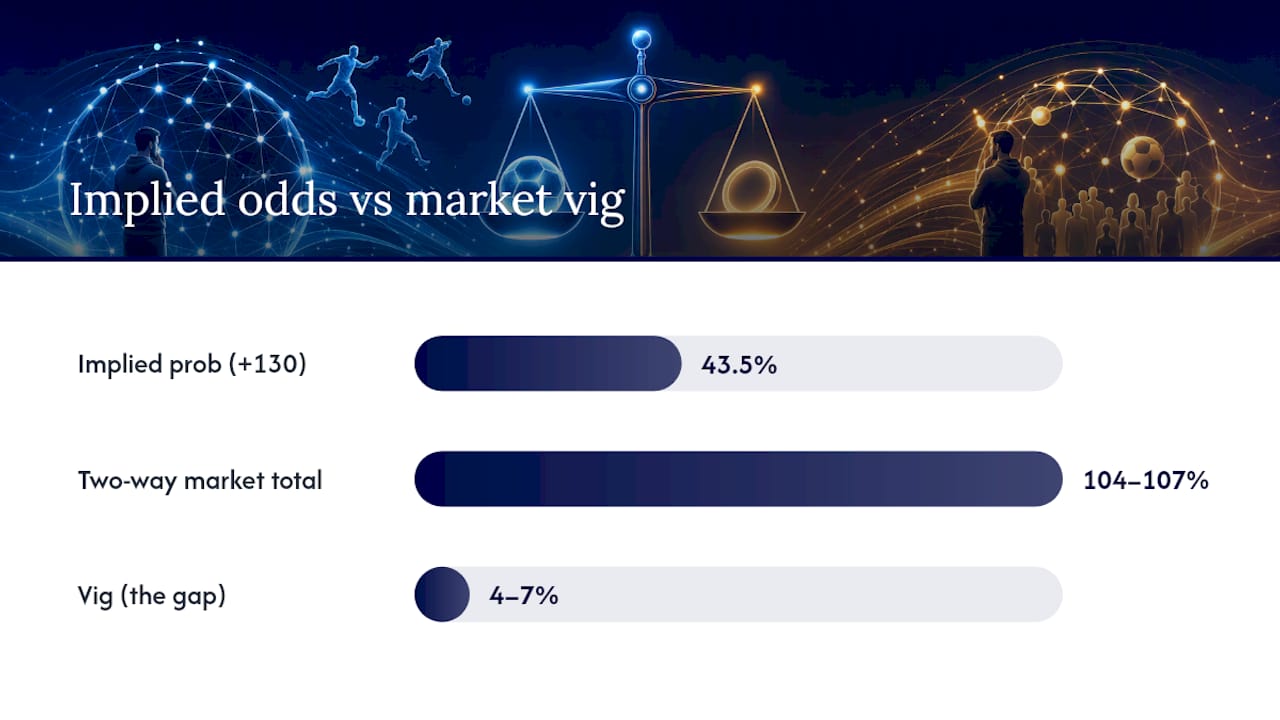
Pro Tip: Converting American odds to implied probability takes one formula. For a favorite (negative odds), it’s odds ÷ (odds + 100). For an underdog (positive odds), it’s 100 ÷ (odds + 100). At +130, that’s 100 ÷ 230, or about 43.5%.
Add those two numbers together on a two-way market and you’ll usually get something over 100%, often 104 to 107%. That gap is the vig, and it’s how Sporting News explains the house edge gets built into every line before you even place a bet.
Full A-Z Glossary of Sports Betting Terms
Bookmark this section. Every time a broadcast or a betting app throws out a phrase you don’t recognize, it’s probably here.
A
Alt line (alternate line): A different point spread or total than the main line, usually offered at adjusted odds. A book might list the main total at 47.5 (-110) alongside an alt line at 44.5 (-170), giving you a lower number at worse odds.
Action: Any bet that’s live and unresolved. “I’ve got action on the game” just means you have money riding on it.
Arbitrage: Betting both sides of an event across different sportsbooks to lock in a small guaranteed profit from pricing gaps. It’s legal but requires speed and larger bankrolls to be worthwhile.
Asian handicap: A spread-style bet, common in soccer, that eliminates the draw as an outcome by using quarter-goal or half-goal lines (like -0.75 or +0.25). It’s essentially a point spread with no push possible on whole-number lines.
B
Bad beat: A bet that looked like a lock until the very end, then lost anyway. A backdoor field goal in garbage time covering the spread against you is the classic example.
Bankroll: Your dedicated betting fund, separate from rent money or savings. Treat it as the total capital you can afford to lose.
Buying points: Paying extra vig to move a spread or total in your favor, like shifting a -7 favorite to -6.5. It’s a straightforward risk-price trade-off: you improve your win odds slightly but shrink your payout, a dynamic Sporting News breaks down in detail.
C
Cash out: A feature letting you settle a bet early, before the game ends, locking in a partial win or loss based on live odds.
Chalk: The favorite, especially a heavy one. “Betting the chalk” means backing the team everyone expects to win.
Closing line: The final odds available right before an event starts, generally considered the market’s most accurate price after absorbing all available information.
CLV (closing line value): How your bet’s odds compare to the closing line. If you bet a team at +150 and it closes at +120, you beat the closing line. Consistently beating it over time is one signal that a bettor is finding real value rather than just getting lucky, a distinction WagerIQ’s betting glossary draws out clearly.
Cover: Winning against the spread. A -6.5 favorite that wins by 10 covers; one that wins by 3 does not.
D
Decimal odds: An odds format common outside the U.S. where the number represents your total return per $1 staked, including your original stake. Decimal odds of 2.50 mean a $10 bet returns $25 total.
Dog (underdog): The team or player expected to lose, typically carrying plus-money odds like +180.
E
Edge: A statistical advantage over the sportsbook’s price, however small. Professional bettors talk in terms of edge, not gut feeling.
Exposure: The total amount of money a bettor or a sportsbook has at risk on a given outcome.
F
Favorite: The side expected to win, marked with negative odds on the moneyline and a minus sign on the spread.
Futures: A long-term bet on an outcome that won’t resolve for weeks or months, like a league MVP or division winner. Futures odds shift as the season unfolds, so locking one in early can be smart or premature depending on the sport.
G
Grand salami: A niche wager on the combined total score across every game on a given day’s slate, mostly seen in hockey.
H
Handicap: Another word for a point spread, especially common in international and soccer betting markets.
Handle: The total amount of money wagered on a particular market or event, tracked by sportsbooks and regulators alike.
Hedge: Placing a second bet to reduce risk or lock in profit on a prior wager. If you bet a team at +500 to win a title and they make the final, hedging the opponent guarantees a payout regardless of outcome.
Hook: The half-point added to a spread or total (the “.5”). Losing by “the hook” means losing by exactly the number that half-point separates you from a push.
Handicapper: Someone who analyzes games and publishes picks or predictions, often for a fee.
I
Implied probability: The win chance a set of odds suggests. See the quick-start section above for the conversion formula. This is the single most useful concept in this entire glossary.
In-play betting (live betting): Wagering placed after an event has started, with odds updating in real time based on what’s happening on the field.
J
Juice (vig, vigorish): The commission a sportsbook charges, typically embedded in odds like -110 on either side of a spread. On a standard -110/-110 line, you need to win about 52.4% of your bets just to break even.
K
Key numbers: Point totals that come up most often in a sport’s final scores, like 3 and 7 in football. Spreads that cross key numbers move at different rates than others.
L
Line: The current odds or point spread offered on a game.
Line movement: How odds shift over time, usually driven by betting volume, injury news, or sharp money. A spread moving from -3 to -4.5 in a day usually means one side is attracting heavy or informed action.
Live betting: See in-play betting.
M
Max bet: The highest wager a sportsbook allows on a given market, which varies widely by sport, bet type, and the bettor’s own account history.
Moneyline: A straight bet on which side wins, with no spread involved. See the quick-start section for a worked example.
N
No-vig line: A theoretical line with the sportsbook’s commission removed, used by sharp bettors to estimate a market’s “true” probability.
O
Odds: The price of a bet, expressed in American, decimal, or fractional format, that determines both your potential payout and the implied probability of an outcome.
Over/under: See total.
P
Parlay: Combining multiple bets into a single ticket where every leg must win. See the quick-start section for the payout math.
Point spread: A handicap designed to make uneven matchups closer to a coin flip for betting purposes.
Press: Increasing your bet size, often after a win, chasing bigger returns. Generally a bankroll-management red flag.
Prop bet: A wager tied to a specific occurrence within a game rather than the final result, like total passing yards or first team to score.
Push: A tie against the number. Your stake is refunded with no win or loss recorded.
R
Run line: Baseball’s version of the point spread, almost always set at 1.5 runs.
S
Sharp: A bettor whose action moves lines because sportsbooks respect their track record and information edge.
Spread: See point spread.
Steam: A sudden, sharp line movement across multiple sportsbooks at once, usually triggered by heavy sharp money hitting the market simultaneously.
Straight bet: A single wager on one outcome, as opposed to a parlay.
T
Teaser: A parlay-style bet where you move the spread or total in your favor on each leg, in exchange for a smaller overall payout than a standard parlay.
Total: A bet on the combined score of both teams, landing over or under a set number.
Tout: Someone who sells betting picks, often with exaggerated claims of a winning record.
U
Underdog: See dog.
Unit: A standardized bet size based on a fixed percentage of your bankroll, used to track performance consistently across different-sized wagers.
V
Vig: See juice.
W
Wiseguy: Slang for a sharp, professional-caliber bettor.
Y
Yard (or “dime”): Betting slang for $1,000. A “dime” bet is $1,000; a “nickel” is $500.
How Do Odds and Payouts Actually Work?
Every odds format answers the same question in different units: how much do you win, and what does that imply about your chances? Compare prices with Raffle Genius — Compare UK Car & Prize Raffles. Once you can convert between them, no sportsbook’s display format will slow you down.
American odds use a baseline of $100. Negative numbers (-150) show what you must risk to win $100; positive numbers (+130) show what a $100 bet returns in profit.
Decimal odds show your total payout per $1 staked, stake included. A decimal price of 1.67 corresponds to -150 in American odds; 2.30 corresponds to +130.
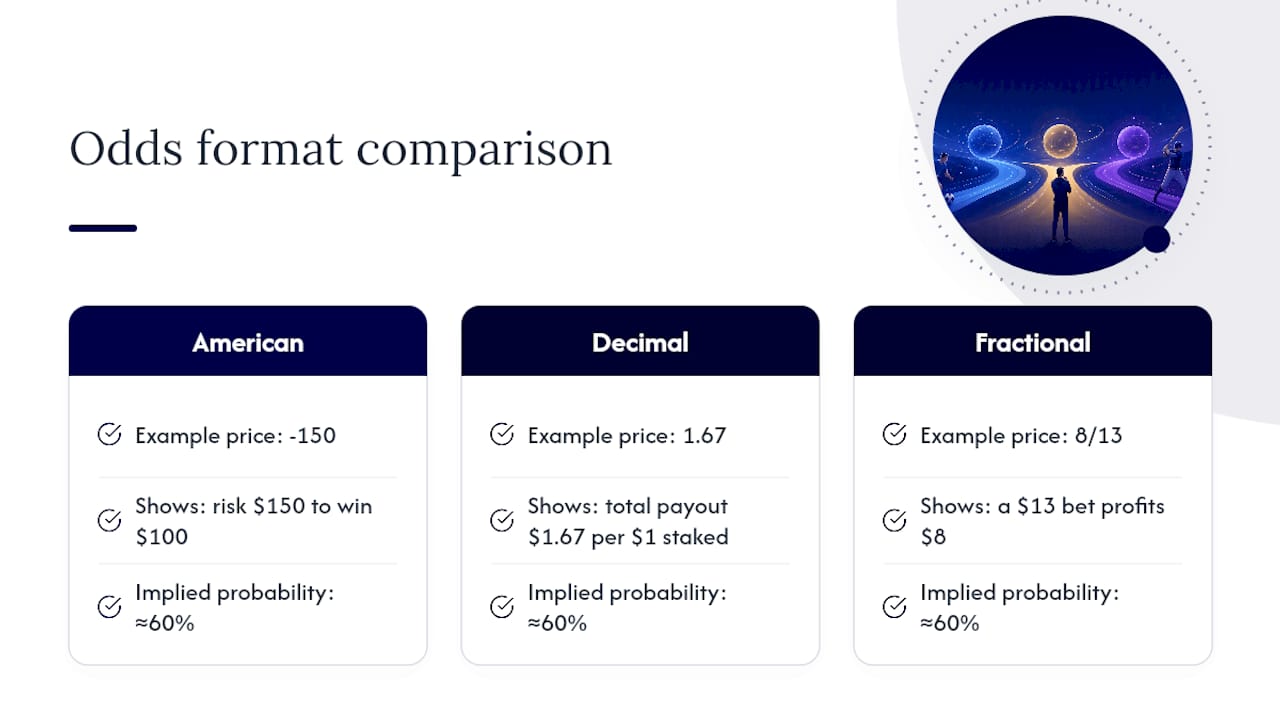
Fractional odds, common in the UK and Ireland, show profit relative to stake as a fraction. 8/13 means an $13 bet profits $8 (again, roughly -150 American); 13/10 means a $10 bet profits $13 (close to +130).
To find implied probability from any format, convert to decimal first, then divide 1 by the decimal odds. A decimal price of 1.67 gives 1 ÷ 1.67, or about 60%. That matches the American -150 calculation from the quick-start section, because it’s the same price expressed three different ways.
Here’s how the math plays out on two real bets:
Notice that a -150 bet returns far less profit than a +250 bet on the same $50 stake, because the favorite is priced as far more likely to win. That’s the entire logic of odds in one table: price and probability move in opposite directions, and vig quietly taxes both sides of that relationship.
What’s a Safe Bankroll and How Do You Set Betting Limits?
Your bankroll is the total money set aside strictly for betting, kept separate from bills, savings, or anything you can’t afford to lose.
Every standard wager is $20, whether you’re betting a coin-flip moneyline or a longshot prop. That discipline keeps one bad week from wiping out a month of careful betting.
Most licensed sportsbooks offer built-in safeguards worth using from day one:
- Deposit limits cap how much money you can add in a day, week, or month.
- Self-exclusion lets you lock yourself out of an account for a set period or permanently.
- Cooling-off periods pause your account temporarily without a full self-exclusion commitment.
- Loss limits stop betting activity once you hit a preset loss threshold.
If betting stops feeling fun or starts affecting your finances, relationships, or sleep, that’s the signal to reach out. The National Council on Problem Gambling runs a confidential national helpline and can point you toward self-exclusion programs and treatment referrals, and Gamblers Anonymous runs free peer-support meetings built around a 12-step recovery model.
Betting Exchanges vs. Traditional Sportsbooks: What’s the Difference?
A traditional sportsbook sets its own odds and takes the other side of every bet you place, building its profit into the vig baked into those odds.
That structure changes the math in your favor in a few specific ways. Exchanges typically post better prices than sportsbooks because there’s no built-in house edge on the line itself, only the commission on wins. You can also “lay” a bet, meaning you take the bookmaker’s side and bet against an outcome rather than only backing it, which opens up trading strategies that don’t exist at a standard sportsbook.
The tradeoff is liquidity. A popular NFL game on an exchange might have plenty of action matching your bet at a fair price; a smaller college basketball game might not, leaving you stuck with a worse price or no match at all. Traditional sportsbooks guarantee a price on almost anything, instantly, because they’re setting that price themselves rather than waiting for another bettor to take the other side.
For most beginners working through this glossary, a traditional sportsbook is the simpler starting point. Exchanges reward bettors who already understand implied probability and line movement well enough to spot when the crowd has mispriced something.
Understanding Betting Limits and Maximum Bets
Every sportsbook sets a max bet, the largest wager it will accept on a given market, and that ceiling moves depending on the sport, the bet type, and the bettor placing it. A mainstream NFL moneyline might carry a max bet in the tens of thousands of dollars, while an obscure prop on a college volleyball match might cap out at a few hundred.
Books set lower limits on markets where they have less confidence in their own pricing, which is usually anything outside major leagues and primary bet types like spreads, totals, and moneylines. Parlays, same-game props, and long-shot futures tend to carry noticeably tighter caps than a straight bet on a marquee game.
Your own betting history affects your limits too. Bettors who consistently win, especially those flagged as “sharp,” often see their max bets quietly reduced or their accounts limited entirely, since a sportsbook’s profit model depends on the overall betting pool, not on any one bettor cleaning up repeatedly. Casual bettors with mixed results rarely run into this problem.
If you’re regularly hitting a book’s max bet on a market you’re confident in, that’s usually a sign to open accounts at multiple sportsbooks rather than trying to push more money through one line. Comparing limits and prices across books, the same instinct that drives odds shopping generally, tends to matter more as your bet sizes grow.
A Publisher’s Perspective on Why Clear Definitions Matter
Roy here. Most betting losses trace back to not fully understanding what you agreed to when you placed the bet, not bad luck. Some betting platforms build odds comparison tools and shareable BetSlips to help you see terms in action instead of just reading a definition.
Pro Tip: Once you know implied probability cold, use it to shop lines across books before you bet, not after.
— Fogell
Where to Learn More About Sports Betting Terms
For deeper reading beyond this glossary, check ESPN’s betting glossary and Britannica’s terminology guide. If betting ever stops feeling like fun, the National Council on Problem Gambling and Gamblers Anonymous offer confidential help. To put these terms into practice with real odds comparisons and expert picks, visit Parlaygeeks.