
15/30 Hold Edge: Fast Execution for U.S. Live Tennis Bettors
The fastest route to profitable tennis live betting is disciplined micro-market trading: build a pre-match thesis, target game-level markets like the 15-30 hold and the deciding-set underdog, and size every entry small. Speed matters as much as selection. Skip broadcast visuals, use a low-latency feed, and cap stakes at a small percentage of bankroll per entry so one bad read doesn’t wreck your session.
TL;DR:
- Small, quick entries on the 15-30 hold or break opportunities are most profitable on fast surfaces with high first-serve win rates.
- Use real-time data feeds and pre-set stakes to avoid delays caused by broadcast lag and market snapbacks, which can cost you money.
- Implement strict bankroll management with profit and loss limits, and avoid overtrading or chasing losses to protect your margin.
- Avoid betting during injuries, sharp odds movements without match reasons, or when market suspensions signal uncertainty.
- Practice early execution through paper trading and logging to develop discipline and reduce reaction time under live pressure.
Table of Contents
- What Makes Tennis Live Betting Different From Pre-Match Wagers
- Core Live Strategies That Produce Repeatable Edges
- How to Beat Latency and Read Live Odds Correctly
- Bankroll and Staking Rules Built for Live Tennis Variance
- Common Live Betting Mistakes and How to Avoid Them
- An Author’s Take and Tools That Help You Practice
- Why Execution, Not Prediction, Wins in Live Tennis Betting
- Sources
What Makes Tennis Live Betting Different From Pre-Match Wagers
Tennis live betting isn’t slower pre-match betting with a running clock. Odds reprice after every point, and the market you’re reading at 30-15 in the second set has almost nothing to do with the closing line you saw before the coin toss. That constant repricing is exactly why in-play tennis needs its own distinct set of tactics rather than a rehash of pre-match handicapping.
The main markets worth knowing:
- Match winner — the standard moneyline, but repriced live after every game
- Next game / game winner — who wins the current game, the shortest-horizon bet available
- Current-set winner and next-set winner — mid-length bets tied to a single set
- Total games — over/under on games in a set or the full match
- Correct score — exact set score, high payout, high variance
- Tie-break markets — winner or over/under on tie-break points
Shorter-horizon markets like next-game and current-set tend to produce more repeatable pricing gaps than the match winner line, because they hinge on a small, observable event (a hold, a break, a mini-run) rather than three hours of accumulated randomness. Your entry triggers should tie directly to serve quality, the score state, and the surface. A big server cruising on a hard court behaves nothing like a grinder on clay facing break point, and the market often prices both the same way for a beat too long.
Core Live Strategies That Produce Repeatable Edges
Three setups show up again and again in profitable live tennis betting, and each has a clear entry rule and a clear reason to walk away.
- The 15-30 hold edge. When a dominant server on a fast surface falls behind 15-30 in his own service game, automated pricing models sometimes overcorrect, pushing his hold-the-game odds lower than his actual serve profile supports. The 15-30 setup works best on hard and grass courts against servers with a first-serve win rate north of 70%. Wait for the price to move, confirm the server’s stats haven’t cratered, then take the hold at whatever number the market offers. If the price hasn’t drifted, there’s no edge; skip it.
- Back the breaker. After a break of serve, the player who just broke often carries momentum into their own service game. Watch for a returner who’s been working long rallies and forcing deuce points; that’s a signal the next game favors them too, especially if the server just double-faulted under pressure.
- Underdog in the decider. Deciding sets reset momentum, and live markets frequently keep pricing the favorite as if the first two sets never happened. If the underdog is physically fresher, or the favorite showed fatigue in set two, the deciding-set line can carry real value.
Pro Tip: Treat the 15-30 setup as a scouting tool, not an autopilot. Check the server’s hold percentage on that specific surface before you bet, not their season average.
None of these require exotic data. They require patience and a willingness to pass when the criteria aren’t fully met, which is harder than it sounds once a match gets exciting.
How to Beat Latency and Read Live Odds Correctly
Broadcast video typically runs several seconds behind the actual point, and that gap is long enough to turn a good idea into a bad bet. If you’re watching a rally on TV and placing your wager off what you see, the price has likely already moved by the time your bet clears. That’s the single most common way live bettors lose money without realizing why.
Build a habit around this instead:
- Use a live score app or an official data feed, not the TV delay, as your primary source of truth
- Keep an odds comparison tool open so you’re not stuck refreshing one sportsbook’s slow-loading line
- Pre-decide your stake size before the point starts so you’re not doing math under time pressure
- Have your bet slip half-built before the score changes, ready to confirm in one tap
Broadcast delay of five to ten seconds is common enough that acting on visuals alone puts you a full point or more behind the real market. Odds also tend to snap immediately after a point ends and then drift slightly as the market digests the game state, which means the best entries usually come right after that initial snap, not during the point itself. Anticipate the repricing pattern instead of chasing it once it’s already happened.
Retail sportsbooks also tend to run wider margins in-play than pre-match, since repricing speed forces bookmakers to protect themselves more aggressively during fast-moving games. Comparing odds across books before you commit matters more in-play than it does pre-match, not less.
Bankroll and Staking Rules Built for Live Tennis Variance
Live tennis betting swings hard, and flat-percentage staking is the simplest way to survive it.
Translate that into dollars before you sit down to bet, not mid-match. That number should not change because you’re three legs deep into a good day or chasing a loss from the last set.
Set hard session boundaries before the match starts:
- Profit stop: lock in gains after a set target (say, 3 to 4 units up) and stop for the match
- Loss stop: walk away after a set drawdown (2 to 3 units down) rather than trying to force it back
- Entry cap: limit yourself to a fixed number of live bets per match, even if the match runs three sets and feels like it’s offering opportunities the whole way
The point of a session rule isn’t pessimism. It’s removing the decision from a moment when you’re least equipped to make it well.
Common Live Betting Mistakes and How to Avoid Them
Most live tennis losses trace back to behavior, not bad analysis. Chasing a loss by doubling the next stake is the fastest way to turn a rough set into a rough month. Overtrading, firing off five or six live bets a match because the action is fun, dilutes your edge into noise. Misreading surface effects, treating a clay grinder’s break point like a hard-court ace machine’s, is a quieter but equally costly error.
Watch for these operational red flags and step away when you see them:
- A visible injury or medical timeout, even a minor one
- Odds drifting sharply with no corresponding shift in the match itself, which often means the market knows something you don’t
- Repeated betting suspensions on a single game, a signal that something (weather, a disputed call, an injury) is unsettled
Pro Tip: Log every live bet, including the ones you almost made but didn’t. The pattern in your near-misses usually reveals your best rule before your losses do.
Pre-commit to your entry criteria before the match starts, and treat a forced pause, even just standing up and walking away for two minutes, as a legitimate part of your process, not a break from it.
An Author’s Take and Tools That Help You Practice
Roy has spent years studying betting markets and translating dense strategy into rules a weekend bettor can actually use during a live match, not just read about afterward. The gap between knowing the 15-30 setup and executing it cleanly under time pressure is where most bettors lose their edge, not in the strategy itself.
That execution gap is exactly what tools should solve. Real-time odds comparison lets you spot the best live number across books in seconds instead of tab-switching mid-point. Shareable BetSlips make it easy to track and review your own entries, which matters more than most bettors admit, since the habit of logging every live bet is what separates a repeatable edge from a lucky week. Parlaygeeks builds around exactly this friction point, pairing live odds tracking with expert picks so you’re not building your entire process from scratch.
If you’re new to the 15-30 setup, paper trade it across roughly 100 matches before staking real money. Log every qualifying moment, whether you’d have bet or passed, then review the pattern before you scale up.

Why Execution, Not Prediction, Wins in Live Tennis Betting
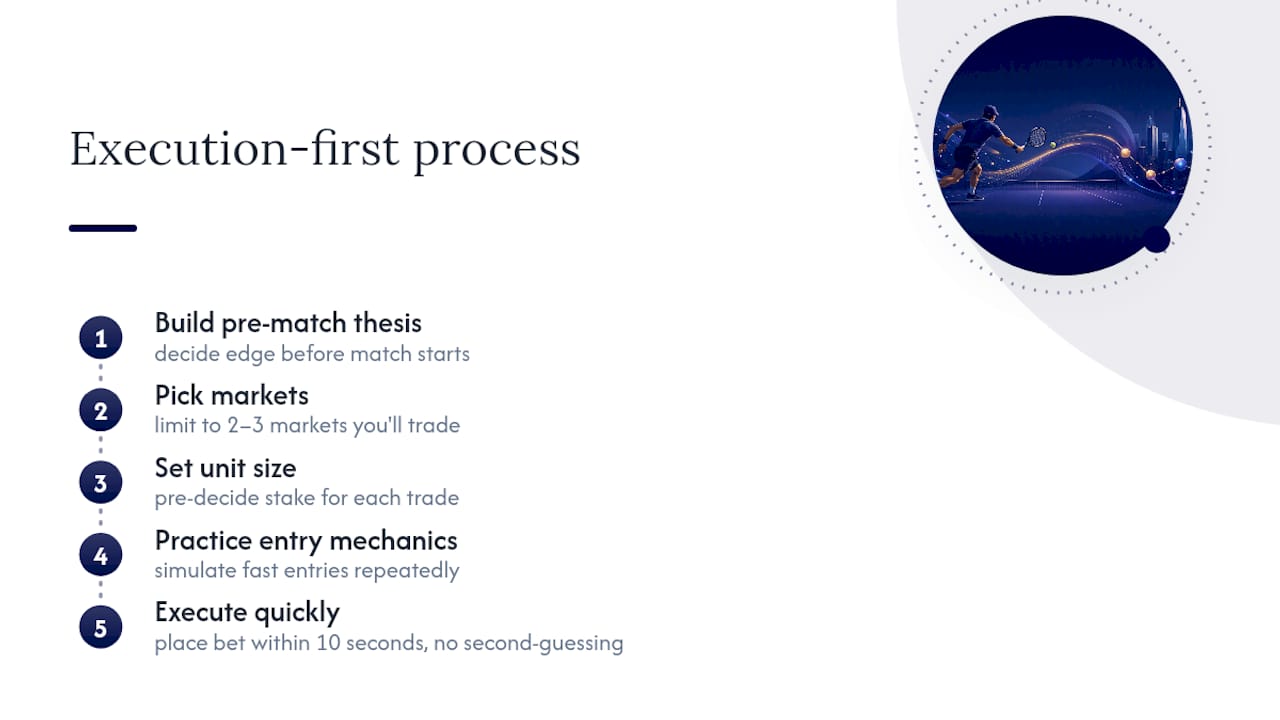
The research on tennis live betting keeps pointing at the same uncomfortable truth: most bettors lose not because they misjudge a player, but because they’re too slow or too undisciplined to act on a read they already had right. The 15-30 edge isn’t a secret formula. It’s a specific, narrow window that rewards whoever gets there first with a clear head and a pre-decided stake.
Conventional advice oversells prediction and undersells process. You’ll find plenty of content on reading a player’s form or fatigue, and that matters, but it’s the smaller half of the equation. The bigger half is whether you can execute a bet in under ten seconds without second-guessing a rule you set an hour earlier. Prioritize that first. Build the pre-match thesis, pick two or three markets you’ll actually trade, set your unit size, and practice the mechanics of fast entry before you worry about finding a sharper angle than everyone else.
— Thelma
Sources
The 15-30 hold edge and its entry criteria come from The Wager Theorem’s live tennis strategy breakdown. Surface effects, margin behavior, and pre-match thesis building draw on livetennis.io’s live betting guide. Broader market mechanics come from CBS Sports’ tennis betting guide, and readers exploring the wider betting ecosystem can check Cardano Casino’s resource hub as well.