
Prove Your Edge With an Underdog Betting Strategy That Tracks CLV
Underdog betting works as a long-term strategy only when you filter for specific, repeatable situations rather than betting dogs on principle. Short home or divisional underdogs, teams coming off a blowout loss, and spots showing reverse line movement carry a real, documented edge. Blanket “always bet the dog” approaches lose money over time. The bettors who win track closing-line value and size bets with a fraction of the Kelly criterion, treating discipline as the actual product.
TL;DR:
- Profitable underdog strategies focus on specific situations like short underdogs, home divisional dogs, and post-blowout fades, rather than betting on all underdogs.
- Market biases cause small edges, but sportsbooks adjust prices to limit value, making multiple filters necessary to find consistent profit.
- Proper bet sizing relies on odds bands and multiple filters, not on confidence or gut feeling, with smaller stakes recommended for longer odds.
- Beating the closing line value is the strongest indicator of long-term success, requiring detailed tracking of line movements and filter effectiveness.
- Rely on discipline and thorough record-keeping over short-term results, using tools to compare odds and verify when value exists before placing a bet.
Table of Contents
- What Makes an Underdog Betting Strategy Profitable
- Situational Filters That Reliably Produce Underdog Value
- Choosing the Right Bet Type and Sizing Your Stakes
- Reading Line Movement and Why Closing-Line Value Matters Most
- Live Betting Tactics: When to Wait Instead of Betting Pregame
- Tracking Your Results to Prove the Edge Is Real
- Common Mistakes and a Quick Pre-Bet Checklist
- A Practitioner’s Note on Discipline Over Results
- Put the Right Odds and Picks in Front of You
- Sources
- FAQ
What Makes an Underdog Betting Strategy Profitable
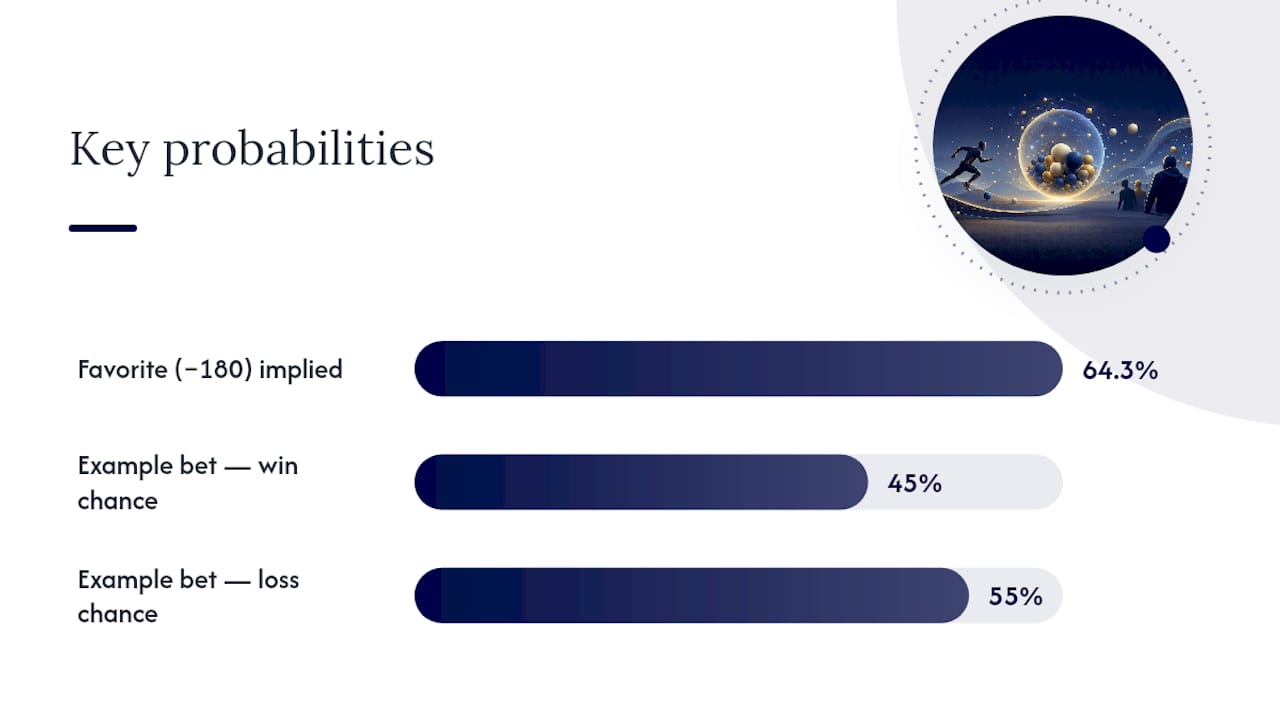
An underdog bet is worth making when the odds pay you more than the team’s true chance of winning deserves. That gap is expected value, and finding it starts with converting American odds into implied probability.
A favorite at −180 implies roughly 64.3%. Add those two numbers and you get more than 100%, because sportsbooks bake in a margin called the vig. Strip that margin out (a process called removing the vig, or calculating “no-vig” probability) and you get the market’s true, cleaner estimate of each side’s chances.
Here’s where the math gets interesting. That’s a breakeven bet, not a valuable one.
- Win (45% chance): $150 profit
- Lose (55% chance): $100 loss
- EV = (0.45 × $150) − (0.55 × $100) = $67.50 − $55 = $12.50 positive EV per $100 wagered
Nobody hits that number consistently on gut feel.
This is where the favorite-longshot bias comes in. Decades of academic research on betting markets confirm that bettors systematically overpay for favorites and underpay for longshots, a pattern documented in research on the favorite-longshot bias published through the University of Chicago Press. Public bettors like backing winners. They want the emotional comfort of rooting for the team expected to win, and sportsbooks price around that preference, nudging favorite lines up and leaving some dogs modestly undervalued.
The catch: this bias produces small, narrow edges, not a printing press. Bookmakers know the bias exists and adjust pricing to keep a blanket “bet every underdog” approach from working, based on analysis of bookmaker pricing behavior. The edge survives only in specific corners of the market where public perception and reality diverge the most, which is exactly why the next section matters more than the math itself.
Situational Filters That Reliably Produce Underdog Value
Professional bettors don’t bet underdogs. They bet underdog situations. The distinction sounds small, but it separates a system with a real edge from one that just feels smart until the losses pile up.
-
Short underdogs, roughly +1 to +3.5 on the spread or +100 to +150 on the moneyline. This is the sweet spot where the market’s talent gap is genuinely close, and historical performance data on this range has shown small but persistent overperformance against the spread, per tracked underdog betting strategies from WagerWisdom. Bigger dogs (+300 and up) require a much stronger specific reason to bet.
-
Home underdogs in divisional matchups. Familiarity compresses talent gaps. Divisional opponents know each other’s tendencies, travel is usually shorter, and home crowd energy provides a real, if modest, lift. This combination shows up across the same historical ATS data referenced above as one of the more durable underdog subsets.
-
Post-blowout fades. A team that just won by 20+ points often gets overpriced the following week as the public piles on the “hot” side, while a team that just lost badly gets discounted below its actual talent level. Fading the public in these exact spots is one of the clearest repeatable filters practitioner guides point to.
-
Lookahead spots and short-week travel. A favorite with a marquee game looming the following week, or a team playing on a short turnaround, sometimes doesn’t bring full focus. These are softer signals than the first three and work best stacked alongside them, not alone.
-
Sport-specific adjustment. High-variance sports like MLB and NHL reward underdog moneylines more consistently because a hot starting pitcher or a hot goalie can single-handedly flip a game’s outcome, a pattern noted in research summarizing the favorite-longshot bias across sports. The NBA, with its lower game-to-game variance and heavier reliance on star talent, punishes sloppy underdog bets more severely. Be pickier there.
No single filter above is a strategy by itself. The real signal shows up when two or three line up on the same game: a short home divisional dog coming off a bad loss, for instance, is a far stronger spot than any one factor alone.
Choosing the Right Bet Type and Sizing Your Stakes
Moneyline and spread underdog bets aren’t interchangeable, and picking the wrong one on the right game wastes a good read. Moneyline makes more sense on short dogs where you genuinely think there’s a real shot at the outright win, since that’s where the payout premium over the spread is worth the added risk. The spread is usually the better call on bigger underdogs, where covering a larger number is a more realistic outcome than winning the game straight up.
Live betting adds a third option, and it deserves its own section below, but the sizing principles apply across all three markets.
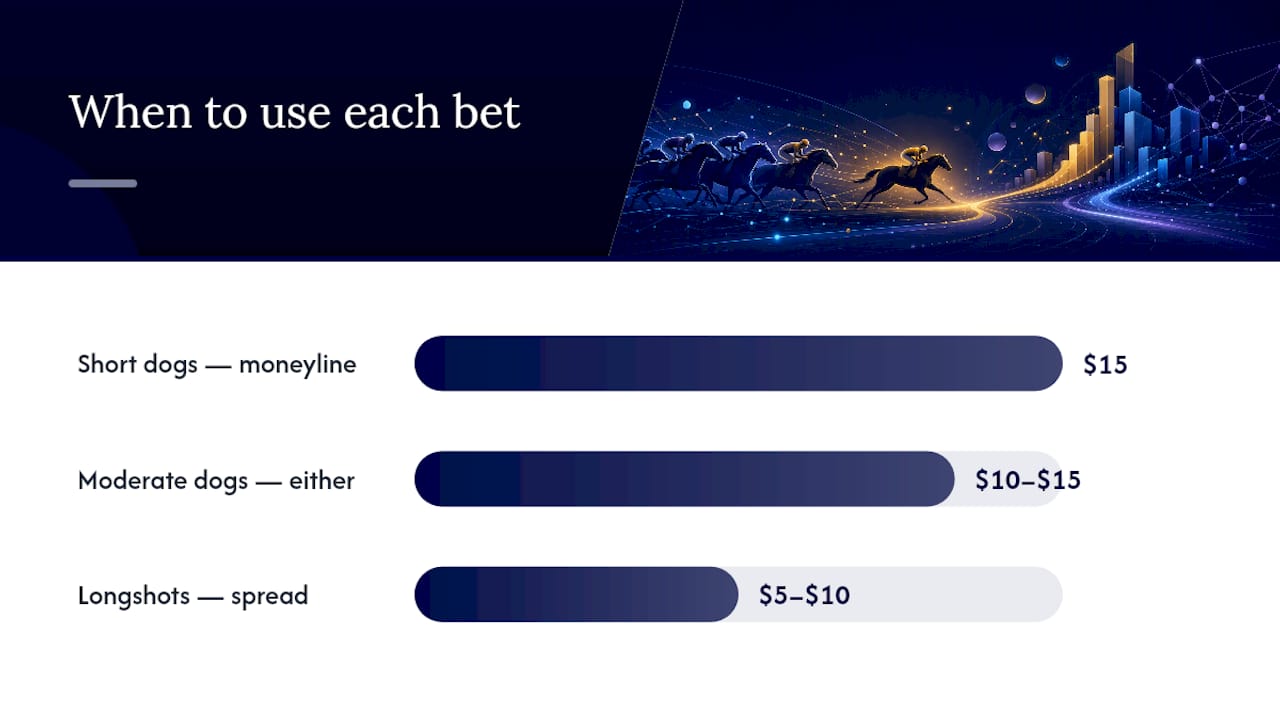
Practical guides on underdog betting commonly recommend this fractional approach specifically because full Kelly assumes your win probability estimate is exact, and it almost never is.
- +100 to +150 (short dogs): $15 per bet, since your win rate should be close enough to the breakeven line that variance is moderate.
- +150 to +250 (moderate dogs): $10 to $15 per bet, tightening as odds lengthen.
- +250 and up (longshots): $5 to $10 per bet, reserved only for spots with multiple confirming filters.
Pro Tip: Never size a bet based on how confident you feel. Confidence spikes after a few wins, right when your actual edge hasn’t changed at all. Size off the odds band and the filter count, not your mood.
Reading Line Movement and Why Closing-Line Value Matters Most
Line movement tells you where money is going, and sometimes it tells you where smart money is going, which is a different thing entirely. Reverse line movement happens when the line shifts toward the underdog even though the public betting percentage favors the favorite. That mismatch usually means sportsbooks are adjusting to sharp, informed action rather than public volume, since books price to balance their liability, not to reward popularity.
Before trusting a reverse-movement signal, check whether there’s an obvious explanation like a late injury report or a weather shift. If the move happens with no clear news attached, that’s a stronger tell that professional money is behind it.
The single best way to know if your underdog reads are actually working is closing-line value, or CLV: the difference between the odds you bet and the odds available right before kickoff. Beating the closing line consistently is widely treated as the strongest available predictor of long-term betting profitability, since the closing number reflects nearly all available information the market has absorbed, per guidance on measuring CLV.
Practical signals worth tracking:
- A dog’s price shortens (say, +150 moving to +130) with betting splits still favoring the favorite.
- No corresponding injury news, lineup change, or weather update explains the move.
- The shift happens gradually across multiple books rather than in one isolated line.
If your bets consistently close at worse odds than what you took, that’s not bad luck. That’s a signal your underdog reads are lagging the market instead of leading it.
Live Betting Tactics: When to Wait Instead of Betting Pregame
Sometimes the best underdog bet isn’t the one you place before kickoff.
-
Let the first quarter or early second quarter play out before betting live. Early-game variance often pushes underdog live odds higher than the pregame line justified, especially if the favorite jumps ahead by a score or two on a fluky sequence rather than clear dominance.
-
Check whether the deficit is moderate, not disqualifying. A dog down by a touchdown with three quarters left is a very different bet than one down 28 points. If your pregame model still applies, meaning nothing has happened to change the underlying talent gap, the live price gap can be pure profit compared to the pregame number.
-
Cap live stakes below your pregame stake, and never chase garbage-time swings. A common rule is capping live bets at half your standard stake size. Live markets move fast and overreact to single plays, which is exactly the kind of volatility that eats undisciplined bettors alive.
Tracking Your Results to Prove the Edge Is Real
Every underdog bet needs a paper trail: the line you bet, the closing line, your stake, the result, and the CLV on that specific game. Without that record, you’re guessing whether your strategy works or just remembering the wins.
Sample size matters more than most bettors want to admit. A hot month of underdog bets means very little; meaningful evaluation of an edge generally requires several hundred logged bets, since standard variance in sports betting is wide enough to disguise a losing strategy as a winning one for weeks at a time.
- Log open line, closing line, stake, odds band, and filter(s) used for every underdog bet.
- Calculate CLV per bet, then average it across your full sample, not just recent results.
- Use an odds-comparison tool like ParlayGeeks to catch pricing gaps across sportsbooks before you bet, since the best available line directly improves your CLV baseline.
- Review injury updates and expert analysis before locking in a filter-based pick, rather than after.
Common Mistakes and a Quick Pre-Bet Checklist
The fastest way to torch an underdog strategy is betting every dog on the board because “dogs are undervalued,” chasing a loss with a bigger stake on the next available underdog, or firing off a bet minutes after an emotional game just to feel something. Watch for line moves tied to obvious public news (everyone already knows, so there’s no edge left) and inflated public narratives built on a tiny sample of recent games.
- Does this game hit at least two situational filters, not just one?
- Have I checked for injury or weather news explaining any line movement?
- Is my stake sized to the odds band, not my confidence level?
Pro Tip: Keep a simple rule: if you can’t name the specific filter behind a bet before you place it, skip the bet.
A Practitioner’s Note on Discipline Over Results
The hardest part of underdog betting isn’t finding value. Betting for the result of one Sunday, instead of the process behind two hundred Sundays, is how good bettors talk themselves out of a working system.
Track your CLV honestly over a real sample before deciding whether your filters work. That number, not your win/loss record from last weekend, is the only evidence that actually counts.
— Thelma
Put the Right Odds and Picks in Front of You
Chasing underdog value across a dozen sportsbook apps eats the time you should be spending on the filters themselves. Some platforms pull real-time odds comparison into one screen, so you can spot the best available price on a short home dog before the number moves against you.
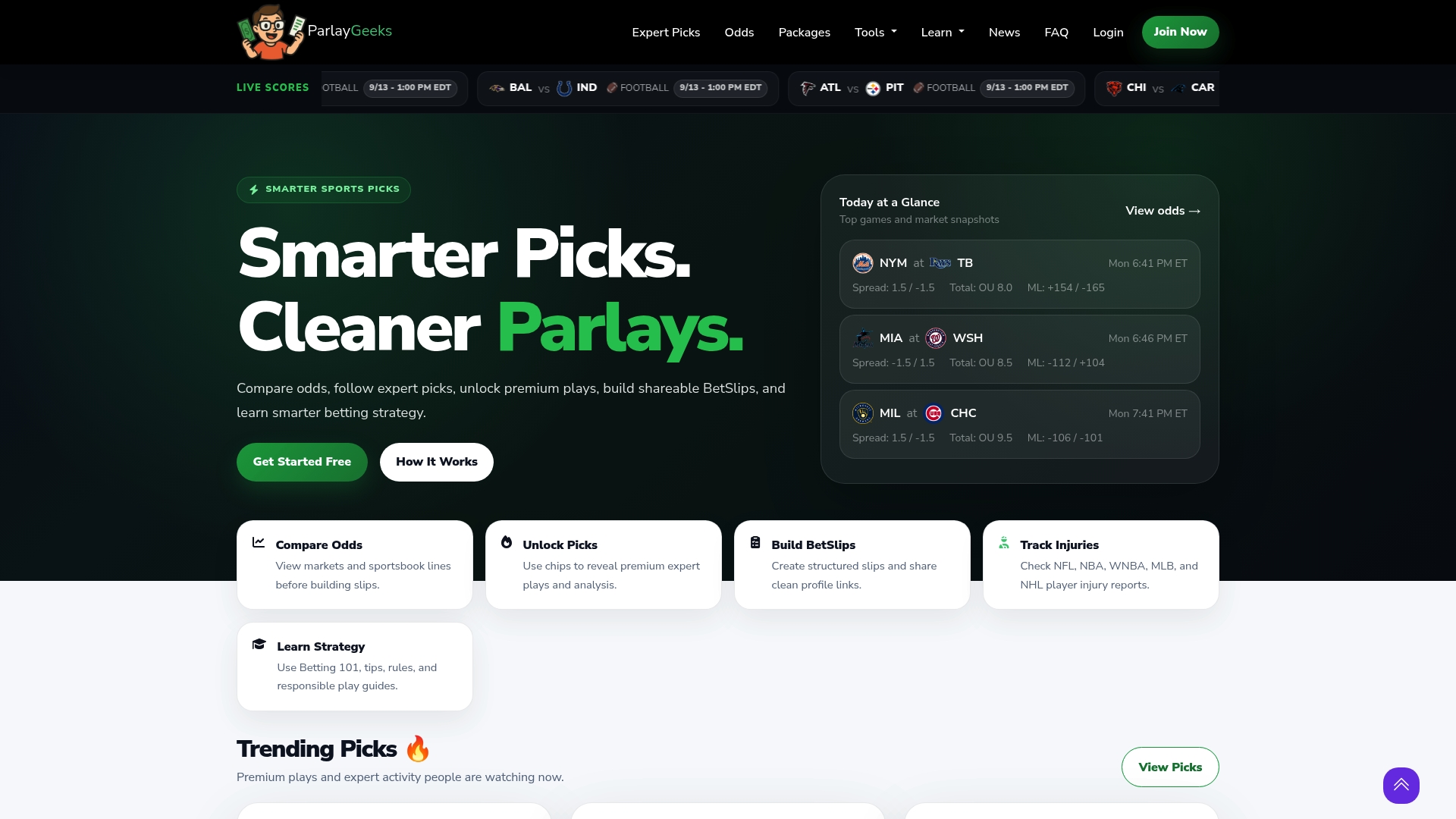
Beyond odds, some platforms give access to unlockable expert picks and analysis across betting markets, live injury reports that help verify whether a line move has a real explanation, and a BetSlip builder you can share publicly or use to follow bettors whose underdog reads you trust. None of that replaces the discipline this article just walked through. Parlaygeeks is a tool to speed up research and sharpen execution, not a shortcut around doing the work.
If you’re ready to start comparing lines and tracking your own underdog plays properly, check out Parlaygeeks and build your first BetSlip today.
Sources
This article draws on peer-reviewed research on the favorite-longshot bias, practitioner analysis of profitable underdog situations, guidance on CLV and situational filters, and market-pricing research from bookmaker behavior studies. For background on how demand shapes pricing in other markets, see this breakdown of spotting undersold competitions.
- Journal article on favorite–longshot bias (University of Chicago Press)
- 4 Profitable Underdog Betting Strategies | WagerWisdom
- Levitt-style analysis of bookmaker behavior and market pricing
FAQ
Is underdog betting a good strategy?
It’s a good strategy only when applied through specific situational filters like short home dogs or post-blowout fades, not as a blanket rule. Betting every underdog without a filter tends to lose money over time because bookmakers price around the favorite-longshot bias.
What is the most profitable betting strategy?
No single strategy guarantees profit, but the most consistently cited approach among sharp bettors combines narrow situational filters, disciplined bankroll sizing, and rigorous CLV tracking rather than relying on any one bet type or team preference. Tools like Parlaygeeks help by surfacing the best available odds before those small edges disappear.
What is the 80/20 rule in betting?
There’s no single, universally recognized definition of a rule like “80/20” specific to sports betting; the phrase gets used loosely to suggest that a small share of bets or filters drive most of a bettor’s long-term profit. Treat it as a general principle rather than a fixed statistic.