
Lock Your Stakes: Unit Size Betting and a 3 Unit Stop Loss Workflow
That single number does the heavy lifting in unit size betting: it caps how much any one loss can hurt, standardizes how you track results over time, and keeps a bad week from turning into a wiped-out account.
TL;DR:
- Using a percentage-based approach keeps bet size proportional to bankroll changes and helps limit losses during bad streaks.
- The typical 1% unit suits most disciplined bettors, offering around 100 bets of safety before risking total depletion at a $10,000 bankroll.
- Confidence scaling and fractional Kelly betting require reliable edge estimates and are riskier than flat betting for most casual or unproven bettors.
- Avoid resizing units after streaks or betting correlated wagers, as these mistakes can cause significant, hidden exposure to bankroll loss.
- Structured workflows and preset rules, like calculating units beforehand and tracking exposure, improve discipline and prevent emotional betting.
Table of Contents
- What Is a Betting Unit and Why Do Bettors Use One?
- How Do You Calculate Your Betting Unit Size?
- Flat Betting vs. Confidence Scaling vs. Kelly Staking
- What Mistakes Wreck a Betting Bankroll?
- Betting Unit Cheat Sheet: Bankroll, Percentage, and Dollar Value
- How Tools Make Unit Discipline Actually Stick
- Why Simple Rules Beat Clever Ones
- Where to Read More on Bankroll and Unit Sizing
- Sources
- FAQ
What Is a Betting Unit and Why Do Bettors Use One?
A unit is a percentage, not a number. That distinction matters because dollar amounts are meaningless without context. Someone who says they “won 5 units” last month gives you a comparable number regardless of whether their bankroll is $500 or $50,000.
This is the core idea behind units in betting: they normalize performance so bettors, tipsters, and tracking services can talk about results without disclosing bankroll size. It also keeps decision-making mechanical instead of emotional, since the stake is calculated the same way every time rather than picked based on how confident (or frustrated) you feel that day.
Practical benefits of unit-based bet sizing:
- Keeps bet size proportional to bankroll as it grows or shrinks
- Lets you compare your own results month to month on equal footing
- Makes losing streaks survivable by capping the damage per bet
- Simplifies record keeping since every stake is expressed the same way
Units are the backbone of real betting unit management, which is really just risk management wearing a betting hat.
How Do You Calculate Your Betting Unit Size?
The math is simple: bankroll multiplied by your chosen percentage equals your unit. The harder part is being honest about the two inputs.
- Set your bankroll. This is money you can afford to lose entirely, separate from rent, bills, or savings. If you’d feel it in your daily life, it doesn’t belong in this number.
- Pick your percentage. Conservative bettors and high-volume players often use 0.5%. A 1% unit is the common default for disciplined recreational and semi-serious bettors. Moderate risk-takers push to 2%. Anything above 3% is widely considered high-risk, closer to gambling than staking strategy.
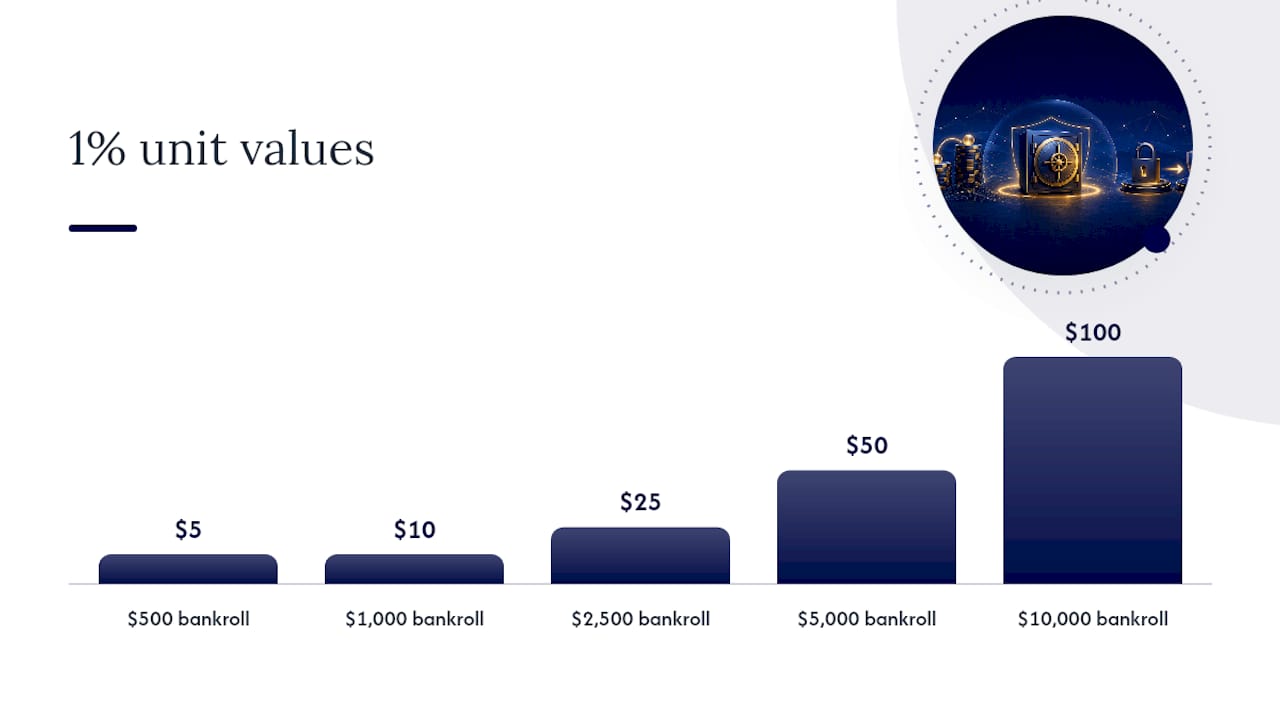
- Do the multiplication. A $1,000 bankroll at 1% gives you a $10 unit. A $5,000 bankroll at 0.5% gives you a $25 unit. Same formula, different inputs.
- Recheck on a schedule, not a whim. Adjust monthly or after a defined bankroll swing (say, up or down 20%), rather than reacting to a single hot or cold streak.
Pro Tip: Write your unit size and percentage down somewhere you’ll actually see it before placing a bet. The moment you start eyeballing stakes “based on feel,” the system stops working.
A $10,000 bankroll at a 1% unit gives you $100 per bet and roughly 100 units of total runway if you flat bet, which is the kind of cushion that survives an ordinary bad month rather than ending it.
Flat Betting vs. Confidence Scaling vs. Kelly Staking
Most bettors settle on one of three staking approaches, and each solves a different problem.
Flat betting means every wager is exactly one unit, no exceptions. It’s the simplest system and the one most bettors should start with, because it removes the temptation to bet bigger when you feel sure of a pick, which is exactly when overconfidence tends to bite hardest.
Confidence scaling lets stakes range from roughly 0.25 to 2 units based on how strong you believe your edge is. The key is defining triggers in advance: maybe a top-tier pick with a confirmed lineup and clear statistical edge gets 2 units, while a speculative prop gets 0.5. Without written triggers, “confidence” just becomes a rationalization for chasing losses.
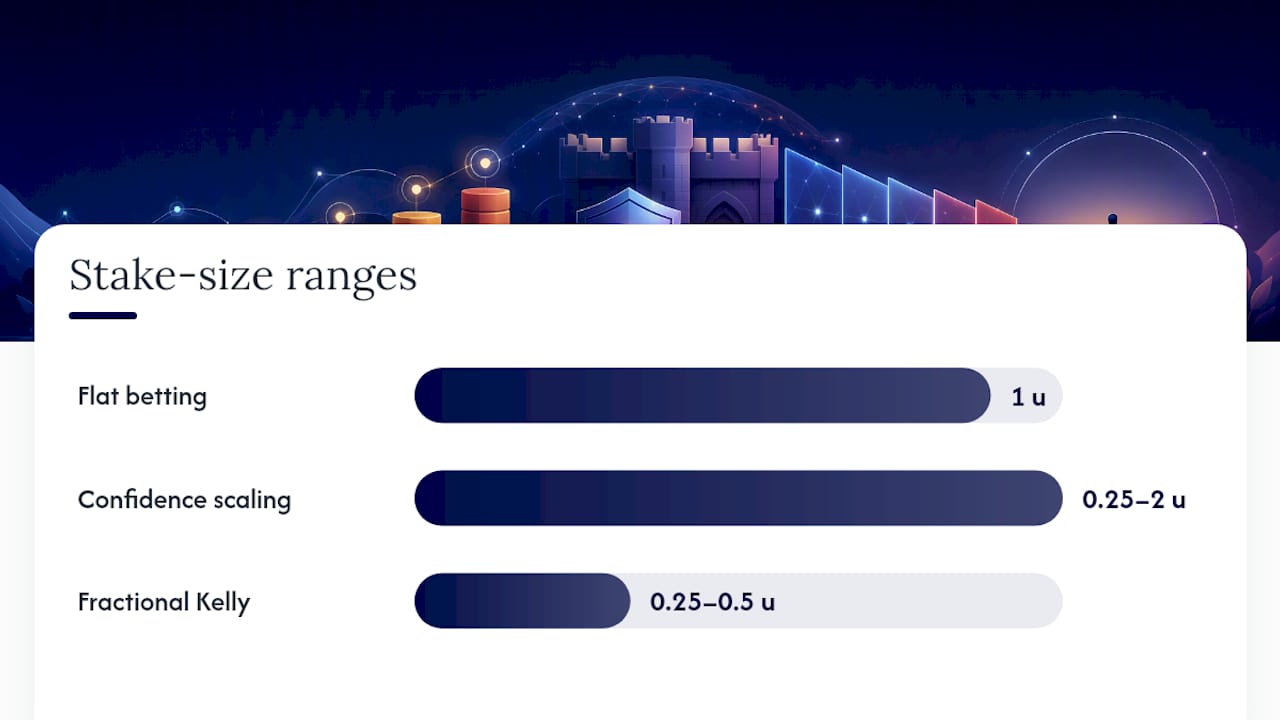
Kelly and fractional Kelly size bets based on your estimated edge and the odds offered. Full Kelly can be brutally volatile if your probability estimates are even slightly off, which is why fractional Kelly, often a quarter or half of the full Kelly stake, is the more common real-world choice.
None of these methods fix a losing strategy. Unit sizing controls how fast you lose money on a bad bet. It does nothing to turn a -EV wager into a profitable one.
- Flat betting: best for beginners and anyone without reliable edge estimates
- Confidence scaling: best for bettors with a documented track record in specific markets
- Fractional Kelly: best for bettors with real, testable probability models
What Mistakes Wreck a Betting Bankroll?
Most bankroll damage doesn’t come from bad picks. It comes from bad sizing decisions around otherwise ordinary picks.
- Treating parlays like straight bets, when a 4 leg parlay carries far more variance per unit risked
- Doubling stakes after a loss to “get even,” which turns a bad night into a bad month
- Resizing your unit up after a short winning streak, mistaking variance for skill
- Ignoring correlated bets (same game, same player, related props) that multiply exposure without you noticing
- Betting without any written rule for stop-loss or daily exposure caps
A simple stop-loss rule, like halting for the day after losing 3 units, protects you from tilt betting. A written exposure cap, such as never having more than 5 units in live action at once, prevents correlated bets from quietly turning into one oversized position.
Runway is the real measure of safety here. A $1,000 bankroll at a 3% unit only survives about 33 straight losses before hitting zero. That same bankroll at 1% survives 100. The percentage you choose is the difference between a bad month and a wipeout.
Betting Unit Cheat Sheet: Bankroll, Percentage, and Dollar Value
The table below shows unit dollar values across common bankroll sizes and percentage bands, so you can find your own numbers without doing the math mid-session.
| Bankroll | 0.5% unit | 1% unit | 2% unit | 5% unit |
|---|---|---|---|---|
| $500 | $5 | $5 | $10 | $25 |
| $1,000 | $5 | $10 | $20 | $50 |
| $2,500 | $25 | $25 | $50 | $125 |
| $5,000 | $25 | $50 | $100 | $250 |
| $10,000 | $50 | $100 | $200 | $500 |
Now run the losing streak test.
A quick unit calculator needs only three inputs to be useful: current bankroll, chosen percentage, and a stop-loss threshold in units. Track those three numbers weekly and you’ll always know your real exposure, not just your gut feeling about it.
How Tools Make Unit Discipline Actually Stick
Knowing your unit size on paper is one thing. Sticking to it when you’re three bets deep into a Sunday slate is another. This is where a structured workflow, rather than mental math under pressure, keeps the system honest.
- Calculate your unit once, lock the dollar amount into a BetSlip, and stop re-deciding it bet by bet
- Track total exposure across multiple slips so correlated same-game props don’t stack into a hidden oversized bet
- Follow expert bettors and compare their picks in units rather than dollars, since that’s the only fair way to judge their actual risk-taking
- Use odds comparison to make sure your unit is being staked at the best available number, not just the first line you saw
The platform was built around this exact workflow, pairing real-time odds comparison with shareable BetSlips so unit sizing stays consistent instead of drifting bet to bet.
Why Simple Rules Beat Clever Ones
The bettors who last years, not months, aren’t the ones with the most sophisticated model. They’re the ones who picked a unit percentage, wrote it down, and refused to negotiate with themselves at 11 p.m. after a bad beat. Complexity feels like control, but a three-line staking rule you actually follow beats a spreadsheet you abandon the first time you’re tilted.
Keep your bankroll separate from money you need for anything else. Review your unit size on a calendar, not based on how last week felt.
— Fogell
Where to Read More on Bankroll and Unit Sizing
- Sporting News breaks down baseline unit percentages and why sizing is a risk control, not an edge.
- BetResearcher’s calculator walks through the bankroll times percentage formula with staking comparisons.
- The National Council on Problem Gambling offers guidance on keeping bankrolls discretionary and betting within safe limits.
Sources
- What is a unit in sports betting? How bettors use the metric to manage their bankroll | Sporting News
- Sports Betting Unit Size Calculator: How Much to Bet | BetResearcher
- Gambling Unit Calculator | Unit Size, Bankroll & Stake Planner
FAQ
What Does One Unit of $1,000 Mean?
It depends entirely on your chosen percentage, since a unit is always a percentage of bankroll, not a fixed figure. At a 1% standard, one unit on a $1,000 bankroll equals $10; at 2%, it’s $20.
What Is One Unit of $100?
Most guides suggest a bankroll that small should still follow the same 0.5% to 2% range rather than betting flat dollar amounts that ignore the percentage rule.
What Does 10 Units Mean in Betting?
Ten units means a stake or result worth ten times your standard unit size. If your unit is $20, a 10 unit result equals $200, and it’s used mainly to describe wins, losses, or bet sizes in a way that’s comparable across bettors with different bankrolls.
What Does 1.5 Units Mean in Betting?
If your unit is $10, a 1 unit bet is $10 and a 2 unit bet is $20.