
Vig Explained: The 4.76% Margin That Raises Your Break Even to 52.38%
Vig, short for vigorish, is the built-in fee a sportsbook bakes into its odds so it earns a margin on every market it posts. It is not a separate charge you see on your bet slip. It shows up as odds slightly worse than a true coin flip, which raises the win rate you need just to break even. The rest of this guide shows you exactly how to calculate it and how to fight back.
TL;DR:
- Most point spread and total bets at -110 have a vig of roughly 4.5% to 5%, increasing significantly for heavy favorites and props.
- Using a no-vig line requires converting odds to implied probabilities, normalizing them, and comparing to market odds to identify value.
- Shopping across multiple sportsbooks and using reduced-juice markets can lower the effective vig and improve long-term profitability.
- Parlays and futures carry higher cumulative vig, with two-leg parlays reaching around 13% and more legs increasing that margin further.
- Small changes in the vig percentage can raise the break-even win rate by over two points, stressing the importance of minimizing betting costs.
Table of Contents
- Vig Meaning: Juice, Vigorish, and Other Terms You’ll See
- How Vig Works: From Posted Odds to a Real Percentage
- Typical Vig Ranges by Bet Type
- The Impact of Vig on Your Break-Even Win Rate
- Ways to Reduce the Impact of Vig on Your Bets
- What Is a No-Vig Line, and Why Sharp Bettors Use One
- ParlayGeeks’ Take: Treat Vig as a Cost You Manage, Not a Mystery You Accept
- Stop Overpaying the Sportsbook on Every Bet
- Sources
Vig Meaning: Juice, Vigorish, and Other Terms You’ll See
Sportsbooks and bettors use a handful of interchangeable words for the same concept, and the overlap trips up a lot of beginners. Understanding vig starts with knowing that “vig” is just shorthand.
The full list of synonyms includes:
- Vigorish — the formal version of the word, defined by Merriam-Webster as the interest or fee charged on a bet or loan.
- Juice — the most common casual term you’ll hear on sports talk shows and betting forums.
- Cut — a slang term for the sportsbook’s take.
- Rake — borrowed from poker, occasionally used loosely for vig in betting contexts.
- House edge — a broader gambling term, often used interchangeably though it technically applies more to casino games.
The word vigorish has roots as a Yiddish-influenced loanword tied to loan-sharking, where lenders charged a premium above the principal. In sports betting, vig terminology mostly comes down to formal writing (vigorish) versus everyday conversation (vig, juice). None of it is optional. It is the sportsbook’s built-in commission, embedded directly into the number you see on the board.
How Vig Works: From Posted Odds to a Real Percentage
Here’s the part that trips people up: the sportsbook never sends you an invoice for its cut. It just prices both sides of a bet slightly higher than true 50/50 odds, and the gap between the two sides is the vig. Legal Sports Report breaks down the calculation into three moves: convert odds to implied probability, add both sides together, then subtract 100%.
The formulas look like this:
- American odds (negative): Implied probability = odds / (odds + 100), expressed as a percent. For -110, that’s 110 / 210 = 52.38%.
- American odds (positive): Implied probability = 100 / (odds + 100). For +120, that’s 100 / 220 = 45.45%.
- Decimal odds: Implied probability = 1 / decimal odds. Decimal 1.91 (roughly equal to -110) gives 1 / 1.91 = 52.36%.
Run the standard -110/-110 spread bet through this process and you get 52.38% on one side and 52.38% on the other. Add them together and you get 104.76%. Since a fair market sums to exactly 100%, that extra 4.76% is the vig.
The math in plain terms: At -110 on both sides of a bet, the sportsbook’s implied probabilities add up to 104.76% instead of 100%. That 4.76% gap is pure margin, collected regardless of who wins.
This is how vig works across virtually every market a sportsbook offers, not just point spreads. The number changes by bet type, but the method for finding it never does.
Typical Vig Ranges by Bet Type
Not every market charges the same rate, and knowing the going range helps you spot when a book is charging more than it should. Standard point spreads and totals priced at -110 on both sides land in the 4.5% to 5% range, which has become the industry default. Moneylines on close games run similarly low, often in the 3% to 5% range, but that number climbs fast on lopsided matchups.
| Bet type | Typical vig range |
|---|---|
| Point spreads / totals (-110 standard) | Typically around 4.5% to 5% |
| Moneylines, close games | Typically around 3% to 5% |
| Moneylines, heavy favorites | Often high |
| Parlays (2+ legs) | Vig compounds per leg and can be significantly higher |
| Futures / props | Typically much higher, often above 13% |
Parlays and futures are where vig calculation explained in isolated bets stops applying cleanly. Each added parlay leg carries its own margin, and those margins stack. A two-leg parlay can carry roughly double the effective vig of a single bet, and three-leg parlays often land in the 13% to 18% range. Futures markets, thin on liquidity and hard to hedge, routinely run even higher.
The Impact of Vig on Your Break-Even Win Rate
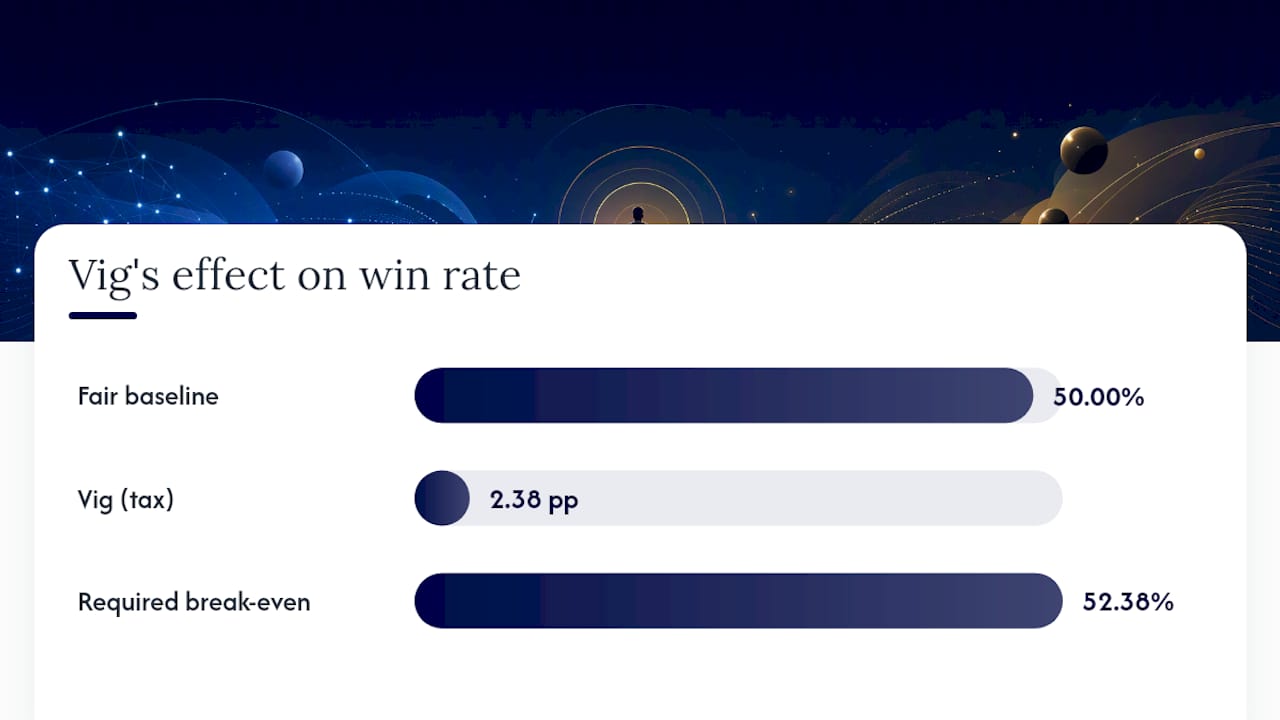
This is the number that actually matters to your bankroll. That extra 2.38 percentage points is the tax vig places on every wager you make.
Small shifts in pricing move that threshold more than most bettors realize:
- At -110: break-even win rate is 52.38%.
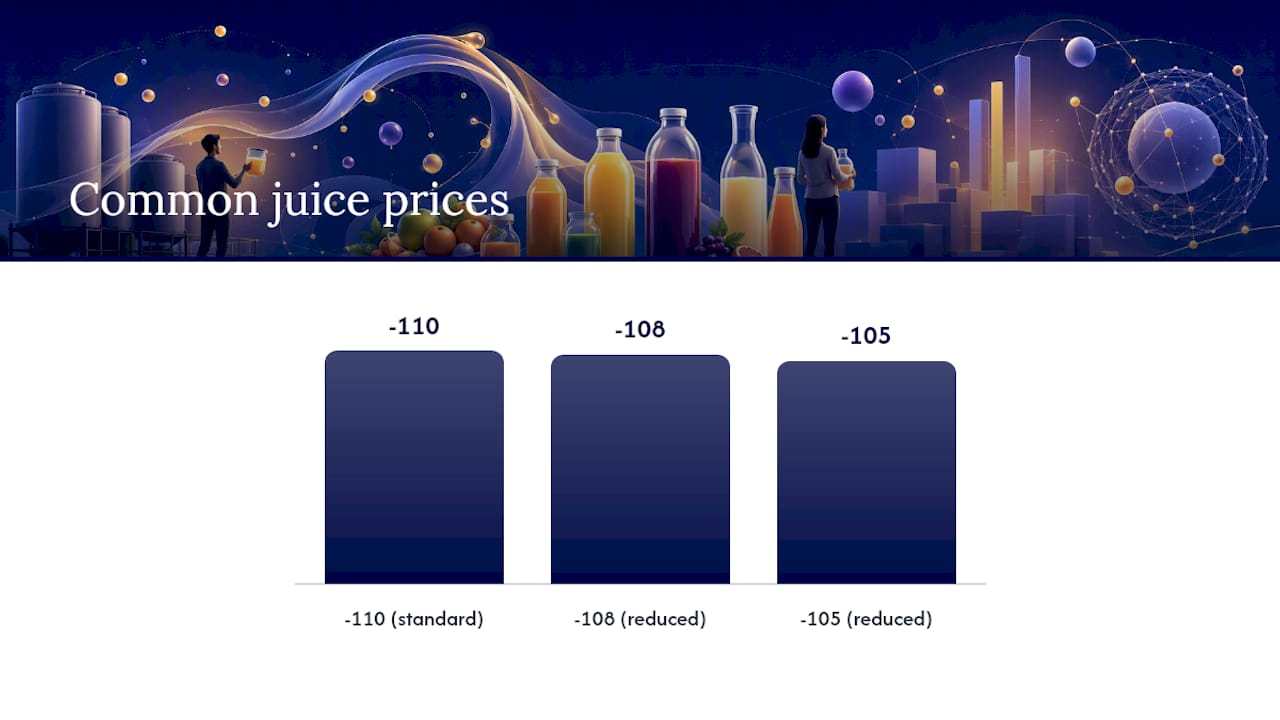
- At -105: break-even win rate drops to roughly 51.22%.
- At -115: break-even win rate climbs to roughly 53.49%.
That gap between -105 and -115 is over two percentage points, which is enormous over a full season of betting. Reduced-juice lines compound in your favor across volume, while parlays push the break-even bar even higher because each leg’s vig stacks on the last.
Ways to Reduce the Impact of Vig on Your Bets
You cannot eliminate vig, but you can consistently pay less of it. The gap between a disciplined bettor and a casual one usually comes down to habits, not luck.
- Shop lines across multiple sportsbooks. Odds on the same game can vary by several points of juice between books, and that difference adds up over a season.
- Look for reduced-juice markets. Some books post -105 or -108 instead of -110 as a standing promotion, which meaningfully lowers your break-even win rate.
- Limit parlay volume. Since vig compounds with each added leg, sticking to straight bets or two-leg parlays keeps the math more manageable.
- Size bets with discipline. Chasing losses at high-vig prices is how a small edge erosion turns into a real bankroll problem.
- Be selective with futures and props. These carry some of the highest vig on the board, so treat them as occasional plays rather than staples.
Pro Tip: Set line-movement alerts and check an odds-comparison feed before you place any bet over -110. A five-minute habit like this can shave real money off your vig exposure over a season without changing anything else about how you bet.
Betting education resources that walk through how betting odds work and implied probability conversions are worth a slow read if the math above felt new. It gets more intuitive after a few practice calculations.
What Is a No-Vig Line, and Why Sharp Bettors Use One
A no-vig line, sometimes called a fair line, strips the sportsbook’s margin out of the posted odds so you can see the market’s true implied probability for each side. Modelers and sharp bettors lean on this constantly to spot mispriced markets.
The process runs in three steps:
- Convert both sides to implied probability using the standard odds formulas.
- Normalize the total to 100% by dividing each side’s probability by the combined sum.
- Convert the normalized probabilities back into fair odds, which now reflect a true, vig-free market.
Bettors compute this no-vig line to compare their own projections against the market and spot overlays, spots where the sportsbook’s price is softer than what a sound model says it should be.
ParlayGeeks’ Take: Treat Vig as a Cost You Manage, Not a Mystery You Accept
Most bettors think about vig the wrong way. They treat it as an abstract tax baked into the system, something to shrug off rather than something to actively manage bet by bet. That mindset costs money.
Some sports betting platforms build odds comparison tools around exactly this problem: giving bettors a fast way to see which book is charging less vig on the same market before the bet gets placed. Pairing that with a parlay calculator and expert picks doesn’t erase the math above, but it puts the math to work for you instead of against you. The bettors who treat line shopping as a habit, not an occasional chore, are the ones who consistently beat the number.
— Fogell
Stop Overpaying the Sportsbook on Every Bet
Line shopping manually across five or six sportsbook apps is slow, and most bettors give up after checking two. Several platforms solve that specific problem: real-time odds comparison across multiple sportsbooks in one place, so bettors can spot better lines instead of settling for worse prices without ever knowing better options existed.

Some platforms offer free parlay calculators to show how vig compounds across legs before placing a multi-bet, which can help bettors understand the risks. Additional features like expert picks, injury updates, and shareable BetSlips can form a toolkit aimed at minimizing costs related to vig. Check current odds across sportsbooks at ParlayGeeks before you place your next bet.