

Line Shopping: How to Get the Best Odds on Every Bet
Line shopping is comparing the odds and point spreads that different sportsbooks offer on the same bet, then placing it where the price is best. Per Sporting News, the goal is to get the most favorable price available on a market before you wager. You don’t have to pick better winners to benefit. You just stop overpaying for the picks you already make.
This guide covers how to do it step by step, what the savings look like in dollars, which details must match before two prices are comparable, and where line shopping stops helping.
TL;DR
- Line shopping means checking the same bet at several legal sportsbooks and taking the best number or price. It costs nothing but a few minutes.
- A better line improves your odds of profit over a large sample without any change to your handicapping, according to Sporting News.
- Compare only identical bets: same event, market, line, period and settlement rules.
- Half-point differences around NFL key numbers like 3 are worth the most. Small price gaps like -105 versus -110 add up over hundreds of bets.
- Limits exist: you need funded accounts, lines move, and availability depends on your state.
Table of Contents
- What line shopping means in sports betting
- Why a better price matters more than you think
- Why half a point can be worth more than the juice
- How to line shop step by step
- Using a comparison tool instead of tabs
- Line shopping parlays
- The limits of line shopping
- Our perspective: shopping is the cheapest edge you have
- Put line shopping into a routine with ParlayGeeks
- A simple line shopping checklist
- FAQ
- Sources
What line shopping means in sports betting
Every legal U.S. sportsbook sets its own odds. They often look alike, but they are rarely identical. One book might list a team at -3 (-110), another at -3 (-105), and a third at -2.5 (-115). Same game, same team, three different products.

Think of it as comparing prices at different stores. The item you are buying, a bet on a specific outcome, is the same everywhere. Only the cost changes. Sporting News notes that sportsbooks do not always agree on lines or odds, and that gap lets a bettor secure a better spread or pay less juice for the same outcome.
Two things can differ between books:
- The number. A spread of -2.5 versus -3, or a total of 47.5 versus 48.
- The price. The odds attached to that number, such as -105 versus -115.
A good line shopper looks at both, because a better number at a worse price is not automatically a better bet.
Why a better price matters more than you think
Most bettors spend their time on who will win. Line shopping attacks a different problem: how much you pay for being right.
Standard U.S. pricing sits at -110 on each side of a spread or total. That means you risk $110 to win $100, and you need to win about 52.38% of the time just to break even. We break down where that figure comes from in our guide to how the vig works.
Now compare break-even points at different prices (our own arithmetic):
| Price | Risk to win $100 | Break-even win rate |
|---|---|---|
| -105 | $105 | 51.22% |
| -110 | $110 | 52.38% |
| -115 | $115 | 53.49% |
The gap between -105 and -115 is more than two percentage points of win rate. That is a large hurdle for a bettor who hits 53% to 54% of spread bets.
A worked example
Suppose you bet $100 on a coin-flip proposition, one you truly win 50% of the time.
- At -110, you win $90.91 when right and lose $100 when wrong. Expected result: 0.5 × $90.91 − 0.5 × $100 = −$4.55 per bet.
- At -105, you win $95.24 when right. Expected result: −$2.38 per bet.
The difference is roughly $2.17 per $100 bet. Across 500 bets of $100, that is about $1,085 kept in your pocket, and you didn’t change a single pick. This is the logic behind the claim that a better line gives you a better chance of profit over a large sample without improving your handicapping.
If you want to turn prices into probabilities quickly, our implied probability workflow walks through it, and our primer on reading American, decimal and fractional odds helps if the formats still slow you down.
Professionals think the same way. Former Jeopardy! champion and bettor James Holzhauer has said that traders in any market constantly compare prices, because another account may carry an off-market number.
Why half a point can be worth more than the juice
Not all line differences are equal. In the NFL, final margins cluster on certain numbers, especially 3 and 7. SportsLine’s Mike Tierney points out that although football spreads often show limited variance between books, small changes at key numbers such as 2.5 and 3.5 carry real value, which makes shopping worthwhile.
Here is how to think about it:
- Taking a favorite at -2.5 instead of -3 means a three-point win now cashes your ticket instead of pushing.
- Taking an underdog at +3.5 instead of +3 turns a three-point loss from a push into a win.
- Paying an extra five cents of juice for that half point is often a fair trade. Paying 20 cents is usually not.
The same logic applies in college football, where spreads and totals are even more spread out between books. If you need a refresher on those markets, see our college football lines explained guide.
When two books sit on opposite sides of a key number, a different strategy opens up entirely: betting both sides to win both. We cover that in middling betting.
How to line shop step by step
The process is simple. The discipline is in doing it every time.
1. Decide on the bet first
Start with the wager you want, not the book you happen to have open. Sporting News frames the first step this way: decide on the wager, then find the best price. Shopping first leads to impulse bets on whatever looks good.
2. Open accounts at several legal sportsbooks
Effective shopping requires accounts at multiple legal sportsbooks to give you a wider range of prices. Three is a workable minimum. Our piece on checking three books before you bet explains why mixing sharper and softer books gives you a fuller picture of the market. If you are still choosing where to open accounts, the 10-minute sportsbook checklist can help.
3. Compare identical bets only
This is where beginners slip. A comparison is valid only when these match across every book:
- Event: the same game, on the same date.
- Market: spread, moneyline, total or prop.
- Outcome: the same team, side or player.
- Line: the same spread or total number.
- Period: full game, first half or one quarter.
- Settlement rules: for example, what happens to a player prop if the player doesn’t play.
A player prop is the usual trap. One book may void the bet if the player is inactive, another may count it as a loss. A slightly better price isn’t better if the rules are worse for you.
4. Take the best price, then re-check it
Lines change constantly. Check the number again right before you submit. The Sporting News guidance is explicit that you should verify the line immediately before placing the bet.
5. Record what you did
Write down the number you took and the best alternative available. Over time you see which of your books tend to post the best prices on which markets. That tells you where to look first and saves time.
Using a comparison tool instead of tabs
Opening five apps for every bet gets old fast. Odds-comparison tools put multiple sportsbooks’ prices side by side, which makes the process much faster.
When you evaluate a tool, look for these features:
- Coverage of the sportsbooks you can actually use in your state.
- Clear display of both the number and the price.
- Fast updates, since stale odds are worse than none.
- Player props, not just sides and totals.
- Injury information, because injuries are one of the main reasons lines move.
Line shopping parlays
Parlays multiply whatever you pay on each leg. A small price edge on one leg may look trivial, but on a four-leg slip every leg’s price compounds. Shopping each leg separately can be worthwhile, but there is a catch: many sportsbooks require all legs on one slip at one book. That means you often compare the whole parlay price across books rather than leg by leg.
Same-game parlays are the area where prices can differ most between books, because each sportsbook models correlation its own way. Our guide to the correlation tax on same game parlays explains why sticking to two to four legs matters. Whichever book you use, always compare the combined payout on the same set of legs before you confirm.
The limits of line shopping
Line shopping is a cost saver, not a money machine. Know where it stops.
You can only shop where you have accounts
Each book needs a funded account, and you have to keep balances at several places. That takes some organization, and you need to keep track of deposits and withdrawals.
Lines move
Prices shift on news, injuries and betting action. Once you place the bet, the price you locked in is what the sportsbook pays if it wins, even if the line moves afterward. But before you bet, a number can disappear while you compare. Pay attention to timing: NFL lines are especially volatile when they first post, and in the NBA, late injury news can shift numbers within minutes. See our look at NBA line movement patterns for what to watch.
Availability depends on your state
Sports betting is legal state by state, and the set of licensed sportsbooks differs from one state to the next. Only use sportsbooks licensed in the state where you are physically located, and check your state gaming regulator’s website for the current list of licensed operators. A comparison tool may show prices from books you can’t use. Ignore those rows.
Sportsbooks can limit winners
Some books restrict the stakes of customers who win consistently. Casual bettors rarely run into this, but it is another reason to hold accounts at several places.
Don’t chase small edges with big stakes
Shopping lowers your cost. It doesn’t make a bad pick good. Stay within a set bankroll plan and keep stake sizes steady.
Our perspective: shopping is the cheapest edge you have
We built ParlayGeeks around a simple belief: most bettors lose money to friction, not to bad luck. Friction is the extra juice, the worse number, the missed injury report, and the time spent juggling tabs.
Here is how we think about line shopping:
- Price first, opinion second. A pick is only as good as the price you take it at. When our experts write up a play, the reasoning is meant to tell you at what number the bet still makes sense, so you know when to walk away.
- Injuries drive most of the movement. If you shop lines without knowing why they moved, you are guessing. That is why we pair odds comparison with live injury reports and player prop information in one place.
- Habit beats cleverness. A bettor who checks three books on every bet will usually beat one who spends hours on a single clever angle and then bets at the first app that loads.
- Your bankroll is the reason to care. Saving a few cents on each of hundreds of bets matters because bankroll is finite. Cheaper bets let you stay in the game longer.
None of this guarantees profit. Betting carries risk, and no tool changes that. What line shopping does is remove a cost you never needed to pay.
— Elaine
Put line shopping into a routine with ParlayGeeks
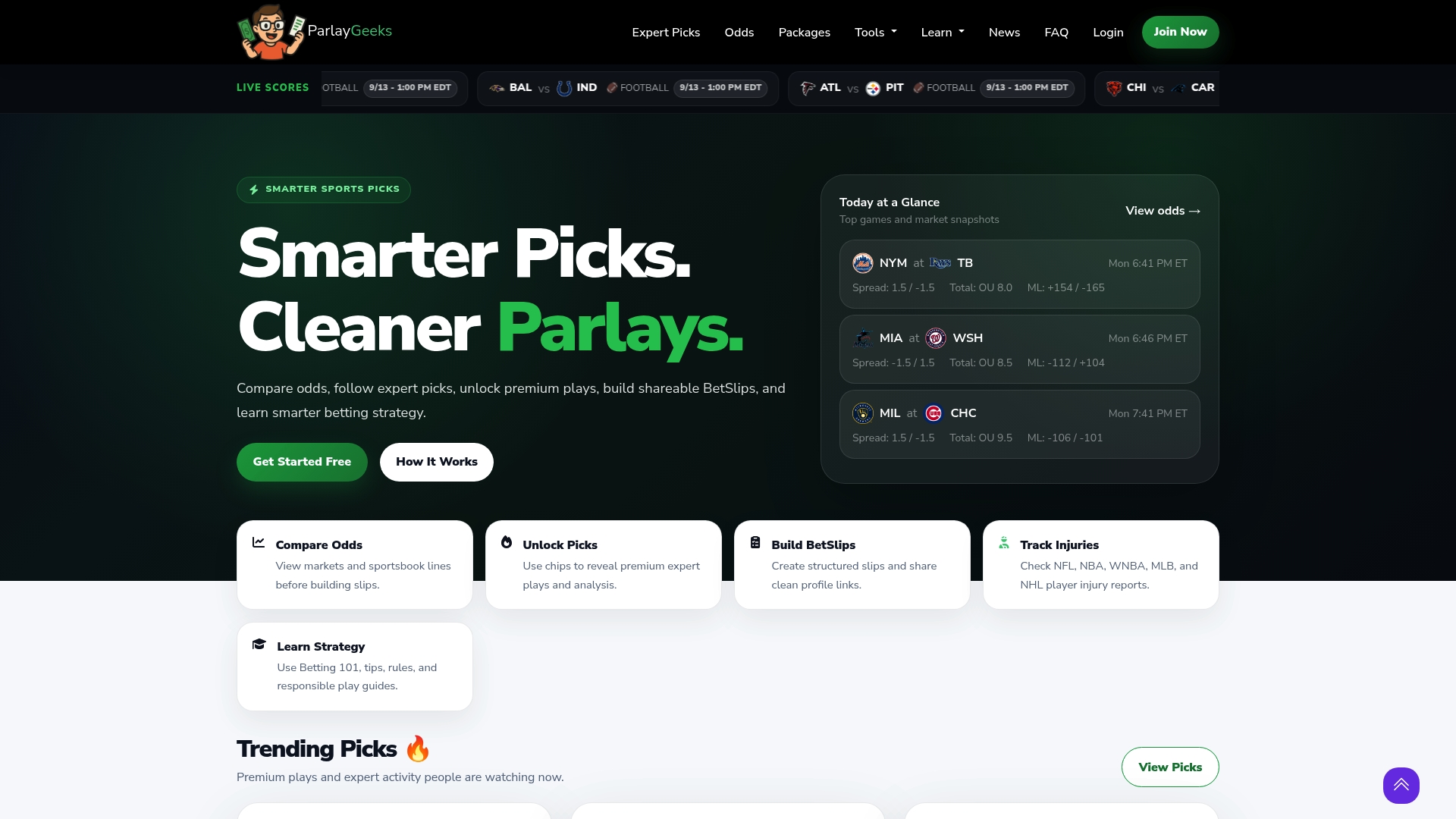
ParlayGeeks brings odds comparison across multiple sportsbooks, live injury reports, a free parlay calculator and a BetSlip builder into one platform, so you don’t have to bounce between sites to research a bet. You can start with the free tools at ParlayGeeks, and follow experts whose reasoning you can read before you decide.
If you want expert picks and analysis with the reasoning shown, the premium plans are Silver at $49 per month, Gold at $99 per month and Platinum at $199 per month. Our site also sells chips as one-time purchases that unlock individual picks and analysis, which suits you if you only want an occasional play. Compare the plans on the premium page and choose what fits how often you bet.
A simple line shopping checklist
Print this or save it to your phone:
- Pick the bet and your maximum price before you open any app.
- Confirm the event, market, period and rules are the same everywhere.
- Check at least three licensed books in your state.
- Compare the number first, then the price. Weigh key numbers heavily in football.
- Re-check the line right before you confirm.
- Log the price you took and the best alternative.
- If no book meets your price, pass. A skipped bet costs nothing.
For beginners deciding between market types before shopping, our moneyline versus spread checklist is a good next read.
FAQ
Is line shopping legal?
Yes. Holding accounts at more than one licensed sportsbook and choosing where to bet is normal practice in states where sports betting is legal. You must use only sportsbooks licensed in the state where you are located when you place the bet. Check your state gaming regulator for the current list.
How many sportsbooks do I need to line shop?
Three is a practical starting point, and more gives you more price variety. Each extra account adds some admin work, so build up gradually. Mixing sharper and softer books tends to show you more of the market.
Does line shopping guarantee I’ll win?
No. It lowers what you pay for each bet, which improves your chances of profit over a large sample, but it does not change whether a given pick wins. Treat it as a cost saver and keep your stakes tied to a bankroll plan.
What should I compare besides the odds?
Check the spread or total number, the period, and the settlement rules. Player props in particular can be voided at one book and graded as losses at another. A matching event and market with different rules is not the same bet.
Is a half-point or a better price more important?
It depends on the sport and number. In the NFL, moving across a key number like 3 often matters more than a few cents of juice. Elsewhere, the price usually matters more. Compare the break-even win rate of each option to decide.
Sources
- Line shopping, explained: How to compare sports betting odds and lines (Sporting News)
- James Holzhauer: Why shopping around and having more than one sportsbook is key (The Athletic)
- Betting guide: The best strategies for sports betting (SportsLine)
- What Line Moves Can Tell Us (Odds Shark)